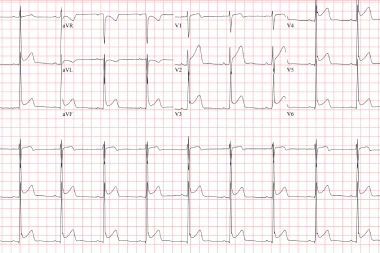
Figure 1: Initial ECG (Case presented by Benjamin Cooper, MD, MEd, FACEP, Department of Emergency Medicine, McGovern Medical School at UTHealth Houston.)
Read More

Figure 1: Initial ECG (Case presented by Benjamin Cooper, MD, MEd, FACEP, Department of Emergency Medicine, McGovern Medical School at UTHealth Houston.)
Read More
A 46-year-old female presents with an evolving eruption that developed on her right hand and spread to her forearm over the past several weeks. She is an immunocompetent commercial landscaper who lives in Brazil, and she does not recall any specific injury. She is regularly exposed to toxic plants and sustains minor scratches and cuts at work. She also suspects that she could have experienced bug bites. She appears well and is without systemic symptoms. …
Read More
A 40-year-old male presents with pain and swelling in his right eye after being struck by a foul ball while coaching his daughter’s softball game. View the images taken and consider what your diagnosis and next steps would be. Resolution of the case is described on the next page.
Read More
Urgent message: By the time an adverse outcome occurs in the urgent care center, it’s too late to go back and ensure the documentation reflects the care the patient received. Lyndsie Pfeifer, DO; Marta Fratczak, Kinkela Harkins, and Michael Weinstock, MD Citation: Pfeifer L, Fratczak M, Harkins K, Weinstock M. Back pain, an urgent care visit—and a devastating outcome. J Urgent Care Med. 2023;17(8):13-17. Key words: back pain, documentation INTRODUCTION It’s easy to let our …
Read More
Urgent message: Given the high rate of systemic involvement in patients with anorectal abscess, it is essential for urgent care providers to identify patients with risk factors and, when indicated, ensure those patients receive incision and drainage and appropriate follow-up care. Cameron W. Galbreath, MSN, FNP-C and Christina Gardner, DHSc, MBA, PA-C Citation: Galbreath C, Gardner C. No butts about it: approaching anorectal abscesses in the urgent care center. J Urgent Care Med. 2023;17(8):19-23. Key …
Read More
Does My Patient Have a Testicular Torsion? Take-home point: Symptoms most suggestive for testicular torsion (TT) are adolescent/pubertal age, palpated hard testicle, and the presence of nausea and vomiting associated with acute scrotal pain. Citation: Lukosiute-Urboniene A, Nekrosius D, Dekeryte I, et al. Clinical risk factors for testicular torsion and a warning against falsely reassuring ultrasound scans: a 10-year single-centre experience. Emerg Med J. 2023;40:134–139. Relevance: As symptoms of TT can be mimicked by other …
Read More
Download the article PDF: It’s Time to Think Differently about Follow-up In the macro and “dot phrase” era, there are many refrains that appear in the electronic medical record (EMR) with such regularity that we don’t even notice them anymore. Statements like All questions were answered prior to discharge, The patient verbalizes understanding and is comfortable with the plan, and Symptomatic care and over-the-counter treatments discussed are so commonly tacked onto charts that our eyes …
Read More
A 61-year-old female with a past medical history of hypertension presents to urgent care with palpitations and shortness of breath for 3 days. She also reports cough and fever, and denies nausea or vomiting. View the initial ECG taken and consider what your diagnosis and next steps would be. Resolution of the case is described on the next page.
Read More
A mother brings her 7-year-old son to your urgent care center because she’s concerned about asymptomatic lesions that have developed on his knees over the past couple of weeks. On examination, you observe smooth, crusted and scaly, erythematous and whitish papules and nodules on both knees. There was no history of recent trauma. The patient had a history of dermatomyositis. View the image and consider what your diagnosis and next steps would be. Resolution of …
Read More
The patient is a 12-year-old boy who presents with pain after his foot became wedged in an escalator at the mall. The image on the left was taken upon presentation; the one on the right is from a 2-week follow-up. Review each and consider what your diagnosis and next steps would be. Resolution of the case is described on the next page.
Read More