Identifying and Treating Superficial Fungal Infections in the Urgent Care Setting

Identifying and Treating Superficial Fungal Infections in the Urgent Care Setting

Urgent message: Rashes often lead patients to seek relief in the urgent care center. The ability to differentiate among common, superficial fungal infections and to select the most appropriate treatment or refer is an important skill to master. Kosta G. Skandamis, MD and George Skandamis, MD Introduction Superficial fungal infections are among the most common skin conditions seen in the urgent care setting. Dermatophytes are the most common type of fungi that infect and survive …

Read More
Treating Common Upper Respiratory Tract Infections in an Era of Increasing Antibiotic Resistance

Treating Common Upper Respiratory Tract Infections in an Era of Increasing Antibiotic Resistance

Urgent message: Thorough evaluation and thoughtful prescribing can help ensure responsible, effective care and patient satisfaction. Joseph Toscano, MD Introduction Upper respiratory tract infections (URTIs) are among the most common reasons patients seek assistance in urgent care practice. The common cold, otitis media, acute sinusitis, and acute pharyngitis are well known to patient and provider alike. Acute bronchitis is a lower respiratory tract infection, with features similar to URTIs. These infections are most often self-limited …

Read More
Preparing for Pandemic Influenza in the Urgent Care Setting

Preparing for Pandemic Influenza in the Urgent Care Setting

Urgent message: Between the current – and still growing – volume of H1N1 flu cases and fast-approaching influenza season, the urgent care physician will be challenged to distinguish among a variety of common cold and influenza-like conditions. Gary Klein, MD, MPH, MBA, CHS-V, FAADM Introduction The mainstream media have certainly accomplished the mission of alerting the public to the dangers of H1N1 flu – perhaps to the point that many are tempted to dismiss their …

Read More
Assessing Patients in the Wake of Motor Vehicle Accidents

Assessing Patients in the Wake of Motor Vehicle Accidents

Urgent message: Patients presenting to urgent care in the wake of a motor vehicle accident have self-selected their treatment setting. However, it is imperative to maintain vigilance for potentially serious and even life-threatening injuries that may not be apparent. Gloria I. Kim, MD and Jill C. Miller, MD According to the National Center for Health Statistics, motor vehicle accidents (MVAs) accounted for nearly 5 million ED visits in 2006. The diverse injuries may be temporary, …

Read More
Common Lacerations of the Head

Common Lacerations of the Head

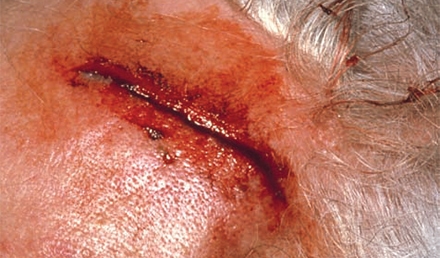
Urgent message: Effective management of head lacerations starts with hemorrhage control but also requires an understanding of appropriate use of anesthesia, the possibility of closed head or nerve injury, and vigilance for non-accidental trauma. Clayton Josephy, MD, Samuel M. Keim, MD, MS, and Paper Rosen, MD Introduction Laceration repair is a common and important responsibility of physicians in the emergency and urgent care settings. A recent review of national trends in ED visits revealed that …

Read More
Toward Ensuring Patient Safety in Urgent Care

Toward Ensuring Patient Safety in Urgent Care

Urgent message: Creating a safety culture in the urgent care clinic starts with proper hand washing before even seeing a patient and ends with transitioning care out of the practice – and includes close attention to every detail in between. The second of two parts. Phillip Disraeli MD, FAAFP The Institute of Medicine’s 1998 Report to Err is Human grabbed media attention by estimating that 98,000 deaths each year can be attributed to adverse events …

Read More
Toward Ensuring Patient Safety in Urgent Care

Toward Ensuring Patient Safety in Urgent Care

Urgent message: As urgent care’s role in the continuum of care continues to evolve, the practitioner must take steps to create a culture that supports proper patient identification, drug safety, and adherence to lab standards. Phillip Disraeli MD, FAAFP In the 1988 report To Err is Human, the Institute of Medicine defined patient safety as “freedom from accidental injury.” The ensuing media coverage focused on the 98,000 deaths that IOM estimated occur each year due …

Read More
Management of Hypertensive Urgency in an Urgent Care Setting

Management of Hypertensive Urgency in an Urgent Care Setting

Urgent message: Effective management of patients presenting to urgent care with acute high blood pressure starts with differentiating between hypertensive emergency and hypertensive urgency and ends with appropriate treatment and counseling. Sanjeev Sharma, MD, Christy Anderson, PharmD, Poonam Sharma, MD, and Donald Frey, MD Introduction Urgent care physicians routinely encounter patients with high blood pressure, but management – particularly for those patients with precarious elevations – remains controversial. Alternative options involve the use of various …

Read More

Evaluation and Management of Lower Extremity Edema

Urgent message: The high specificity but broad range of possible causes associated with a primary complaint of lower extremity edema poses a particular challenge to the urgent care clinician. Proper assessment of the differential diagnoses is the first step toward optimal outcomes, whether they be facilitated by treatment or referral. Michael S. Miller, DO Patients presenting to urgent care with a primary complaint of edema of the lower extremities of any duration can pose a …

Read More
Management of Patients Presenting with Constipation

Management of Patients Presenting with Constipation

Urgent message: Constipation can be a sign of serious – even life-threatening – etiologies. Once non-benign causes have been ruled out, emphasis should be on evacuation and dietary and lifestyle changes to prevent recurrence. Claire West, MD, Samuel M. Keim, MD, MS, and Peter Rosen, MD Introduction Constipation is a common complaint, accounting for approximately 2.5 million doctor visits annually. With increasing difficulty in obtaining a quick appointment with a primary care physician, more and …

Read More
Log In