
JOHN SHUFELDT, MD, JD, MBA, FACEP Lawyer: Now doctor, isn’t it true that when a person dies in his sleep, he doesn’t know about it until the next morning? Lawyer: Doctor, how many autopsies have you performed on dead people? Witness: All my autopsies are performed on dead people. Lawyer: Do you recall the time that you examined the body? Witness: The autopsy started around 8:30 p.m. Lawyer: And Mr. Johnson was dead at the …
Read More2013 Physical Therapy G Codes
DAVID STERN, MD (Practice Velocity) Q. We offer Physical Therapy services to patients in our urgent care center and some patients have Medicare insurance. I understand there are new codes that we must use for Medicare. What are they and how do we use them? A.The Centers for Medicare and Medicaid Services (CMS) was mandated by the Middle Class Tax Relief Act of 2012 to collect information regarding beneficiaries’ function and condition, therapy services furnished, …
Read MoreDeveloping Data: July/August, 2013
These data from the 2012 Urgent Care Industry Benchmarking Study are based on a sample of 1,732 urgent care centers; 95.2% of the respondents were UCA members. Among other criteria, the study was limited to centers that have a licensed provider onsite at all times; have two or more exam rooms; typically are open 7 days/week, 4 hours/day, at least 3,000 hours/year; and treat patients of all ages (unless specifically a pediatric urgent care). In …
Read MorePhysicians Criticizing Physicians: A Two-Headed Snake
Lee A. Resnick, MD, FAAFP In the Hippocratic Oath it is written and we are bound: “To hold him who has taught me this art as equal to my parents and to live my life in partnership with him, and if he is in need of money to give him a share of mine, and to regard his offspring as equal to my brothers in male lineage and to teach them this art if they …
Read More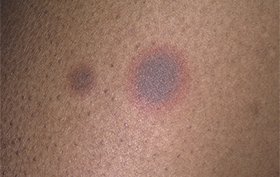
67-year-old African American male who developed two asymptomatic lesions on thigh
The patient, a 67-year-old African American male, developed two asymptomatic lesions on his thigh 4 months before his visit to the urgent care center. The lesions had faded and recurred twice during the interval from when they first started until his visit. The lesions recurred at the exact location each time. The patient had a past medical history significant for hypertension, asthma, and osteoarthritis. His medications included captopril, propranolol, and albuterol. He used naproxen as …
Read More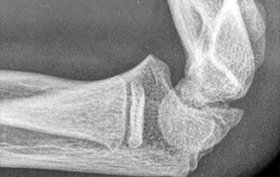
12-year-old boy, suffered a blow to his left elbow
The patient, a 12-year-old boy, suffered a blow to his left elbow. View the image taken (Figure 1) and consider what your diagnosis would be.
Read More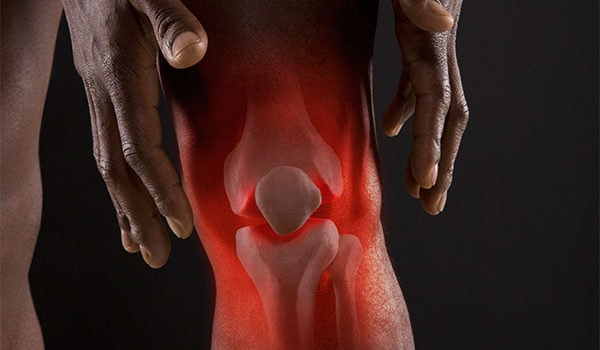
Evaluation of Knee Pain: An Urgent Care Approach
Urgent message: Knee pain is a diagnostic challenge for urgent care providers, but a strong understanding of the anatomy and potential etiologies will prepare them for success. CHRISTOPHER TANGEN, DO Approximately 10% of all urgent care visits are for musculoskeletal complaints and knee pain is a common such presentation. An urgent care provider’s approach is different than that of specialists because patients present with more acute cases, and therefore, the physician needs to consider a …
Read MoreHow to Successfully Build Out an Urgent Care Center
Author: Marisa Manley Author Information: Marisa Manley is president, Healthcare Real Estate Advisors, a nationwide real estate consulting and advisory firm. Competition among urgent care centers has increased as they have become a more important and common feature in the American healthcare landscape. Among the baseline requirements for a successful urgent care center are high visibility, ease of access and an inviting, reassuring, and professional environment. Whether you are creating a new urgent care center …
Read MoreDare We Doubt the Wisdom of Patient Empowerment?
Lee A. Resnick, MD, FAAFP “Patient empowerment,” “patient-centered care, “patient-focused care,” and “shared medical decision-making” are among a growing number of terms intended to shift the power and control of healthcare decisions from physicians to patients. The concepts are, for all intents and purposes, accepted as “good.” It is merely assumed that empowered patients are better off than those who defer control of their healthcare decisions to their clinicians. Despite an almost revolutionary change in …
Read More