
Published on
Download the article PDF: Clinical Image Challenges May 2026
Differential Diagnosis
- Bronchopulmonary sequestration
- Pulmonary vein dilatation
- Pulmonary abscess
- Community-acquired pneumonia
- Partial anomalous pulmonary venous return
- Pulmonary nodule
- Atelectasis
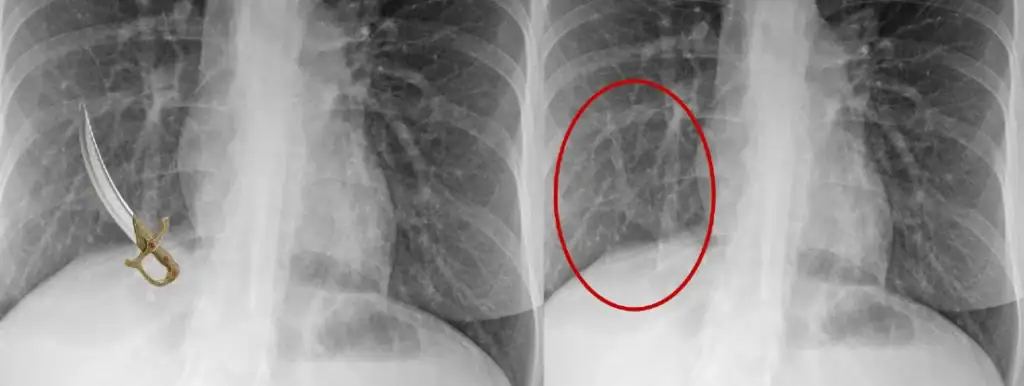
Diagnosis
A branching linear density is seen extending up from the slightly elevated right hemidiaphragm to the right lung base, and a vertical vein extends to the right upper chest. This may represent partial anomalous pulmonary venous return (PAPVR) with Scimitar sign.
PAPVR is a congenital anomaly where 1 or more pulmonary veins drain into the right atrium or systemic venous circulation instead of the left atrium of the heart. The defect itself has no significant clinical impact, and asymptomatic patients generally do not require intervention. The left-to-right shunting can increase pulmonary blood flow, which can lead to pulmonary hypertension and volume overload. The diagnosis of PAPVR is typically made with cardiovascular imaging or catheterization; echocardiography may be sufficient for making the diagnosis in some cases. Surgical repair is the definitive treatment and focuses on redirecting the anomalous pulmonary veins into the left atrium.
What to Look For
- Frequent infections: Patients with symptomatic PAPVR often report a history of recurrent pulmonary infections such as pneumonia and bronchitis as well as fatigue and dyspnea.
- Signs of right heart volume overload: Assess for peripheral edema, increased jugular venous pressure (JVD), ascites and hepatomegaly. These patients are more likely to have significant left-to-right shunts, and surgery is the definitive treatment.
- The Scimitar sign on imaging: Access for a curvilinear vascular shadow along the right cardiac border caused by an anomalous right pulmonary vein draining into the inferior vena cava (IVC), resembling a Turkish sword or “scimitar.”
Pearls For Urgent Care Management
- Laboratory testing: In the case of clinically significant fluid overload, laboratory testing including metabolic panel to evaluate renal function and electrolytes is indicated
- Diuretic therapy: consider starting low dose oral furosemide 20 mg daily for patients naïve to diuretics
- Close follow-up with primary care and/or cardiology, especially if starting diuretics in urgent care
- Cardiovascular imaging: Patients with a scimitar sign noted on radiograph should be referred for cardiovascular imaging.