
Published on
Download the article PDF: Urgent Care Evaluation And Management Of De Quervain Tenosynovitis
Urgent Message: Patients presenting with radial wrist pain that is exacerbated by thumb and wrist motion may raise the suspicion for De Quervain tenosynovitis (DQT). Utilizing a clinically focused framework is important for the evaluation and management of DQT.
Jacob Welch OMS-3, William O’Neal MD
Keywords: wrist pain, De Quervain tenosynovitis, Finkelstein test, Eichhoff test
Editor’s Note: The patient case scenario is hypothetical to enhance educational value.
Abstract
De Quervain tenosynovitis (DQT) is a frequent cause of radial-sided wrist pain, resulting from tendinopathy of the first extensor compartment. DQT is associated with repetitive movements of the thumb and wrist, and is characterized by inflammation of the tendons within this compartment—the abductor pollicis longus and extensor pollicis brevis. This review provides a clinically focused framework for the urgent care provider on the evaluation and management of DQT, structured around common questions faced at the bedside. The pathophysiology is discussed, highlighting a modern understanding that includes both degenerative changes and a secondary inflammatory response.
Diagnosis is primarily clinical, based on a history of gradual-onset pain over the radial styloid, exacerbated by movement. The physical exam is notable for point tenderness and a positive provocative maneuver, such as the Finkelstein or Eichhoff tests. While imaging is not required for diagnosis, radiography is appropriate to rule out underlying bony pathology, such as osteoarthritis or fracture in the hand or wrist.
Urgent care management is centered on conservative, non-operative therapies. The most crucial components include comprehensive patient education on activity modification, immobilization with a thumb spica splint, and a course of oral or topical nonsteroidal anti-inflammatory drugs. The provider must also be able to differentiate DQT from “red flag” conditions (eg, scaphoid fracture, septic tenosynovitis) and common mimics (eg, Wartenberg syndrome). Patients with severe or refractory symptoms unresponsive to initial conservative management warrant referral for specialty evaluation, which may include corticosteroid injections or surgical consultation.
Clinical Scenario
A 21-year-old female who was a senior in college presented to urgent care. She said she had been typing a term paper and practicing for the spring softball intramural league. She reported pain on the radial aspect of her right wrist, which she described as dull and throbbing. The pain began 4 days prior and was worse with range of motion. She denied fever, numbness, or injury to the hand or wrist.
Her vital signs were normal, and her general appearance was normal. She was breathing comfortably, and the right wrist was normal in appearance. There was tenderness to palpation over the radial aspect of the distal forearm, which was worse with range of motion, particularly ulnar deviation of the wrist. There was no erythema or swelling. Her neurovascular status was intact with 2+ radial pulse, and sensation was intact in the distribution of the radial, ulnar, and median nerves.
Background and Epidemiology
De Quervain tenosynovitis (DQT) is a common cause of wrist pain with clear demographic patterns. The condition affects women more often than men, with an incidence rate of 2.8 cases per 1,000 person-years, compared to just 0.6 in men.1 The peak age of onset is typically between 40 and 59 years.2 It is famously linked to pregnancy and the postpartum period, with a cumulative incidence of 2.1% in pregnant women.3 Rheumatoid arthritis is also a significant risk factor; tenosynovitis is a known feature of rheumatoid arthritis, with one study showing its presence in 47.7% of patients with the disease.4
The condition is strongly associated with activities involving repetitive thumb and wrist motion, including certain sports. Increased training time in professional volleyball players has been shown to increase the likelihood of the disease,5 and it is also identified in amateur tennis players, particularly those using a grip that promotes radial-sided wrist movements.6 DQT has also been linked to frequent texting,7 and a survey of teenagers who play mobile games found a positive Finkelstein test in 49% of participants, with the risk increasing with prolonged play time and frequent changes in wrist position.8 Despite popular belief, there is no association between the disease and manual labor.9
Relevant Anatomy
DQT involves the first extensor compartment of the wrist, a fibro-osseous tunnel situated on the radial side of the wrist, directly over the radial styloid process. Two key tendons responsible for thumb movement travel through this sheath: the abductor pollicis longus (APL) and the extensor pollicis brevis (EPB).10 (Figure 1)
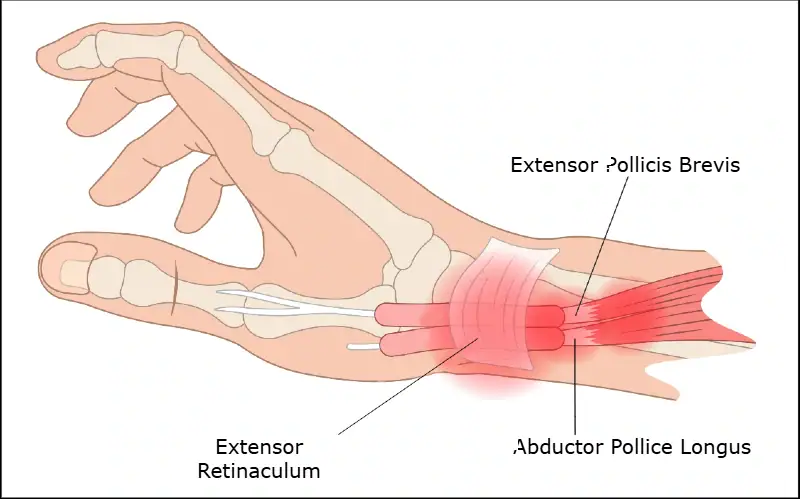
Anatomical variations within this compartment are common and have significant clinical implications, particularly regarding the failure of treatment. Septations within the compartment are a key anatomical variation contributing to DQT. A complete or partial septum dividing the compartment is found in 40%–60% of cases.11,12 The presence of a septum isolating the EPB tendon in its own subcompartment may be a primary reason for the failure of corticosteroid injections if the medication fails to reach both subcompartments.11,12 Multiple variations of tendons of the APL, found in all specimens in one cadaveric study, are also considered clinically relevant to the development of DQT.13
Pathophysiology
Historically, DQT has been considered a noninflammatory, degenerative process, making the “-itis” suffix in “tenosynovitis” a misnomer.14,15 Histopathological studies have consistently characterized the condition to be without inflammation, but with thickening of the EPB and APL tendon sheaths and the accumulation of mucopolysaccharide, an indicator of myxoid degeneration.15 These changes were considered pathognomonic, resulting from intrinsic degenerative mechanisms.14,15 This thickening of the EPB and APL tendons or the extensor retinaculum itself causes impaired gliding of the tendons within the extensor retinaculum, resulting in mechanical impairment.
More recent research has provided direct evidence that an inflammatory response is present in DQT. A study found that inflammatory markers, including neutrophil elastase and cyclooxygenase, were present and increased with the severity of collagen disorganization. The study also identified macrophage infiltration in more advanced stages of the disease, providing clear evidence for the role of inflammatory cells and factors in its pathophysiology.16 This suggests that the pathology of DQT is likely a combination of both degenerative changes and a secondary inflammatory response, which helps explain the clinical efficacy of anti-inflammatory treatments.
History
A thorough clinical history is essential, as the diagnosis of DQT is based primarily on patient presentation.17 The onset of symptoms is typically gradual over weeks to months and is not associated with a single acute traumatic event.18
Pain is the most prominent symptom, localized to the radial side of the wrist over the styloid process. Painful sensation may radiate proximally into the forearm or distally into the thumb. The pain is constant but is exacerbated by specific movements, such as grasping objects, abducting the thumb, and ulnar deviation of the wrist. It is crucial to inquire about aggravating activities, which often involve repetitive or unaccustomed hand use. Common examples include lifting a child (“mommy’s thumb”), wringing out clothes, using scissors, or engaging in hobbies like golf. 17,18 The pain can be severe enough to disturb sleep or render the hand immobile.18 While pain is the primary complaint, patients may also report stiffness or swelling. Patients may also report a sensation of “popping” or “creaking.” Typically, symptoms are relieved with rest, icing, or immobilization.17
Physical Examination
The diagnosis of DQT is primarily clinical,17,19 established via patient history and physical examination.20 The cardinal finding is localized tenderness upon palpation of the first extensor compartment at the radial styloid.20 Visual inspection may also reveal localized swelling or fullness over the compartment, though the physical appearance is often normal.20
The diagnosis is supported by provocative maneuvers, though significant confusion persists in the literature regarding the “Finkelstein test.”21 The maneuver most commonly employed in clinical practice is the Eichhoff test, wherein the patient flexes the thumb into their palm and closes the fingers over it, after which the examiner passively ulnar-deviates the wrist.19,21 This test is frequently, and incorrectly, referred to as the Finkelstein test.19 The true Finkelstein test, as originally described in 1930,22 involves the examiner grasping the patient’s thumb and applying sharp ulnar abduction.19,22 This original maneuver is noted to be sensitive but less specific as described in the most recent European HANDGUIDE consensus from 2014, as it may elicit pain in asymptomatic individuals.19 More recent studies from 2018, however, have shown that the opposite is true: the Finkelstein test produces fewer false positives than the Eichhoff test.23
To improve diagnostic precision, the wrist hyperflexion and abduction of the thumb (WHAT) test has been proposed as a more precise tool.21 A prospective study that used sonography as the diagnostic standard found the WHAT test demonstrated a greater sensitivity (0.99) and an improved positive predictive value (0.95) when compared to the Eichhoff test.21
The physical examination must also exclude common pathologies with similar presentations.19 This differential diagnosis includes carpometacarpal osteoarthritis, which can be assessed using a “grind test” (axial compression and rotation). Other pathologies include Wartenberg syndrome (superficial radial nerve irritation), assessed by checking for a Hoffmann-Tinel sign (percussion over the nerve eliciting radiating paresthesia), and intersection syndrome, which presents as pain 4-8 cm proximal to the radial styloid.19
Diagnostic Imaging
While the diagnosis is clinical, imaging serves to confirm clinical suspicion and, more importantly, to rule out other underlying pathologies.20
Radiography
According to the American College of Radiology (ACR) Appropriateness Criteria, initial radiography of the wrist is “usually appropriate” for the evaluation of chronic wrist pain.24 Radiographs are effective in assessing for bony pathologies, such as a scaphoid fracture, radial styloid fracture, or osteoarthritis of the carpometacarpal joint.19,25
Although Finkelstein’s original paper reported radiographs as “uniformly negative,”22 subsequent evidence contradicts this. A study demonstrated that a focal radial styloid abnormality is a significant radiographic indicator of DQT.25 These radiographic findings may include cortical erosion, sclerosis, or periosteal bone apposition. These osseous changes are hypothesized to be a reactive process secondary to the adjacent, thickened, and abnormal tendon sheath.25
Advanced Modalities
The ACR considers that ultrasound (US) “may be appropriate” for the initial evaluation of chronic wrist pain.24 Both sonography and magnetic resonance imaging (MRI) can demonstrate findings consistent with DQT, including tendon sheath thickening and surrounding soft-tissue edema.25
If initial radiographs are negative and diagnostic uncertainty persists or other pathology is suspected, the ACR lists MRI of the wrist without IV contrast as “usually appropriate” as the next imaging study.24
Laboratory Testing
Laboratory tests are not indicated unless the clinical picture is atypical. If significant systemic inflammation or polyarthralgia is present, referral for rheumatoid testing may be warranted to investigate for an underlying inflammatory arthritis.4
Urgent Care Management
The management of DQT in the urgent care setting is centered on conservative, non-operative therapies.19 The primary goals are to reduce pain, decrease inflammation of the tendon sheath, and modify activities to prevent recurrence.19 Treatment is typically initiated in a stepwise fashion, beginning with the least invasive options.19
Non-Pharmacological
Patient Education and Activity Modification
Providing adequate patient education is the most crucial step in treating DQT.19 Conservative management hinges on the patient’s understanding of the nature of the injury. The European HANDGUIDE consensus emphasizes that patients should always receive instructions on activity modification, such as avoiding repetitive thumb and wrist movements and avoiding movements that cause pain.19
Splinting
Immobilization with a splint is a foundational component of conservative management. The European HANDGUIDE consensus recommends a “long lower-arm-based splint” that immobilizes the wrist, which can either include or exclude the interphalangeal (IP) joint of the thumb.19 This is typically worn for 3 to 8 weeks. If a patient does not comply with splinting and activity modification, the underlying mechanical friction will continue, leading to treatment failure, frequent return visits, and progression to a chronic condition requiring more invasive intervention.19
Pharmacological
Nonsteroidal Anti-Inflammatory Drugs
Oral nonsteroidal anti-inflammatory drugs (NSAIDs)are commonly used as a first-line agent, particularly for mild symptoms. A study on conservative management found that for patients with minimal symptoms, splinting and NSAIDs provided adequate relief.26 For patients with minimal symptoms (acute and mild symptoms), splinting combined with oral NSAIDs has been shown to be an effective initial treatment.19,26 However, this combination was notably less effective for patients with moderate to severe symptoms.26
Glucocorticoids
Although not routinely performed in the urgent care setting, local corticosteroid injection (CSI) is a highly effective primary treatment for DQT. A 2009 randomized controlled trial demonstrated that 1 or 2 local injections of triamcinolone acetonide (TCA) provided significant short-term improvement in symptoms compared to a placebo injection, with a number needed to treat of 2.27 This beneficial effect was maintained in responders at a 12-month follow-up.27 Experts recommend using intermediate-acting corticosteroids, such as methylprednisolone or triamcinolone, mixed with a local anesthetic.19,28
The role of splinting as an adjunct to CSI is debated in the literature. A 2014 study found that combining CSI with a thumb spica cast resulted in a significantly higher treatment success rate (93%) compared to CSI alone (69%).28 However, a 2020 prospective randomized trial found that immobilization following CSI did not contribute to improved patient outcomes and noted that CSI alone was superior for the resolution of wrist pain.29
Providers must be cautious regarding the rare but serious complication of a tendon rupture following corticosteroid injection. A recent review of tendon ruptures after local steroid injection for stenosing tenosynovitis of the hand identified that this complication is frequently associated with the use of triamcinolone acetonide at doses of 10 mg or greater.30 While the risk is often linked to repeated injections, instances of rupture have been documented after as few as 1 or 2 applications.30
Referral and Follow-up
Sports Medicine
For patients whose symptoms are refractory to initial conservative measures—specifically splinting, activity modification, and NSAIDs—referral to a non-operative sports medicine specialist for further evaluation and possible corticosteroid injection is the most appropriate next step.19
Orthopedic Surgery
Referral to an orthopedic hand surgeon is indicated for patients whose symptoms are refractory to conservative management, which typically involves failing 1 or 2 corticosteroid injections.19 Surgical intervention is also a primary consideration for patients presenting with severe, chronic symptoms. Surgical management has a high rate of success. A retrospective study found a surgical cure rate of 91%, with 88% of patients reporting full satisfaction with the outcome.31
Next Level Urgent Care Pearls
- Know the difference between the Finkelstein and Eichhoff tests. The maneuver most taught—making a fist over the thumb followed by ulnar deviation—is the Eichhoff test.
- Upgrade your diagnostic testing. Consider using the wrist hyperflexion and abduction of the thumb (WHAT) test. Recent studies suggest the WHAT test demonstrates greater sensitivity and an improved positive predictive value compared to the traditional Eichhoff test.
- Consider anatomic variations in refractory cases. A complete or partial septum dividing the first extensor compartment is found in 40% to 60% of cases. If a patient fails conservative management or injection therapy, it may be due to a septation preventing medication from reaching the subcompartment.
- Screen for texting thumb. Modern usage of mobile devices is a significant risk factor. Ensure patient education includes modification of how to hold and use handheld devices.
- Consider mimics such as Wartenberg syndrome. Prominent numbness, tingling, or paresthesia over the dorsum of the hand and thumb should raise suspicion for Wartenberg syndrome, an entrapment of the superficial branch of the radial nerve.19,32 This condition can mimic DQT or, importantly, coexist with it.33,34
Red Flags and Legal Pitfalls
- Delaying or failing to initiate effective conservative treatment. DQT can progress from an acute, manageable condition to a chronic state.19 As symptoms become more severe and persistent (ie, lasting over 3-6 months), patients are less likely to respond to simple measures and often necessitate corticosteroid injections or surgical referral.19 The condition should not be dismissed as minor, as it can be associated with significant disability, impairing a patient’s work and daily activities.35
- Failing to consider a differential diagnosis in the context of trauma. A history of a fall on an outstretched hand or a direct blow to the wrist changes the clinical picture. Radial-sided wrist pain, especially with tenderness in the “anatomic snuffbox,” must be evaluated to rule out a scaphoid fracture.36
- Confusing DQT with osteoarthritis of the thumb carpometacarpal (CMC) joint.19,35 The conditions can coexist, but a positive “grind test” eliciting pain or crepitus upon axial loading and rotation of the thumb metacarpal points toward CMC arthritis.37 Misdiagnosis is a key reason for the persistence of symptoms; in analyses of failed De Quervain surgery, a notable number of patients are found to have underlying CMC osteoarthritis that was the true source of their pain.38
- The provider must be alert for signs of septic tenosynovitis. Clinical features not typical of De Quervain, such as significant erythema, warmth, fever, or severe, unrelenting pain at rest, warrant an urgent workup for infection.
Clinical Scenario Conclusion
The patient’s history of repetitive wrist and thumb motion from typing and softball, combined with her physical exam findings, was highly suggestive of DQT. She was diagnosed clinically in urgent care. The patient was provided with a forearm-based thumb spica splint and educated on activity modification, including taking breaks from typing and adjusting her grip during athletic activities. A course of over-the-counter naproxen was recommended for pain and inflammation. She was given instructions to follow up with her primary care physician or student health services if her symptoms failed to improve after 2-3 weeks of conservative treatment.
Takeaway Points
- DQT affects the APL and EPB tendons in the first extensor wrist compartment.
- Suspect DQT in patients with radial wrist pain exacerbated by thumb and wrist motion, especially new parents or those with jobs requiring repetitive hand movements.
- The diagnosis is clinical; positive Finkelstein, Eichhoff, or WHAT tests combined with point tenderness over the radial styloid is highly suggestive.
- Initial UC management is conservative: immobilize with a thumb spica splint, advise NSAIDs and ice, and educate on avoiding painful activities.
- Imaging is only necessary to rule out a bony pathology; refer patients who fail conservative treatment for specialty evaluation and possible corticosteroid injection.
Manuscript submitted December 16, 2025; accepted March 11, 2026.
References:
- Wolf JM, Sturdivant RX, Owens BD. Incidence of de Quervain’s tenosynovitis in a young, active population. J Hand Surg Am. 2009;34(1):112-115. doi:10.1016/j.jhsa.2008.08.020
- Hassan K, Sohn A, Shi L, Lee M, Wolf JM. De Quervain Tenosynovitis: An Evaluation of the Epidemiology and Utility of Multiple Injections Using a National Database. J Hand Surg Am. 2022;47(3):284.e1-284.e6. doi:10.1016/j.jhsa.2021.04.018
- Bae KJ, Baek GH, Lee Y, Lee J, Jo YG. Incidence and Risk Factors for Pregnancy-Related de Quervain’s Tenosynovitis in South Korea: A Population-Based Epidemiologic Study. Clin Orthop Surg. 2023;15(1):145-152. doi:10.4055/cios22099
- Rowbotham EL, Freeston JE, Emery P, Grainger AJ. The prevalence of tenosynovitis of the interosseous tendons of the hand in patients with rheumatoid arthritis. Eur Radiol. 2016;26(2):444-450. doi:10.1007/s00330-015-3859-0
- Rossi C, Cellocco P, Margaritondo E, Bizzarri F, Costanzo G. De Quervain disease in volleyball players. Am J Sports Med. 2005;33(3):424-427. doi:10.1177/0363546504268134
- Tagliafico AS, Ameri P, Michaud J, Derchi LE, Sormani MP, Martinoli C. Wrist injuries in nonprofessional tennis players: relationships with different grips. Am J Sports Med. 2009;37(4):760-767. doi:10.1177/0363546508328112
- Ali M, Asim M, Danish SH, Ahmad F, Iqbal A, Hasan SD. Frequency of De Quervain’s tenosynovitis and its association with SMS texting. Muscles Ligaments Tendons J. 2014;4(1):74-78. Published 2014 May 8.
- Ma T, Song L, Ning S, Wang H, Zhang G, Wu Z. Relationship between the incidence of de Quervain’s disease among teenagers and mobile gaming. Int Orthop. 2019;43(11):2587-2592. doi:10.1007/s00264-019-04389-9
- Stahl S, Vida D, Meisner C, Stahl AS, Schaller HE, Held M. Work related etiology of de Quervain’s tenosynovitis: a case-control study with prospectively collected data. BMC Musculoskelet Disord. 2015;16(1):126. doi:10.1186/s12891-015-0579-1
- Wehbé MA. Anatomy of the extensor mechanism of the hand and wrist. Hand Clin. 1995;11(3):361-366.
- Bahm J, Szabo Z, Foucher G. The anatomy of de Quervain’s disease. A study of operative findings. Int Orthop. 1995;19(4):209-211. doi:10.1007/BF00185223.
- Jackson WT, Viegas SF, Coon TM, Stimpson KD, Frogameni AD, Simpson JM. Anatomical variations in the first extensor compartment of the wrist. A clinical and anatomical study. J Bone Joint Surg Am. 1986;68(6):923-926.
- Thwin SS, Fazlin F, Than M. Multiple variations of the tendons of the anatomical snuffbox. Singapore Med J. 2014;55(1):37-40. doi:10.11622/smedj.2013216
- Kay NR. De Quervain’s disease. Changing pathology or changing perception? J Hand Surg Br. 2000;25(1):65-69. doi:10.1054/jhsb.1999.0277
- Clarke MT, Lyall HA, Grant JW, Matthewson MH. The histopathology of de Quervain’s disease. J Hand Surg Br. 1998;23(6):732-734. doi:10.1016/s0266-7681(98)80085-5
- Kuo YL, Hsu CC, Kuo LC, et al. Inflammation is present in de Quervain Disease–correlation study between biochemical and histopathological evaluation. Ann Plast Surg. 2015;74 Suppl 2:S146-S151. doi:10.1097/SAP.0000000000000459
- Adams JE, Habbu R. Tendinopathies of the Hand and Wrist. J Am Acad Orthop Surg. 2015;23(12):741-750. doi:10.5435/JAAOS-D-14-00216
- Moore JS. De Quervain’s tenosynovitis. Stenosing tenosynovitis of the first dorsal compartment. J Occup Environ Med. 1997;39(10):990-1002. doi:10.1097/00043764-199710000-00011
- Huisstede BM, Coert JH, Fridén J, Hoogvliet P; European HANDGUIDE Group. Consensus on a multidisciplinary treatment guideline for de Quervain disease: results from the European HANDGUIDE study. Phys Ther. 2014;94(8):1095-1110. doi:10.2522/ptj.20130069
- Ilyas AM, Ast M, Schaffer AA, Thoder J. De quervain tenosynovitis of the wrist. J Am Acad Orthop Surg. 2007;15(12):757-764. doi:10.5435/00124635-200712000-00009
- Goubau JF, Goubau L, Van Tongel A, Van Hoonacker P, Kerckhove D, Berghs B. The wrist hyperflexion and abduction of the thumb (WHAT) test: a more specific and sensitive test to diagnose de Quervain tenosynovitis than the Eichhoff’s Test. J Hand Surg Eur Vol. 2014;39(3):286-292. doi:10.1177/1753193412475043
- Finkelstein H. Stenosing tendovaginitis at the radial styloid process. J Bone Joint Surg. 1930;12(3):509-540.
- Wu F, Rajpura A, Sandher D. Finkelstein’s Test Is Superior to Eichhoff’s Test in the Investigation of de Quervain’s Disease. J Hand Microsurg. 2018;10(2):116-118. doi:10.1055/s-0038-1626690.
- Stensby JD, Fox MG, Nacey N, Blankenbaker DG, Frick MA, Jawetz ST, Raizman NM, Said N, Stephens LA, Subhas N, Walker EA, Wright CL, Chang EY; Expert Panel on Musculoskeletal Imaging. ACR Appropriateness Criteria chronic hand and wrist pain: 2023 update. J Am Coll Radiol. 2024;21(6):S65-S78.
- Chien AJ, Jacobson JA, Martel W, Kabeto MU, Marcantonio DR. Focal radial styloid abnormality as a manifestation of de Quervain tenosynovitis. AJR Am J Roentgenol. 2001;177(6):1383-1386. doi:10.2214/ajr.177.6.1771383
- Lane LB, Boretz RS, Stuchin SA. Treatment of de Quervain’s disease:role of conservative management. J Hand Surg Br. 2001;26(3):258-260. doi:10.1054/jhsb.2001.0568
- Peters-Veluthamaningal C, Winters JC, Groenier KH, Meyboom-DeJong B. Randomised controlled trial of local corticosteroid injections for de Quervain’s tenosynovitis in general practice. BMC Musculoskelet Disord. 2009;10:131. doi:10.1186/1471-2474-10-131
- Mardani-Kivi M, Karimi Mobarakeh M, Bahrami F, Hashemi-Motlagh K, Saheb-Ekhtiari K, Akhoondzadeh N. Corticosteroid injection with or without thumb spica cast for de Quervain tenosynovitis. J Hand Surg Am. 2014;39(1):37-41. doi:10.1016/j.jhsa.2013.10.013
- Ippolito JA, Hauser S, Patel J, Vosbikian M, Ahmed I. Nonsurgical Treatment of De Quervain Tenosynovitis: A Prospective Randomized Trial. Hand (N Y). 2020;15(2):215-219. doi:10.1177/1558944718791187
- Inomori Y, Shimura H, Wakabayashi Y, Fujita K, Nimura A. Tendon rupture after local steroid injection for stenosing tenosynovitis of hand: A report of three cases and literature review. JOS Case Reports. 2023;2(2):19-22. doi:10.1016/j.joscr.2023.02.001
- Ta KT, Eidelman D, Thomson JG. Patient satisfaction and outcomes of surgery for de Quervain’s tenosynovitis. J Hand Surg Am. 1999;24(5):1071-1077. doi:10.1053/jhsu.1999.1071
- Kuschner SH, Berihun H. Robert Wartenberg Syndrome and Sign: A Review Article. Open Orthop J. 2021;15:13-16. doi: 10.2174/1874325002115010013
- Lanzetta M, Foucher G. Association of Wartenberg’s syndrome and De Quervain’s disease: a series of 26 cases. Plast Reconstr Surg. 1995;96(2):408-412. doi:10.1097/00006534-199508000-00023
- Siddiq MAB. de Quervain’s Tenosynovitis with Accessory Abductor Pollicis Longus Tendon and ‘Wartenberg’s syndrome’ – A Case Report. Curr Rheumatol Rev. 2023;19(2):230-234. doi:10.2174/1573397118666220920095156
- Currie KB, Tadisina KK, Mackinnon SE. Common Hand Conditions: A Review. JAMA. 2022;327(24):2434-2445. doi:10.1001/jama.2022.8481
- Clementson M, Björkman A, Thomsen NOB. Acute scaphoid fractures: guidelines for diagnosis and treatment. EFORT Open Rev. 2020;5(2):96-103. Published 2020 Feb 26. doi:10.1302/2058-5241.5.190025
- Merritt MM, Roddey TS, Costello C, Olson S. Diagnostic value of clinical grind test for carpometacarpal osteoarthritis of the thumb. J Hand Ther. 2010;23(3):261-268. doi:10.1016/j.jht.2010.02.001
- Urbán F, Bábás G, Czinke Z, Rimaszèki Z, Bajdik B. Failure of Surgical Treatment in the De Quervain Tenosynovitis: What Is the Reason? What Is the Reason? HAND. 2016;11(1_suppl):102S-103S. doi:10.1177/1558944716660555gr
Author Affiliations: Jacob Welch, BS, medical student, University of Pikeville, Pikeville, Kentucky. William O’Neal, MD, Adena Health System, Ohio. Authors have no relevant financial relationships with any ineligible companies.

William O'Neal, MD
