
Published on
Download the article PDF: Gynecologic Causes Of Abdominal And Pelvic Pain Diagnosis And Management
Urgent Message: Abdominal and pelvic pain are common presentations to urgent care. Clinicians need to maintain a broad differential to make the correct diagnosis and offer appropriate treatment.
Anisah Chauhdry, MS; Naushair Hussain, DO; Michael B. Weinstock, MD
Keywords: pelvic pain; ectopic pregnancy; pelvic inflammatory disease; ovarian torsion; ovarian cysts; dysmenorrhea
Editor’s Note: The patient case scenario is hypothetical to enhance educational value.
Abstract
Causes of abdominal and pelvic pain in reproductive-aged women include many diagnoses as well as some potential gynecologic emergencies. This review article highlights key gynecologic etiologies including ectopic pregnancy, pelvic inflammatory disease, ovarian torsion, ovarian cysts, endometriosis, and dysmenorrhea. A thorough history, abdominal and pelvic examinations, and ultrasound are essential for diagnosis, appropriate triage, and treatment for patients who present with these complaints.
Introduction
Abdominal and pelvic pain are common clinical complaints.[1] Urgent care clinicians must understand how to diagnose, triage, and manage these cases effectively. High consideration should be given for gynecologic etiologies, which include pregnancy-related, infectious/inflammatory, structural/mechanical, and hormonal factors, as well as ectopic pregnancy, pelvic inflammatory disease (PID), ovarian torsion, ovarian cysts, and dysmenorrhea. Ectopic pregnancy remains the leading cause of first-trimester maternal mortality and must be ruled out in any patient with pelvic pain and potential pregnancy.[2] PID is a common, clinically diagnosed infection requiring prompt broad-spectrum antibiotics to prevent infertility and chronic pain. Ovarian torsion represents a surgical emergency due to the risk of ovarian ischemia, while ovarian cysts are frequently benign but may cause pain or torsion. Dysmenorrhea, the most common gynecologic condition, is pain related to menstruation.[3]
Case Presentation
A 25-year-old G1P1 (gravida 1, para 1, ie, 1 pregnancy and 1 birth) woman presented to urgent care with 2 days of right lower quadrant (RLQ) sharp and stabbing abdominal pain. She reported it began gradually and was progressively worsening. The pain was 8 out of 10 in intensity, without radiation of the pain. Her last menstrual period was roughly 6 weeks ago. She had been sexually active with her male partner, but they had been inconsistent with using condoms. She denied dysuria, increased urinary frequency or hesitancy, vomiting, diarrhea, or vaginal discharge. The urine pregnancy test was positive.
- Past medical history: None
- Medications: None
- Social history: Occasionally smokes; minimal alcohol
- Physical exam: Temperature of 37.2°C; heart rate of 105 beats per minute; blood pressure of 100/60 mm Hg; respiratory rate of 15 breaths per minute; and oxygen saturation of 99% on room air
- General: No acute distress; appeared uncomfortable
- Chest: Tachycardic rate and regular rhythm; no murmurs or bruits
- Lungs: Clear to auscultation bilaterally; no wheezes or rhonchi
- Abdomen: Normal appearance without surgical scars; soft, moderately to severely tender to palpation in RLQ with mild guarding; no rebound tenderness
- Pelvic exam: Blood in the vaginal vault; positive cervical motion tenderness; right adnexal tenderness
Epidemiology
Abdominal pain in women has a broad differential diagnosis, ranging from benign to life-threatening conditions. According to the Centers for Disease Control and Prevention (CDC), stomach and abdominal pain were the number 1 reason for emergency department visits in the United States from 2016 to 2022.1
When a female patient presents with abdominal pain, providers must consider a wide range of etiologies, including gynecologic, gastrointestinal, urinary, musculoskeletal, and traumatic etiologies. However, this review will focus specifically on gynecologic etiologies, which can be categorized into 4 broad groups:
- Pregnancy-related
- Infectious/inflammatory
- Structural/mechanical
- Hormonal
There are many diagnoses that may be considered in each of these groups, however, this review will focus on the following etiologies:
- Pregnancy-related—ectopic pregnancy
- Infectious/inflammatory—pelvic inflammatory disease
- Structural/mechanical—ovarian torsion, ovarian cysts, and endometriosis
- Hormonal—dysmenorrhea
Pregnancy-Related Causes: Ectopic Pregnancy
Ectopic pregnancy is defined as the implantation of a fertilized ovum outside the normal uterine cavity. The fallopian tube is the most common site of implantation, accounting for more than 90% of cases.[4] In the United States, ectopic pregnancies occur in approximately 1–2% of all reported pregnancies.[5] Despite being relatively uncommon, ectopic pregnancy remains the leading cause of pregnancy-related death in the first trimester, responsible for 3–6% of such fatalities, primarily due to complications related to tubal rupture.2 The classic triad of ectopic pregnancy includes amenorrhea, abdominal or pelvic pain, and vaginal bleeding. However, these symptoms are often nonspecific, making clinical diagnosis challenging.
Risk factors for ectopic pregnancy primarily involve conditions that lead to tubal inflammation or scarring, such as a history of pelvic inflammatory disease and prior pelvic or fallopian tube surgeries. Women with a history of ectopic pregnancy have an increased risk of recurrence. After 1 prior ectopic pregnancy, the recurrence risk is approximately 10%, rising to more than 25% after 2 or more prior ectopic pregnancies. Additional risk factors include maternal age over 35 years, use of fertility medications, history of in vitro fertilization, and tobacco use.4
On physical exam, several findings are associated with ectopic pregnancies. Examples include the presence of an adnexal mass without evidence of an intrauterine pregnancy (IUP), which has a favorable likelihood ratio (LR+) of 111; cervical motion tenderness, which has an LR+ of 4.9; and adnexal tenderness, which has an LR+ of 1.9.2 Given these limitations, physical examination should always be interpreted in the context of the complete clinical picture.
In urgent care, initial evaluation for any woman of reproductive age presenting with abdominal pain or vaginal bleeding should begin with a urine pregnancy test. If an ultrasound to rule in IUP is not available, the patient should be referred to the emergency department (ED) for further evaluation.
In the ED, an ultrasound should be performed to either rule in IUP, or if a fetus (with heart tones) is not seen, then a transvaginal ultrasound (TVUS) should be done to evaluate for ectopic pregnancy.4 β-hCG quantitative testing is helpful in the evaluation but cannot alone confirm or exclude ectopic pregnancy. A “discriminatory level” of β-hCG refers to the threshold above which an intrauterine gestation should be visible on TVUS.4 According to the American College of Obstetricians and Gynecologists, if no IUP is visualized when the β-hCG exceeds 3,500 mIU/mL, this strongly suggests a likely nonviable gestation, either ectopic or early pregnancy loss.4 When the clinical picture raises concern for an abnormal gestation, a repeat β-hCG level after 48 hours is indicated; its interpretation depends on serial measurements and correlation with ultrasound findings. Falling β-hCG levels may indicate a failing intrauterine pregnancy or an ectopic pregnancy, which should prompt continued observation and follow-up with OB/GYN specialists.
TVUS is the diagnostic modality of choice. The presence of a gestational sac containing a yolk sac or fetal pole outside the uterus is diagnostic of ectopic pregnancy.2 Ultrasound identifies an ectopic pregnancy in many cases, most commonly appearing as a heterogeneous adnexal mass that is separate from the ovary, which is seen in roughly 60% of patients.2 Free intraperitoneal fluid on ultrasound raises concern for hemoperitoneum and may warrant emergent operative intervention.[6]
Management depends on the patient’s hemodynamic stability and presence of rupture. For hemodynamically stable patients with confirmed, unruptured ectopic pregnancies, medical management with methotrexate is a safe and effective treatment. Although single-dose methotrexate regimens are more convenient, multidose protocols have demonstrated higher success rates.6 Medical management avoids surgical risks but requires multiple office visits and close monitoring of β-hCG levels to ensure resolution. In contrast, surgical management, typically via laparoscopy with salpingectomy, is necessary for unstable patients who have evidence of rupture or who fail medical therapy.
Infectious/Inflammatory Causes: Pelvic Inflammatory Disease
PID is an ascending infection of the upper female reproductive tract that primarily affects young, sexually active women.[7] It is a significant clinical concern in urgent care and emergency department settings due to its often subtle presentation and the potential for serious complications, which include ectopic pregnancy, infertility, tubo-ovarian abscess (TOA), and chronic pelvic pain.7
According to analyses of data from the National Health and Nutrition Examination Survey 2013–2014, approximately 4.4% of sexually active women aged 18–44 years in the United States reported a history of PID, equating to roughly 2.5 million women.[8]
PID may affect any part of the upper genital tract, including the uterus (endometritis), fallopian tubes (salpingitis), ovaries (tubo-ovarian abscess), and even the peritoneum (pelvic peritonitis). The infection can spread to the perihepatic area, leading to inflammation of the liver capsule and the formation of perihepatic adhesions (ie Fitz-Hugh–Curtis syndrome, which is pathognomonic for PID).7
PID most commonly results from the ascent of pathogens from the lower genital tract. Sexually transmitted infections (STIs) are frequent culprits, particularly Chlamydia trachomatis and Neisseria gonorrhoeae.7 Approximately 15% of untreated chlamydial infections progress to PID.[9] Bacterial vaginosis (BV) has also been associated with increased PID risk, although no evidence exists that screening for BV reduces PID incidence.9
Key risk factors for PID include:9
- Age <25 years
- Multiple or new sexual partners
- Unprotected intercourse with a symptomatic partner
- Early onset of sexual activity (<15 years)
- History of STIs or previous PID episodes
The diagnosis of acute PID can be challenging due to its nonspecific presentation. Patients often report lower abdominal or pelvic pain, which may be accompanied by abnormal uterine bleeding, dyspareunia, dysuria, nausea, or vomiting. Despite the severity of the underlying infection, more than half of patients may be afebrile on presentation. Systemic signs such as fever or sepsis tend to occur only in more advanced or severe cases.7 PID is a diagnosis usually made clinically.
Findings on pelvic examination may include mucopurulent cervical discharge, cervical motion tenderness, and adnexal tenderness. A bimanual and speculum exam should be performed in suspected cases. Lab testing, including complete blood count and inflammatory markers like erythrocyte sedimentation rate and C-reactive protein are not typically done, but may become abnormal in severe cases.7 STI testing reveals chlamydia and gonorrhea in approximately 20–30% of cases, and BV is present in more than 50%.7
According to CDC guidelines, outpatient management of PID should include:7,[10]
- Ceftriaxone 500 mg intramuscularly once at diagnosis
- Doxycycline 100 mg orally twice daily for 14 days
- Metronidazole 500 mg orally twice daily for 14 days
Structural/Mechanical Causes: Ovarian Torsion
Ovarian torsion is a gynecologic surgical emergency. Approximately 30% of adnexal torsion cases occur in women under age 20.[11] Ovarian torsion is the partial or complete rotation of the ovary around the infundibulopelvic ligament, leading to obstruction of ovarian blood flow. Ovarian torsion occurs more frequently on the right side due to the restrictive presence of the descending colon on the left, which limits ovarian mobility.[12] Prompt diagnosis is critical, as delays can result in ischemia, necrosis, and reduced fertility.
Risk factors for ovarian torsion include:11
- History of pelvic mass >5 cm found on physical exam or imaging modality
- Prior pelvic surgery
- Congenitally long ovarian ligaments
- Excessive pelvic ligament laxity
- Small uterus
The hallmark symptom of ovarian torsion is sudden-onset, non-radiating, intermittent unilateral lower abdominal pain (present in more than 80% of patients), often accompanied by nausea and vomiting.11 Given the nonspecific symptoms, a high index of suspicion is recommended. Rebound tenderness and peritoneal signs are only present in 12–27% of patients.11
Unfortunately, lab tests are not helpful in confirming the diagnosis.11 Transabdominal ultrasound is the first-line imaging modality, with a sensitivity of 92% and specificity of 96%. Common findings include:11
- Enlarged, heterogeneous ovary
- Asymmetric ovarian size (torsed ovaries may be up to 12 times the volume of the unaffected ovary)
- Peripheral displacement of follicles
- Whirlpool sign (twisted vascular pedicle, which is highly specific but difficult to detect)
Ultrasound Doppler flow studies have limitations: Up to 60% of confirmed torsion cases demonstrate normal arterial flow due to intermittent or collateral circulation.11 While computed tomography (CT) and magnetic resonance imaging (MRI) can also be used, no clinical or imaging finding can definitively exclude torsion. Emergent diagnostic laparoscopy is the gold standard.11
Structural/Mechanical Causes: Ovarian Cysts
Ovarian cysts are a common finding in both premenopausal and postmenopausal women. These fluid-filled sacs arise from the ovary and can be classified as physiologic (functional) or pathologic. While the vast majority of ovarian cysts are benign, ovarian cancer must remain on the differential. Stage 1 ovarian cancer can be cured in up to 90% of patients, however, as the ovarian cancer spreads and metastasizes, advancing to stages 3 and 4, the survival rate drastically drops to 20% or less.[13],[14]
Most ovarian cysts are discovered incidentally on imaging.13 When symptomatic, patients may present with abdominal or pelvic pain, a sensation of pressure or fullness, or complications such as torsion or rupture—causing peritoneal inflammation with the fluid that is inside the cyst wall.
TVUS is the imaging modality of choice due to its accessibility, cost-effectiveness, and diagnostic utility.13 Simple cysts up to 10 cm in diameter are typically benign. Concerning features include septations, irregular margins, solid components, or increased vascularity.13
The American College of Radiology developed O-RADS (Ovarian-Adnexal Reporting and Data System) to standardize ultrasound reporting and risk stratification for malignancy (Table 1). If TVUS is inconclusive or technically limited, MRI is the next best modality.13
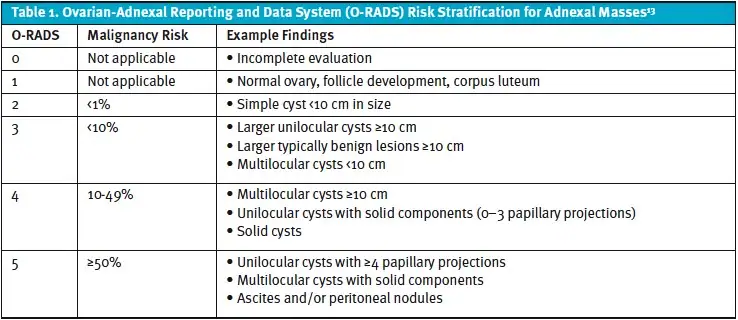
Most ovarian cysts are benign and can be managed conservatively with follow-up imaging. Current recommendations are to have a repeat TVUS in 8–12 weeks for simple or hemorrhagic cysts measuring 5–10 cm.13 If a hemorrhagic cyst persists beyond this period, referral to gynecology is warranted. Oral contraceptives are no longer recommended for the prevention or treatment of ovarian cysts.13 Patients who present with persistent pain, an increase in cyst size, or any imaging features suggestive of malignancy should be referred for surgical evaluation.
Hormonal Causes: Dysmenorrhea
Dysmenorrhea is painful menstruation and is the most common gynecologic condition affecting women.3 Pain severity can range from minimal to debilitating.
Primary dysmenorrhea refers to painful menstruation without an underlying pelvic pathology. In contrast, secondary dysmenorrhea is associated with an additional pelvic diagnosis, such as endometriosis, PID, uterine fibroids (leiomyomas), or interstitial cystitis.3
Primary dysmenorrhea typically begins with the onset of ovulatory menstrual cycles, usually within 6–12 months of menarche, though it may occur up to 2 years later in some adolescents.3 The prevalence decreases with age. The pain is characteristically crampy, fluctuates in intensity, and begins shortly before or at the start of menstruation, often lasting up to 72 hours.3 It is most commonly localized to the suprapubic region and may radiate to the lower back or upper thighs.
Risk factors include:3
- Age <30 years
- Body mass index <20
- Smoking
- Early menarche (before age 12)
- Longer or heavier menstrual periods
- Irregular cycles
- History of sexual assault
- Family history of dysmenorrhea
Physical examination typically reveals a mobile, non-tender uterus of normal size with no adnexal masses, uterosacral nodularity, or mucopurulent discharge. In patients with a concern for a diagnosis, such as PID, toxic shock, foreign body, or mass, a pelvic exam is recommended.[15]
For patients with dysmenorrhea not seeking pregnancy, hormonal contraception is considered first-line therapy, either alone or in combination with nonsteroidal anti-inflammatory drugs (NSAIDs). These therapies reduce endometrial proliferation and prostaglandin production, thereby relieving pain.15 Options include combined oral contraceptives, progestin-only methods, and intrauterine devices (IUDs).
Other therapies may include:
- NSAIDs: A nonhormonal option, they work by inhibiting prostaglandin synthesis and are superior to both placebo and acetaminophen for treating primary dysmenorrhea. They should be initiated 1–2 days before the onset of menses and continued during the first 2–3 days of bleeding.15
- Nonpharmacologic options: While physical activity, acupuncture, and high-frequency transcutaneous electrical nerve stimulation have been studied, none have demonstrated superiority compared with hormonal or NSAID therapies. Small studies suggest potential benefits from Chinese herbal medicine and dietary supplements, but these findings require further validation.15
Structural/Mechanical Causes: Endometriosis
Endometriosis should be considered in the gynecologic differential diagnosis of chronic pelvic pain. This chronic, estrogen-dependent inflammatory disease is characterized by ectopic endometrial-like tissue outside the uterine cavity and affects approximately 10% of reproductive-age women worldwide. It is a prevalent cause of chronic pelvic pain and infertility, with most patients reporting dysmenorrhea, noncyclic pelvic pain, or dyspareunia, and approximately one-quarter experiencing infertility.[16] Established risk factors include early menarche, shorter menstrual cycle length, lower body mass index, nulliparity, and obstructive Müllerian anomalies.16
Diagnosis is frequently delayed by several years, often following evaluation by multiple clinicians. Although a definitive diagnosis requires laparoscopic visualization with histologic confirmation, a clinical diagnosis is commonly made based on characteristic symptoms supported by examination and imaging findings.16 TVUS is useful for identifying ovarian endometriomas, and pelvic magnetic resonance imaging may assist in detecting deep infiltrating disease; however, normal imaging does not exclude endometriosis. For patients not seeking pregnancy, first-line management consists of hormonal suppression with combined estrogen-progestin contraceptives or progestin-only therapies. Gonadotropin-releasing hormone analogs, antagonists, and surgical excision are reserved for persistent or refractory symptoms, although recurrence remains a recognized limitation of treatment.16
Case Resolution
Given the high concern for ectopic pregnancy, the patient was sent to the emergency department where an OB/GYN specialist was consulted. The patient was then taken to surgery for diagnostic laparoscopy where she was confirmed to have a ruptured right tubal ectopic pregnancy. Right salpingectomy was performed. The patient had an uneventful post-op course and made a full recovery.
Pitfalls In Abdominal and Pelvic Pain Diagnosis and Management
Several common diagnostic errors can delay appropriate management of gynecologic causes of abdominal and pelvic pain. A urine pregnancy test should be obtained in all reproductive-age patients presenting with abdominal or pelvic pain, as ectopic pregnancy may present with subtle or nonspecific findings.2,4,5,6 Ectopic pregnancy should not be excluded based solely on a β-hCG value below the discriminatory threshold or a single nondiagnostic ultrasound.2,4,5,6
A thorough pelvic examination remains essential. Failure to perform a speculum and bimanual examination may result in missed findings such as cervical motion tenderness, adnexal tenderness, uterine enlargement, or abnormal discharge, which help distinguish ectopic pregnancy and PID from other etiologies.7,9 Isolated pyuria without bacteriuria should prompt consideration of STI or PID rather than empiric treatment for urinary tract infection.7,9,10
Ovarian torsion cannot be excluded by preserved Doppler flow, as normal arterial perfusion may be present in confirmed cases.11,12 Likewise, the presence of free pelvic fluid without a discrete adnexal mass does not rule out ruptured ovarian cyst.13 In patients with chronic pelvic pain, symptoms should not be attributed to primary dysmenorrhea without evaluating for secondary causes such as endometriosis or uterine leiomyomas, which are frequently underrecognized and associated with delayed diagnosis.3,16
Conclusion
Pelvic pain in women can range from benign to life-threatening, with delays in diagnosis leading to significant morbidity, including surgical complications, infertility, and mortality. Given that abdominal pain is one of the most common clinical complaints, urgent care facilities must understand how to triage and manage these cases effectively. As reviewed, several common etiologies of acute abdominal pain in women can be identified through a thorough history, physical examination, and the use of ultrasound, all of which are critical in making a timely diagnosis and preventing further complications.
Takeaway Points
- Ectopic pregnancy is the leading cause of first-trimester maternal mortality. In women of childbearing age with abdominal or pelvic pain, always perform a urine pregnancy test.
- PID is a clinical diagnosis typically seen in young and sexually active women. It requires broad-spectrum antibiotics, given promptly to prevent infertility and other sequelae.
- Ovarian torsion is a surgical emergency that should be referred to an ED.
- Ovarian cysts are common and usually benign, but ovarian cancer should remain on the differential.
- Dysmenorrhea is best managed with NSAIDs and/or hormonal contraception.
Manuscript submitted November 25, 2025; accepted March 15, 2026.
References
- [1]. National Center for Health Statistics. Emergency Department Visits in the United States, 2016–2022. Centers for Disease Control and Prevention. Accessed July 2025. https://www.cdc.gov/nchs/dhcs/ed-visits/index.htm
- [2]. Jeffers K, Koyfman A, Long B. Updates in emergency medicine: Ectopic pregnancy. Am J Emerg Med. 2024;85:90-97. doi:10.1016/j.ajem.2024.09.005
- [3]. Ferries-Rowe E, Corey E, Archer JS. Primary Dysmenorrhea: Diagnosis and Therapy. Obstet Gynecol. 2020;136(5):1047-1058. doi:10.1097/AOG.0000000000004096
- [4]. American College of Obstetricians and Gynecologists’ Committee on Practice Bulletins—Gynecology. ACOG Practice Bulletin No. 193: Tubal Ectopic Pregnancy. Obstet Gynecol. 2018;131(3):e91-e103. doi:10.1097/AOG.0000000000002560
- [5]. Hendriks E, Rosenberg R, Prine L. Ectopic Pregnancy: Diagnosis and Management. Am Fam Physician. 2020;101(10):599-606.
- [6]. Schreiber CA, Sonalkar S. Tubal Ectopic Pregnancy. N Engl J Med. 2025;392(8):798-805. doi:10.1056/NEJMcp2402787
- [7]. Frock-Welnak DN, Tam J. Identification and Treatment of Acute Pelvic Inflammatory Disease and Associated Sequelae. Obstet Gynecol Clin North Am. 2022;49(3):551-579. doi:10.1016/j.ogc.2022.02.019
- [8]. Kreisel K, Torrone E, Bernstein K, Hong J, Gorwitz R. Prevalence of pelvic inflammatory disease in sexually experienced women of reproductive age—United States, 2013–2014. MMWR Morb Mortal Wkly Rep. 2017;66(3):80-83. doi:10.15585/mmwr.mm6603a3
- [9]. Curry A, Williams T, Penny ML. Pelvic Inflammatory Disease: Diagnosis, Management, and Prevention. Am Fam Physician. 2019;100(6):357-364.
- [10]. Centers for Disease Control and Prevention. Pelvic inflammatory disease (PID) – STI treatment guidelines. www.cdc.gov. Published 2022. Accessed July 2025. https://www.cdc.gov/std/treatment-guidelines/pid.htm
- [11]. Adnexal Torsion in Adolescents: ACOG Committee Opinion No, 783. Obstet Gynecol. 2019;134(2):e56-e63. doi:10.1097/AOG.0000000000003373
- [12]. Bridwell RE, Koyfman A, Long B. High risk and low prevalence diseases: Ovarian torsion. Am J Emerg Med. 2022;56:145-150. doi:10.1016/j.ajem.2022.03.046
- [13]. Farkas AH, Abumusa H, Rossiter B. Structural Gynecological Disease: Fibroids, Endometriosis, Ovarian Cysts. Med Clin North Am. 2023;107(2):317-328. doi:10.1016/j.mcna.2022.10.010
- [14]. Elias KM, Guo J, Bast RC Jr. Early Detection of Ovarian Cancer. Hematol Oncol Clin North Am. 2018 Dec;32(6):903-914. doi: 10.1016/j.hoc.2018.07.003. Epub 2018 Sep 28. PMID: 30390764; PMCID: PMC6376972.
- [15]. McKenna KA, Fogleman CD. Dysmenorrhea. Am Fam Physician. 2021;104(2):164-170.
- [16]. As-Sanie S, Mackenzie SC, Morrison L, et al. Endometriosis: a review. JAMA. 2025;334(1):64-78. doi:10.1001/jama.2025.2975
Author Affiliations: Anisah Chauhdry, MS, medical student, Lincoln Memorial University, DeBusk College of Osteopathic Medicine. Naushair Hussain, DO, internal medicine resident, Indianapolis University School of Medicine. Michael B. Weinstock, MD, Adena Health System; Department of Emergency Medicine, Wexner Medical Center at The Ohio State University; The Journal of Urgent Care Medicine. Authors have no relevant financial relationships with any ineligible companies.
Read More
- How Useful Is Ultrasound in Acute Female Pelvic Pain?
- Abdominopelvic Pain, Part 1: Approach to Men in the Urgent Care Setting
- Abdominopelvic Pain, Part 2: Approach to Women in the Urgent Care Setting
- Pelvic Pain, Dysuria, and Back Pain in an Adolescent Female