
Published on
Download the article PDF: Urgent Care Refers 1 Patient In 50 To The Ed
Urgent Message: Urgent care sends roughly 1 patient in 50 to the emergency department. Most of those referrals involve symptoms that call for imaging, laboratory testing, or monitoring that the clinic cannot provide. Some are emergencies identified during the visit for an ordinary complaint.
Keywords: emergency department referral; emergency department transfer; urgent care referral patterns; practice variation; clinical documentation; urgent care operations
Alan A. Ayers, MBA, MAcc
Consider a scenario in which a patient writes a scathing online review after paying his co-pay and waiting at an urgent care, only to have the clinician send him to the emergency department (ED) instead—making the patient feel as if his time and money were wasted. The emergency physician then objects to receiving a patient he believes urgent care should have handled. Meanwhile, the urgent care clinician never learns what happened to the patient in the ED. This disconnect can be explained and possibly improved upon by leveraging data.
An analysis of 14.2 million deidentified private urgent care visit records from the Experity network from the first half of 2026 found 218,585 visits ended in an ED referral. The big-picture analysis helps answer 3 questions operators have never been able to answer with their own data:
- How often does ED referral happen?
- What kind of patient experiences a referral?
- What did the urgent care do before the patient was referred?
How Often Does Urgent Care Refer Patients to the ED?
Between 1.5–2.6% of urgent care visits end with a referral to the ED, or roughly 1 patient in 50. The category is expressed as a range because visit disposition is captured inconsistently in the documentation. According to data from the analysis, about 40% of providers with at least 500 visits recorded no referrals over 6 months, which almost certainly means some referrals happened but were not recorded.
In many clinics, the disposition field represents extra documentation work in the EMR for the clinician. It is not required to close the chart, and it competes with other tasks that drive payment. Therefore, it may not be completed even when a referral is made. Meanwhile, a provider who sends a patient to the ED by phoning the charge nurse, printing records, and walking the family to their car on the way out has done the clinical work. But whether that work shows up as a coded disposition depends on whether it was built into the closing workflow.
Among the subset of providers who do record their ED referrals, the rate was found to be 2.56% of visits. Common sense would suggest—based on the reality of unrecorded referrals—that the true rate of ED referrals in urgent care overall is likely closer to the 2.6% end of the range.
Which Patients Are Referred and Why?
Most ED-referred patients leave with a symptom recorded, not a diagnosis. Abdominal pain in its various forms, for example, accounts for roughly 1 in 6 referrals, the largest symptom category, according to the analysis, and unspecified chest pain was found to be the top individual symptom code at 7.6%. These 2 categories represent patients who often need something ruled out, which may require, for example, computed tomography (CT) imaging, serial cardiac enzymes, monitoring, or surgical consultation, which are resources rarely available at an urgent care center.
Plotting the chief complaint recorded at registration against the services billed and the final outcome allows these visits to be sorted into 3 distinct groups, each with a different story behind it:
- ED referral needed because a higher level of care was evident at arrival. Chest pain or pressure, shortness of breath, and palpitations together make up about 11% of referrals. These patients look like emergency cases from the moment they check in, and the clinic is not deciding whether to send them to the ED so much as documenting what is happening before they go.
- ED referral needed because the urgent care clinic could not treat the patient. These are patients who are referred quickly with little testing. Among ED-referred patients who came to urgent care with a laceration, for example, only 25% had any test or treatment recorded in urgent care beyond the exam itself. Among those who came in with swelling, only 21% had any test or treatment recorded. The reasons for quick referral may include: wounds beyond what the clinic can repair; injuries needing a CT scan the urgent care isn’t able to offer; or infections requiring intravenous antibiotics the urgent care isn’t set up to administer.
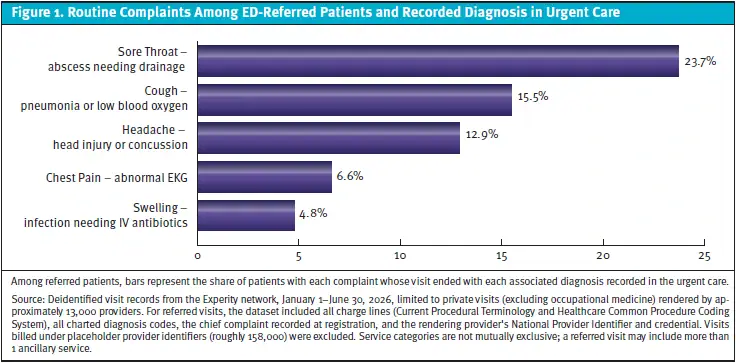
- ED referral needed because the higher level of care was identified as necessary during the urgent care visit. The third group is the one that should change how operators talk about referrals. These are patients who walk in looking like they could be treated within typical urgent care capabilities but left with an emergency. Cough alone accounts for 5.5% of the 218,585 ED referrals in the dataset, roughly 12,000 visits, and 11% of those patients turned out to have pneumonia with another 4% showing low blood oxygen in the record, thanks to testing in the urgent care (Figure 1). Sore throat ED referrals are rare, but when one happens, the analysis found nearly a quarter of the time, the patient had a throat abscess that needed to be drained, which warranted the ED referral.
What Happens in Urgent Care Before an ED Referral?
Just over half of all referred visits (52.8%) included at least 1 diagnostic or therapeutic service at the urgent care beyond the evaluation itself. Examples of the more common services provided in urgent care before ED referral are summarized in Table 1.
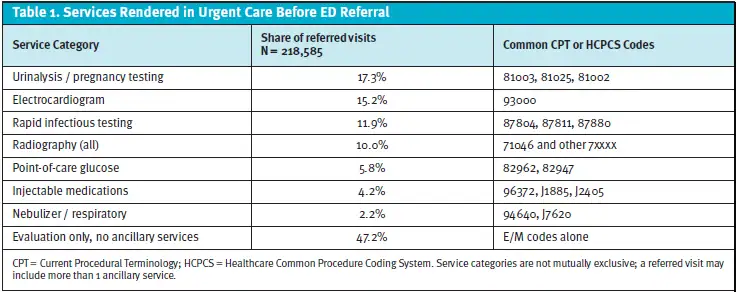
In the analysis, the remaining 47.2% of visits with ED referrals showed no billed ancillary services. History, physical examination, and medical decision making instead served as the urgent care evaluation in these cases, and the coding data indicate that clinical work was substantial: 83.8% of those visits were billed at E/M level 4 or 5, consistent with substantial medical decision-making complexity. Most of these visits without ancillary services involved head injuries or complex wounds, and testing would have delayed necessary care.
Three-quarters of ED referrals with chest pain included an electrocardiogram (ECG) at the urgent care, which means one-quarter in the dataset did not. Whether those decisions were clinically appropriate is a question for medical directors rather than administrators, but it is a question an operator can only ask if the data is being captured in the first place.
Referral rates differ widely from one provider to the next. Out of every 1,000 patients seen, the lowest-referring individual clinicians send 3 to the ED, while the highest-referring clinicians send 56 patients to the ED. The clinician’s credential explains almost none of that difference. Nurse practitioners, physician assistants, and physicians refer at nearly the same rates across the board. What the data cannot conclude is the “right” or “optimal” rate of ED referrals because the records analyzed here end at the urgent care clinic door and do not include the ED outcome.
What the Data Means for Operators
Before urgent care operators can draw conclusions about ED referrals, they have to clean up their workflows. There is no way to manage a referral rate that is not accurately reported, and today about 40% of high-volume providers (at least 500 visits) show no referrals at all in their records. This is not because they never send anyone to the ED, but because, as noted above, the field that captures the referral was likely not completed. Whether the disposition field can be made mandatory in the record is often a logistical question, but whether the field is completed by clinicians is a workflow question within any operator’s control. A daily or weekly audit of visits with no disposition recorded or a standing expectation that the team confirms the disposition before the chart is closed can help to capture the data.
The referral patterns also reveal what is missing. A center sending a steady stream of patients with abdominal pain to the ED may realize something about its capabilities and resources. Solutions may include, for example, adding a test the clinic already has the capability to run, building a relationship with a nearby imaging center that takes same-day walk-ins, or knowing which specialists in the area will see a patient the next morning so the ED is not the only option. Operators who review their own referral diagnoses each quarter will find patterns worth acting on, and most of the solutions cost less than adding a piece of equipment.
Finally, the discovered emergencies are worth talking about outside the clinic. A referral rate for pneumonia, for example, shows urgent care is doing real diagnostic work before the patient reaches the ED. That is the story operators should bring to payer negotiations and health system partnership discussions, backed by their own data.
Read More
- Which ED Referrals Are Appropriate? The Problem of Perspective
- Urgent Care Centers Can Reduce ED Referrals for CT Scans in Mild Head Injury with Integration of Brain Activity Biomarker
