
Published on
Download the article PDF: Factors Associated With The Use Of An Online Appointment Tool In Urgent Care Centers
Urgent Message: Significant differences in the use of an online appointment tool based on age, race, insurance type, and urgent care setting underline the need for targeted strategies to address differences in adoption across patient groups.
E. Melinda Mahabee-Gittens, MD, PhD; Parth Divekar, MS; Lara Stone, MA; David Schnadower, MD, MPH; Sinem Toraman Turk, PhD
Keywords: online appointment scheduling; pediatric urgent care; virtual queueing; digital health; healthcare access; health disparities
Abstract
Aim: To keep up with increases in pediatric visits to urgent care (UC) centers, we used an online appointment tool called “Save my Spot” (SMS). The study objective was to examine the frequency of overall use of SMS to schedule UC visits and identify differences in use by sociodemographic characteristics and by UC setting locations.
Design/Method: We performed a retrospective analysis of pediatric UC visits to evaluate factors associated with use of the SMS virtual queueing feature using descriptive statistics, bivariate tests, and univariate logistic regression.
Results: Overall, 12,644/17,075 (74%) linked UC visits used SMS. In univariate logistic regression, visits involving younger children (0–2 years) had lower odds of SMS use compared with visits involving older children (3–17 years) (odds ratio [OR]=0.81; 95% confidence interval [CI]: 0.75–0.87; p<0.0001). Visits involving White patients had higher odds of SMS use compared with patients of other races (OR=1.72; 95% CI: 1.60–1.85; p<0.0001). Visits involving patients with public insurance had lower odds of SMS use compared with patients with all other insurance types (OR=0.56; 95% CI: 0.52–0.60; p<0.0001). SMS use also varied by UC setting, with the urban site having lower odds of SMS use compared with suburban sites (OR=0.51; 95% CI: 0.47–0.55; p<0.0001).
Conclusions: The results demonstrate significant differences between SMS tool use by age, race, insurance type, and UC setting, underlining the need for targeted strategies to address these disparities and enhance the SMS tool adoption across diverse patient demographic groups.
Introduction
Urgent care (UC) centers provide healthcare on a walk-in, no-appointment basis for acute illnesses or injuries that are not medical emergencies.1 UCs may have advantages over emergency departments (ED) including lower visit costs, shorter wait times, and convenient locations.1,2 These and other factors have increased the demand for UCs and associated services.3 Consequently, the number of UCs in the United States has increased from 8,676 in 2016 to almost 15,000 in 2024 with the highest rates of growth in suburban regions.1,4
Although UCs are often created to address the demand for prompt care, UCs can experience flow issues and long wait times when patients arrive at the same time (eg, when the UC first opens for the day) or during times when there is a high prevalence of infectious illnesses (eg, during influenza season) or other illnesses in the community.5 To decrease wait times and improve the efficiency of care in UCs, some UCs have developed or adapted online appointment tools designed to help patients and families schedule appointments for in-person UC visits.6 However, the use of these tools requires that families have online access to these systems and the necessary level of healthcare information technology literacy required to navigate these systems.
Although online appointments are designed to benefit patients, they may also increase the digital divide in healthcare seen among certain patient groups including minorities, those with public insurance, those with lower educational levels, and those living in certain settings.7-9 These same individuals may especially benefit from the use of pediatric UCs instead of EDs for their children’s minor illnesses as individuals from these sociodemographic subgroups often have higher rates of ED utilization if their children do not have a regular pediatric primary care provider, if they have less stable insurance, or if they have financial insecurity.10,11 However, the parent/guardian use patterns of online pediatric UC visit appointment scheduling among individuals with differing sociodemographic backgrounds are unknown. Such information could be used to provide education to these groups about the availability of convenient access to care to meet their children’s urgent healthcare needs.
To bridge this gap, we examined the use of “Save My Spot” (SMS), an online UC appointment system used to improve the flow and decrease wait times in 5 UCs that were part of a tertiary care children’s hospital. The primary study objectives were to examine and compare the frequency of use and nonuse of SMS overall, by sociodemographic characteristics of patients, and by UC center locations. The primary hypothesis was that overall use of SMS would be lower among racial minorities, among those who had public insurance, and in UC sites that were in urban regions compared to those in suburban regions.
Methods
Study Design and Setting
This study was part of a larger mixed-methods study involving a secondary data analysis of electronic medical records (EMR). It included 0–17-year-old patients who had UC visits at 1 of 5 UC sites at a large midwestern Children’s Hospital, which has approximately 70,000 total annual UC visits. The location, setting (urban or suburban), and times of operation are: 1) main base hospital—urban location, open daily from 9 AM–12 AM; 2) satellite—suburban location, open daily 12 PM–11 PM; 3) 3 stand-alone UC sites in suburban locations, open Monday–Friday 6 PM–11 PM and Saturday and Sunday 12 PM–7 PM.
Save My Spot Online Appointment Tool System
To improve flow and decrease wait times and crowding, SMS was introduced in 2018 and is described in detail elsewhere.12 Briefly, SMS is an app-based or webpage-enabled application that allows parents to view and select their preferred UC time as soon as that UC opens. A programmed algorithm based on the number of patients already being seen and available staffing dynamically adjusts the available appointment times that patients can select.
Inclusion and Exclusion Criteria and EMR Review
Data for this secondary analysis was obtained in 2 steps. First, we identified all urgent care (UC) encounters among patients aged 0–17 years across 5 UC sites between January 1 and December 31, 2022. Second, encounters were included in the final analytic dataset only if the Epic EMR encounter could be reliably linked to a corresponding record in the SMS scheduling tool.
Epic EMR data and SMS scheduling data for 2022 were extracted, standardized (eg, name and date formatting), and deduplicated prior to linkage. Probabilistic record linkage was then performed using identifiers available in both systems. The probabilistic linkage variables were first name, last name, date of birth, and visit date; an additional unique identifier was incorporated as a comparison field when available but was not required. These variables were used to generate candidate Epic–SMS pairs and compute posterior match probabilities.
Record linkage was conducted in Splink (DuckDB backend) using “link-only” mode. To limit the number of candidate Epic–SMS pairs evaluated, we applied blocking rules requiring exact agreement on first name and allowing small differences in last name (Levenshtein distance ≤1). Comparison functions were specified for each linkage variable, including fuzzy string comparisons for names (Levenshtein distance ≤2), near-exact agreement for date of birth (distance ≤1), and approximate agreement for visit dates. High-confidence deterministic matches (exact agreement on first name, last name, date of birth, and visit date) were used to initialize m and u probabilities, after which Splink’s expectation–maximization algorithm was used to refine parameter estimates and compute posterior match probabilities.
Final match predictions were generated using a posterior probability threshold of 0.6 and exported to a timestamped CSV file. To ensure accurate patient-level linkage for analysis, we applied a post-linkage verification step and retained only matched pairs with exact agreement on 4 required fields: first name, last name, date of birth, and sex (Sex was used for verification because it was reliably available in the Epic EMR and provides an additional safeguard against false matches). Matched pairs that did not meet this 4-field verification requirement were excluded. The resulting linked dataset represented unique patient encounters.
For all included encounters, sociodemographic and setting variables were extracted from the Epic EMR, including age (calculated at the time of visit), sex, race, insurance type, UC setting, and whether SMS was used (yes/no). Insurance type was collapsed into 3 categories: public (eg, Medicaid, Medicare, other state/federal programs), commercial (eg, employer-sponsored or individual private plans), and self-pay (uninsured/out-of-pocket). Visit setting was consolidated into urban (main base hospital UC) vs suburban (all other locations). The Strengthening the Reporting of Observational Studies in Epidemiology (STROBE) guidelines were followed.13 The study protocol was approved by the hospital institutional review board (IRB# 2023-0143); a waiver of informed consent was granted.
Statistical Analysis
Descriptive and inferential analyses were conducted to examine factors associated with use of the SMS tool. Continuous variables (eg, patient age) were summarized using means and standard deviations and compared between SMS users and non-users using 2-sample t-tests. Categorical variables were summarized using counts and percentages and compared using chi-square tests of independence or Fisher’s exact tests, as appropriate. Associations between patient and setting characteristics and SMS use were quantified using univariate logistic regression models, reporting odds ratios (ORs) with 95% confidence intervals (CI), with SMS use (yes/no) as the dependent variable. For regression analyses, categorical predictors were collapsed into a limited number of clinically meaningful groups to facilitate interpretation and maintain consistent contrasts across models. For example, insurance type was coded as public (eg, Medicaid) versus all other insurance types (commercial and self-pay). All statistical tests were 2-sided with statistical significance defined as p<0.05. Analyses were conducted in Python. We also note this as a limitation, as collapsing categories may mask heterogeneity within the all-other-insurance group.
Results
Table 1 shows the number and percentage of encounters with and without use of SMS by child sociodemographic characteristics and UC setting. In total, 17,075 UC encounters were successfully linked between the Epic EMR and SMS datasets (analytic sample); of these, 12,644 (74%) used SMS and 4,431 (26%) did not. Encounters not included in the analytic sample primarily reflect visits that could not be linked across datasets due to missing or inconsistent linkage fields (eg, name, date of birth, or visit date) or visits with no corresponding SMS record. In Table 1, patient sex was not meaningfully associated with SMS use when examined as the proportion of each sex using SMS: 74.06% of female patients used SMS (6,118/8,261) compared with 74.05% of male patients (6,526/8,814). This is consistent with the univariate logistic regression results showing no association between patient sex and SMS use (OR=1.00; 95% CI: 0.93–1.07; p=0.99). Examining patient age, the average age was 6.23 years, with children in the SMS parental users group being slightly older on average (6.32 years) compared to nonusers (5.96 years). Parents of younger children (aged 0–2 years) had lower SMS use than parents of children aged 3–17 years. SMS use differed by patient race; in the regression analysis, visits involving White patients had higher odds of SMS use than visits involving patients of other races. Furthermore, we observed differences in SMS use by insurance: the proportion of encounters using SMS was lower among those with public insurance (67.42%) than among those with all other insurance types (78.82%) (Table 1; p<0.0001). Lastly, use of SMS varied notably by UC setting with higher use among patients at suburban sites (except for 1 site) compared to the urban, main hospital UC.
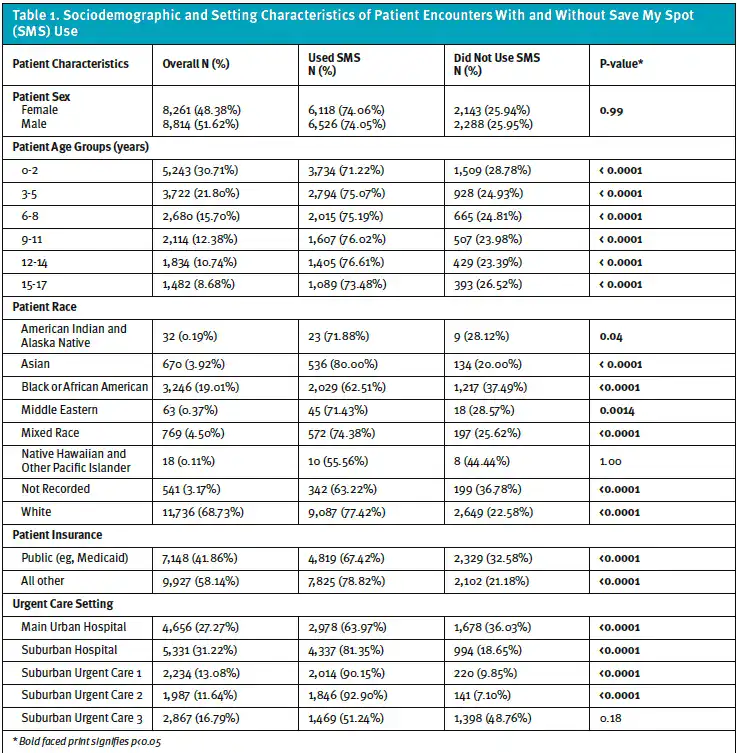
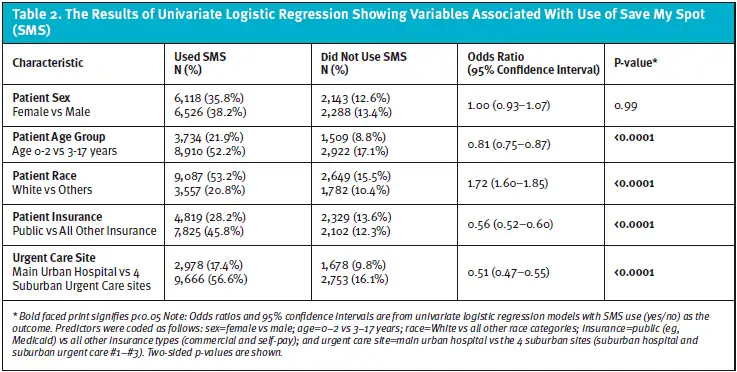
Table 2 presents the association between various patient characteristics and the use of SMS, emphasizing the OR with 95% CI and p-values. For patient sex, there was no significant difference in SMS use between encounters involving female and male patients. Although the bivariate comparison showed a small difference in SMS use by patient sex, patient sex was not associated with SMS use in univariate logistic regression (OR=1.00; 95% CI: 0.93–1.07; p=0.99). When examining patient age, parents of younger children (0-2 years) were significantly less likely to use SMS compared to parents of older children and teenagers (3–17 years), with an OR of 0.81 (95% CI: 0.75–0.87; p<0.0001). Regarding patient race, parents of White patients were more likely to use SMS compared to parents of patients from other racial backgrounds (OR=1.72; 95% CI: 1.60–1.85; p<0.0001). For patient insurance type, parents whose children had public insurance (eg, Medicaid) had lower odds of using SMS compared to parents of children with other types of insurance (OR=0.56; 95% CI: 0.52–0.60; p<0.0001). Concerning UC setting, parents of patients visiting the urban site had significantly lower odds of using SMS compared to those at the suburban sites (OR=0.51; 95% CI: 0.47–0.55; p<0.0001).
Discussion
This study found sociodemographic and urban vs suburban setting differences in SMS use across pediatric UC visits. Because SMS is used by a parent/guardian but our dataset contained patient- and visit-level characteristics (not parent/guardian demographics), the associations reported here should be interpreted as differences in SMS use by patient characteristics. SMS use was higher for visits involving children aged 3–17 years compared with 0–2 years (OR, 0.81; 95% CI, 0.75–0.87, for 0–2 vs 3–17 years) and higher for White patients compared with non-White patients (OR, 1.72; 95% CI, 1.60–1.85). Visits involving children with public insurance had lower odds of SMS use compared with all other insurance types (OR, 0.56; 95% CI, 0.52–0.60). We did not observe a meaningful association between patient sex and SMS use (OR, 1.00; 95% CI, 0.93–1.07).
These age findings align with national patterns of pediatric UC utilization in 2022,14 which show higher UC visit rates among older children, particularly ages 12–17 years (30.3%) and 6–11 years (26.6%). One possible explanation is opportunity and familiarity: Families who use UC more frequently may have more exposure to site communications and workflows (eg, signage, discharge instructions, portal messages) that advertise SMS, making them more likely to adopt it over time. In addition, visits for older children may be easier to schedule in advance (eg, fewer unpredictable infant/toddler presentations), and parents/guardians of school-aged children may have greater incentive to minimize time away from school and work by using a “save my spot” feature. These explanations are hypothesis-generating, as we did not measure prior UC use, SMS awareness, or reasons for choosing SMS.
The higher SMS use rates observed in this study among patients who were White or patients who did not have public insurance aligns with prior work which examined UC use rates in 2019.15 This work reported that overall UC use rates were highest among non-Hispanic White children (29.2%) vs non-Hispanic Black or Hispanic children (24.9% and 22.6%, respectively) and highest among children with private insurance (27.6%), followed by children with public insurance (25.2%) and children who did not have insurance (19.3%).15 We observed higher SMS use at the suburban sites than at the urban site. However, because we did not perform multivariable adjustment, this site-level difference may reflect differences in patient mix across sites (eg, insurance type, race/ethnicity, and age distribution) rather than an independent effect of site.
Rates of pediatric UC visits in the U.S. have increased from 21.6% in 2021 to 28.4% in 2022.14 These increased rates are due to a number of reasons including the need for fast, convenient, and cost-effective care for acute illnesses that may not need to be evaluated in an ED setting.16 Thus, hospitals and insurance companies may find UCs an alternative site for providing care due to these and other reasons. Some past research has reported higher UC usage among parents with higher educational levels and higher incomes.15 Parent/guardian characteristics (eg, sex, education, income, language, and digital access) were not available in our data; therefore, we cannot directly attribute differences in SMS use to specific parental characteristics. However, we observed lower SMS use among children with public insurance, which is important as insurance type is often used as a proxy for socioeconomic status in health services research.17 Accordingly, the lower rates of SMS usage observed among publicly insured patients may be associated with underlying social determinants of health, including differences in parent/guardian education, household income, health literacy, English proficiency,17 and access to reliable broadband internet and internet-enabled devices.18 The lower uptake of SMS among publicly insured visits is concerning as children with public insurance would benefit from the same appointment system that SMS offers. Further, children with public insurance may utilize EDs more often than those with private insurance,19 and these ED visits may incur higher costs than UC visits for many nonemergent pediatric conditions.20 This difference is concerning from both an equity and health-system perspective. If publicly insured families are less able to access or use SMS, they may be less likely to realize the time-saving and logistical benefits of scheduled UC visits. Further, differences in awareness of SMS, comfort with online scheduling, ability to plan ahead (eg, work schedule flexibility, transportation constraints), and prior experiences with the health system may also contribute. From an implementation perspective, these results suggest that outreach and enrollment support tailored for publicly insured families (eg, multilingual messaging, in-clinic assistance, simplified workflows) may help reduce barriers to using SMS. Thus, improving awareness of and access to SMS (eg, targeted communication, language-accessible materials, and in-clinic enrollment support) may be an important strategy to reduce barriers for publicly insured families.
Limitations
This study has several limitations. First, this was an observational analysis of routine operational data; therefore, the reported ORs reflect associations between patient/visit characteristics and SMS use and should not be interpreted as causal. Second, because analyses were limited to univariate logistic regression, we could not adjust for potential confounding among correlated predictors. In particular, UC site is likely associated with patient race/ethnicity and insurance (and other unmeasured socioeconomic factors), so the observed associations for site, race, and payer may not represent independent effects. Third, the analytic sample included only visits that could be linked between the Epic EMR and SMS datasets; visits that could not be matched were excluded, which may introduce selection bias if linkable encounters systematically differed from those not linkable. Fourth, the primary outcome was use of SMS, and we did not have the operational timestamps needed to evaluate whether SMS affected UC throughput (eg, appointment request time, arrival time, time to first provider, total length of stay) or to account for visit complexity and volume (eg, chief complaint, tests/procedures, diagnoses, disposition, site census). Fifth, SMS use is a parent/guardian decision, yet our analysis relied on child/patient demographics available in the EMR; therefore, these findings should be interpreted as associations with patient- and visit-level characteristics rather than direct measures of parent/guardian characteristics. This represents a key limitation and highlights the need for future work that includes parent-level measures (including education, income, health literacy, language/digital-access variables, awareness of SMS) to better understand and address barriers to SMS use. Finally, several predictors were collapsed for regression analyses (eg, race and payer groupings), which may mask heterogeneity within categories and should be considered when interpreting results. Future studies that include linkage to operational timestamps and parent/guardian characteristics could better assess the impact of SMS on wait times and equity in access to digital scheduling.
Conclusions
Overall, this analysis highlights differences in SMS use by patient age, race, insurance category, and UC setting. Targeted implementation and outreach strategies may help reduce disparities in SMS adoption across patient groups. Although this study did not measure wait times, throughput, or clinical quality or outcomes, future studies should assess whether broader and more equitable SMS uptake is associated with improvements in operational efficiency and care processes in pediatric UC.
Disclaimers
The views expressed in the submitted article are the authors’ own and not an official position of the institution or the funder.
Sources of Support
This study was funded, in part, by the National Institute of Environmental Health Sciences (R01ES030743)
Manuscript submitted February 19, 2026; accepted August 9, 2026.
References
- Urgent Care Association. Urgent care industry white paper. Updated August 17, 2023. Accessed December 9, 2024. https://urgentcareassociation.org/wp-content/uploads/2023-Urgent-Care-Industry-White-Paper.pdf
- Saidinejad M, Paul A, Gausche-Hill M, et al. Consensus statement on urgent care centers and retail clinics in acute care of children. Pediatr Emerg Care. 2019;35(2):138-142. doi:10.1097/PEC.0000000000001656
- Lehan E, Briand P, O’Brien E, Hafeez AA, Mulder DJ. Synergistic patient factors are driving recent increased pediatric urgent care demand. PLOS Digit Health. 2024;3(8):e0000572. doi:10.1371/journal.pdig.0000572
- Urgent Care Association. Urgent care data. Accessed December 9, 2024. https://urgentcareassociation.org/about/urgent-care-data/#next
- Cedar Point Health. Wait times: urgent care vs. ER. Published January 23, 2024. Accessed December 9, 2024. https://cedarpointhealth.com/wait-times-urgent-care-vs-emergency-room/
- ER Express. How to improve average urgent care wait times. Updated November 11, 2022. Accessed December 9, 2024. https://www.erexpress.com/improve-average-urgent-care-wait-times/
- Anthony DL, Campos-Castillo C, Lim PS. Who isn’t using patient portals and why? Evidence and implications from a national sample of US adults. Health Aff (Millwood). 2018;37(12):1948-1954. doi:10.1377/hlthaff.2018.05117
- Brodie M, Flournoy RE, Altman DE, Blendon RJ, Benson JM, Rosenbaum MD. Health information, the Internet, and the digital divide. Health Aff (Millwood). 2000;19(6):255-265. doi:10.1377/hlthaff.19.6.255
- 9. Ganguli I, Orav EJ, Lupo C, Metlay JP, Sequist TD. Patient and visit characteristics associated with use of direct scheduling in primary care practices. JAMA Netw Open. 2020;3(8):e209637. doi:10.1001/jamanetworkopen.2020.9637
- 10. Butun A, Linden M, Lynn F, McGaughey J. Exploring parents’ reasons for attending the emergency department for children with minor illnesses: a mixed methods systematic review. Emerg Med J. 2019;36(1):39-46. doi:10.1136/emermed-2017-207118
- 11. Shi Q, Castillo F, Viswanathan K, Kupferman F, MacDermid JC. Low income and nonadherence to health supervision visits predispose children to more emergency room utilization. Glob Pediatr Health. 2020;7:2333794X20938938. doi:10.1177/2333794X20938938
- 12. Toraman Turk S, Stone L, Bouvay K, et al. Caregiver perspectives and preferences regarding timely access to unscheduled acute care in paediatric urgent care centers: a qualitative evaluation of Save My Spot tool. J Adv Nurs. 2025;81(7):4198-4207. doi:10.1111/jan.16642
- 13. von Elm E, Altman DG, Egger M, et al. The Strengthening the Reporting of Observational Studies in Epidemiology (STROBE) statement: guidelines for reporting observational studies. Epidemiology. 2007;18(6):800-804. doi:10.1097/EDE.0b013e3181577654
- 14. QuickStats: percentage of children and adolescents aged <17 years who visited an urgent care center or a clinic in a drug store or grocery store in the past 12 months, by age group and year—National Health Interview Survey, United States, 2021–2022. MMWR Morb Mortal Wkly Rep. 2024;73(3):68. doi:10.15585/mmwr.mm7303a5
- 15. Black LI, Zablotsky B. Urgent care center and retail health clinic utilization among children: United States, 2019. NCHS Data Brief. 2020;(393):1-8. https://www.cdc.gov/nchs/products/databriefs/db393.htm
- 16. Sankrithi U, Schor J. Pediatric urgent care—new and evolving paradigms of acute care. Pediatr Clin North Am. 2018;65(6):1257-1268. doi:10.1016/j.pcl.2018.07.014
- 17. Snyder RA, Chang GJ. Insurance status as a surrogate for social determinants of health in cancer clinical trials. JAMA Netw Open. 2020;3(4):e203890. doi:10.1001/jamanetworkopen.2020.3890
- 18. Sharma P, Patten CA. A need for digitally inclusive health care service in the United States: recommendations for clinicians and health care systems. Perm J. 2022;26(3):149-153. doi:10.7812/TPP/21.156
- 19. Cairns C, Ashman JJ, Kang K. Emergency department visit rates by selected characteristics: United States, 2022. NCHS Data Brief. 2024;(503):1-8. https://stacks.cdc.gov/view/cdc/159284
- 20. Montalbano A, Rodean J, Kangas J, Lee B, Hall M. Urgent care and emergency department visits in the pediatric Medicaid population. Pediatrics. 2016;137(4):e20153100. doi:10.1542/peds.2015-3100
Author Affiliations: E. Melinda Mahabee-Gittens, MD, PhD, Division of Emergency Medicine, Cincinnati Children’s Hospital Medical Center, Cincinnati, Ohio; University of Cincinnati College of Medicine, Cincinnati, Ohio. Parth Divekar, MS, Division of Biomedical Informatics, Cincinnati Children’s Hospital Medical Center, Cincinnati, Ohio. Lara Stone, MA, Division of Emergency Medicine, Cincinnati Children’s Hospital Medical Center, Cincinnati, Ohio. David Schnadower, MD, MPH, Division of Emergency Medicine, Cincinnati Children’s Hospital Medical Center, Cincinnati, Ohio; University of Cincinnati College of Medicine, Cincinnati, Ohio. Sinem Toraman Turk, PhD, Yale School of Public Health, Department of Health Policy and Management, and Yale Global Health Leadership Initiative, New Haven, Connecticut. Authors have no relevant financial relationships with any ineligible companies.