The patient is a 19-year-old male who complains of pain after receiving a blow to the shoulder. His range of motion is limited due to pain; he is otherwise healthy. View the image and consider what your diagnosis and next steps would be.
Read More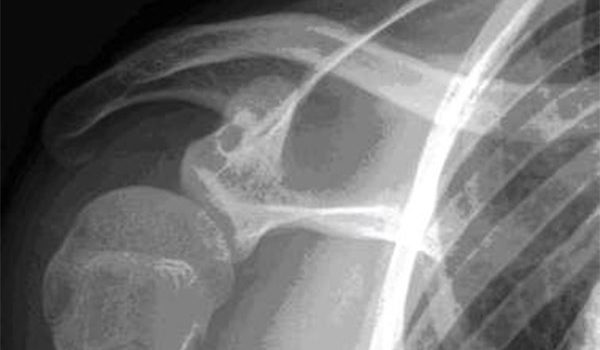

Practice Management
The patient is a 19-year-old male who complains of pain after receiving a blow to the shoulder. His range of motion is limited due to pain; he is otherwise healthy. View the image and consider what your diagnosis and next steps would be.
Read More
The patient is a 32-year-old male who woke up at 1 a.m. with a burning sensation in the mid-chest (a first-time event, he reports). The patient is not diaphoretic, and has no dyspnea. He is generally healthy and has no known risk factors for heart disease. His physical exam is unremarkable. In addition, you find: BP: 154/102 Pulse: 68 Sat: 99% Temperature: 97.3 °F View the EKG taken and consider what your diagnosis and next …
Read More
Urgent message: Vigilance for risk factors and diagnostic methods related to Paget-Schroetter syndrome in patients presenting to urgent care with relevant risk factors is essential to initiating therapy on site and timely referral to a hospital and/or vascular surgeon. Darshan Shah, MD, Shikhar Saxena, MD and Shailendra Saxena, MD, PhD Introduction Upper extremity deep venous thrombosis (UEDVT) is estimated to constitute 1% to 4% of all cases of deep venous thrombosis (DVT).1 The incidence may …
Read MoreIn each issue, JUCM will challenge your diagnostic acumen with a glimpse of x-rays, electrocardiograms, and photographs of dermatologic conditions that real urgent care patients have presented with. If you would like to submit a case for consideration, please e-mail the relevant materials and presenting information to [email protected] The patient is a 2 ½-year-old who presents with pain in the left ankle after receiving a blow to the lower leg. You find he is unable …
Read MoreIN early 2008, UCA revamped its annual survey in conjunction with researchers at Massachusetts General Hospital and Harvard University with the goal of assuring that the UCA Benchmarking Committee’s efforts produced a scientifically valid report. Here, we present some of the data from this landmark survey. As reported in the May installment of Developing Data, 93.3% of urgent care centers offer lab tests of one kind or another on the premises. In March, we told …
Read MoreDAVID STERN, MD (Practice Velocity) Q. We recently coded a visit for a young woman who thought – although she had no symptoms or foreign-body sensation – that there was a tampon left in her vagina. On pelvic exam, however, no retained tampon was found. What ICD-9 code is appropriate? Should the physician still diagnose this as a foreign body in the vagina? Question submitted by Japhlet Aranas, Resurrection Healthcare, Illinois A. One should not …
Read MoreJohn Shufeldt, MD, JD, MBA, FACEP My kids might offer a dissenting opinion, but I think I am pretty hip. And, although I have no idea what these lyrics mean … I want your ugly I want your disease I want your everything As long as it’s free I want your love Love-love-love I want your love … I still have Lady Gaga on in my iTunes. In fact, I kind of like these lyrics; …
Read MoreUpper Gastrointestinal Tract Hemorrhage, Warfarin, and Urinary Tract Antibiotics Key point: Ciprofloxacin increased GI hemorrhage while on coumadin by twice as much, and cotrimoxazole by four times. Citation: Fischer HD, Juurlink DN, Mamdani MM, et al. Hemorrhage during warfarin therapy associated with cotrimoxazole and other urinary tract anti-infective agents: A population-based study. Arch Intern Med. 2010; 170(7): 617-621. Hemorrhage is a well-known side effect of long-term warfarin use in older patients. Interactions between warfarin and …
Read MoreA quarter of a century ago, a former colleague of mine who specialized in stress management told me that everyone experiences stress; what matters is how one manages it. Analogous advice would seem to apply to sales: “Every sales professional experiences rejection. What matters is how they manage that rejection.” This month’s column features a plan for learning how to live with rejection, and turning it to your advantage.
Read More