

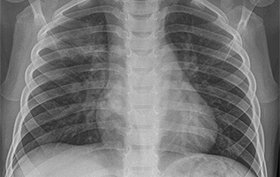
3-year-old boy with a cough and fever
This x-ray was taken on a 3-year-old boy with a cough and fever. View the image taken (Figure 1) and consider what your diagnosis would be.
Read MoreDiabetes Mellitus: Current Diagnosis, Screening and Management Issues in Urgent Care
Urgent Message: Diabetes mellitus is a common, complex and important condition frequently encountered in the urgent care setting. This article reviews current diagnostic criteria for diabetes and prediabetes and types of diabetes and discusses issues related to screening for diabetes and management issues relevant to urgent care. The authors previously reviewed the management of acute hyperglycemia in the July/August 2012 issue of JUCM. Author: Anthony J. Pick, MD, CDE and David L. Pick, MD, FAAFP …
Read MoreDeveloping Data: December, 2013
These data from the 2012 Urgent Care Industry Benchmarking Study are based on a sample of 1,732 urgent care centers; 95.2% of the respondents were UCA members. Among other criteria, the study was limited to centers that have a licensed provider onsite at all times; have two or more exam rooms; typically are open 7 days/week, 4 hours/day, at least 3,000 hours/year; and treat patients of all ages (unless specifically a pediatric urgent care). In …
Read More2014 CPT Changes, Suture Removal, Place of Service Code
DAVID STERN, MD (Practice Velocity) Q. I understand that we will be able to bill for cerumen removal for both ears in 2014. Is that true? A.Yes. In 2014, you will be able to bill CPT code 69210, “Removal impacted cerumen requiring instrumentation, unilateral” with modifier -50, “Bilateral procedure.” Keep in mind, Medicare will typically not cover simple, non-impacted earwax removal. CMS requires that physicians meet the following criteria for reimbursement of the removal of …
Read MoreClinical Challenge: December, 2013
The patient, a 12-year-old female, presented after twisting her right ankle. She could not bear weight on her right leg. View the image taken (Figure 1) and consider what your diagnosis would be.
Read MoreAbstracts in Urgent Care: December, 2013
Long-term survival following pneumococcal pneumonia Key point: Pneumococcal pneumonia foretold considerably higher 10-year mortality than the expected rate. Citation: Sandvall B, Rueda AM, Musher DM. Long-term sur- vival following pneumococcal pneumonia. Clin Infect Dis. 2013;56(8):1145-1146. Before antibiotics, pneumonia was called “the old man’s friend” for carrying the old and infirm to a swift and relatively painless death. Now that short-term survival after pneumonia is the rule, does the disease provide any long-term prognostic information? Veterans …
Read MoreHelp me understand…
JOHN SHUFELDT, MD, JD, MBA, FACEP lease don’t share this with anyone but truth be told, I love paramedics. I sometimes thought I had it bad (I really didn’t think that, but it makes the story better if I sound tragic) treating the myriad disenfranchised in an inner city ED until I talked with the paramedic who wrestled the feces-covered, bath salts and meth-using, naked, combative maniac who was my patient the previous night. (The …
Read More
Erythema Infectiosum
Urgent message: Rashes are common in urgent care and taking a careful patient history is important for proper diagnosis of the underlying cause. ICHHA SETHI, MB,BS, JASKARAN S. SETHI, MB,BS, MIKAYLA SPANGLER, Pharm D, BCPS, and SHAILENDRA SAXENA, MD, PhD Introduction Physicians in both primary care and urgent care clinics encounter facial rash quite frequently. Given the high prevalence and variable number of etiologies, it is important to diagnose these patients appropriately so that they …
Read More