
Published on
Download the article PDF: Clinical Image Challenges July August 2026 1
Differential Diagnosis
- Anterior shoulder dislocation
- Anterior shoulder subluxation
- Acute labral tear
- Posterior shoulder dislocation
- Occult proximal humerus fracture
- Rotator cuff injury
Diagnosis
The correct diagnosis in this case is an anterior shoulder dislocation.
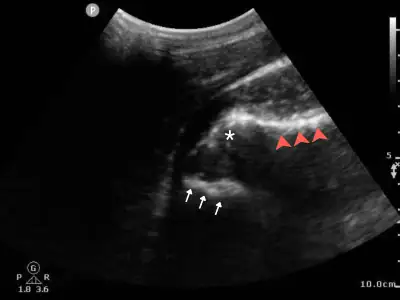
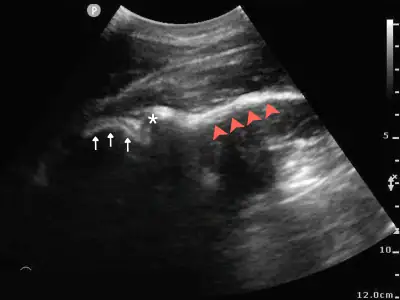
POCUS demonstrates that the humeral head (white arrows) is displaced anterior and inferior to the glenoid fossa (asterisk) (Image 2). Because the posterior approach was used, the anteriorly displaced humeral head appears deep relative to the glenoid and scapular spine (coral arrow heads). No cortical disruption suggestive of fracture is identified. Note that the humeral head sits in the glenoid fossa post-reduction (Image 3).
Discussion
Anterior shoulder dislocations account for approximately 95-98% of shoulder dislocations and are the most common type encountered in urgent care and emergency medicine settings.1 The classic mechanism involves forced abduction and external rotation. However, patients with recurrent instability may experience dislocation during low-force or atraumatic activities, such as dressing or undressing, as seen in this case.
Patients with anterior shoulder dislocations typically hold the affected arm in slight abduction and external rotation. Posterior shoulder dislocations, by contrast, are associated with adduction and internal rotation and are commonly seen after seizures, electrocution, or significant anterior shoulder trauma.
POCUS is a rapid and highly accurate modality for diagnosing shoulder dislocations. The most recent and largest meta-analysis (10 studies, 1,836 assessments, 636 dislocations) found POCUS was 99.1% sensitive and 99.9% specific for shoulder dislocation (likelihood ratio [LR] + 796.2; LR − 0.01), with the posterior technique showing greater sensitivity than the anterior/lateral approach.2
Even novice sonographers achieved 100% sensitivity and specificity across 84 patients after brief ultrasound training in 1 prospective cohort study.3
POCUS also offers a significant time advantage, with one study demonstrating diagnosis a median of 43 minutes faster than standard radiography and image acquisition times averaging only 19 seconds.4
Ultrasound allows for rapid bedside diagnosis, avoids ionizing radiation, and can be particularly valuable in urgent care settings where radiographs may be unavailable or delayed. Additionally, ultrasound may be used to confirm successful reduction immediately after the procedure.
Radiographs should still be obtained in select situations, including first-time dislocations following reduction, high-impact injuries with concern for associated fractures, or cases requiring preoperative planning.5
What to Look For
- Humeral head not centered over the glenoid fossa on the posterior approach.
- Anterior dislocation: humeral head appears inferior/deep to the glenoid.
- Posterior dislocation: humeral head appears superior/superficial to the glenoid.
- Compare with the contralateral shoulder when uncertain.
- Evaluate for cortical disruption suggestive of fracture.
Pearls for Urgent Care Management
- Ultrasound is highly sensitive and specific for diagnosing shoulder dislocations.
- Recurrent anterior shoulder dislocations may occur with minimal trauma.
- Small internal and external shoulder rotations can help identify the humeral head.
- POCUS can rapidly confirm successful reduction after the procedure.
References
- Pulavarti RS, Symes TH, Rangan A. Surgical interventions for anterior shoulder instability in adults. Cochrane Database Syst Rev. 2009;(4):CD005077. doi:10.1002/14651858.CD005077.pub2.
- Gottlieb M, Patel D, Marks A, Peksa GD. Ultrasound for the diagnosis of shoulder dislocation and reduction: a systematic review and meta-analysis. Acad Emerg Med. 2022;29(8):999-1007. doi:10.1111/acem.14454.
- Secko MA, Reardon L, Gottlieb M, et al. Musculoskeletal ultrasonography to diagnose dislocated shoulders: a prospective cohort. Ann Emerg Med. 2020;76(2):119-128. doi:10.1016/j.annemergmed.2020.01.008.
- Lahham S, Becker B, Chiem A, et al. Pilot study to determine accuracy of posterior approach ultrasound for shoulder dislocation by novice sonographers. West J Emerg Med. 2016;17(3):377-382. doi:10.5811/westjem.2016.2.29290.
- Herring SA, Kibler WB, Putukian M, et al. Initial assessment and management of select musculoskeletal injuries: a team physician consensus statement. Med Sci Sports Exerc. 2024;56(3):385-401. doi:10.1249/MSS.0000000000003324.
Read More
- Point of Care Ultrasound (POCUS) in Urgent Care
- Algorithmic Prediction of Utilization and Financial Viability Modeling for Point-of-Care Ultrasound (POCUS) in Adult Urgent Care Patients
- 51-Year-Old With Chest Pain After a Skiing Fall