
Published on
Download the article PDF: When To Consider Idiopathic Normal Pressure Hydrocephalus In The Older Urgent Care Patient
Urgent Message: The features of idiopathic normal pressure hydrocephalus are easily attributed to normal aging, so the diagnosis is frequently missed. Clinicians should know when to suspect the syndrome, how to evaluate for it, and how to refer to a specialist for diagnosis confirmation and management.
Keywords: idiopathic normal pressure hydrocephalus; gait disturbance; urinary incontinence; cognitive impairment; ventriculomegaly; older adults; urgent care
Kenneth V. Iserson, MD, MBA, FACEP, FAAEM
Abstract
Idiopathic normal pressure hydrocephalus (iNPH) is one of the few reversible causes of dementia and gait decline in older adults, yet fewer than 20% of those affected are correctly diagnosed. Its cardinal features—gait disturbance, urinary incontinence, and cognitive slowing—are common, individually nonspecific, and easily attributed to normal aging. Thus, a diagnosis of iNPH is frequently missed. Because older adults so often present to urgent care with falls, unsteadiness, urinary symptoms, and confusion, clinicians are encouraged to recognize the constellation of iNPH symptoms and initiate evaluation. This article describes when to consider iNPH, how to take a focused history, how to perform a brief structured gait examination, when and how to use neuroimaging, and how to construct a referral that moves the patient efficiently toward specialist evaluation, diagnosis, and treatment.
Introduction
Idiopathic normal pressure hydrocephalus (iNPH) is 1 of the few reversible causes of dementia in older adults. First described by Hakim and Adams in 1965,1 it classically presents with a triad of gait disturbance, urinary incontinence, and cognitive decline, accompanied by ventriculomegaly on neuroimaging despite normal cerebrospinal fluid (CSF) opening pressure. Unlike neurodegenerative dementias such as Alzheimer disease, iNPH arises from a mechanical and hydrodynamic process—impaired CSF absorption and altered intracranial compliance.2-3 Left untreated, patients experience progressive disability, dementia, and shortened survival.4-5 CSF diversion by shunting improves outcomes in appropriately selected patients, with benefits most evident in gait and balance and secondary gains in urinary continence, cognition, and functional independence.6-9 Early recognition can facilitate timely specialist evaluation and treatment; earlier shunt surgery has been associated with improved survival.10
The difficulty is not that iNPH is rare but that its features are common. Falls, unsteadiness, urinary incontinence, urinary urgency, and cognitive slowing are individually familiar and readily attributed to aging or to a comorbid condition. When each complaint is explained away on its own, the treatable syndrome that unites them is never considered—a pattern of premature closure that accounts for much diagnostic error.11-13 Older adults increasingly seek care in urgent care settings,14 where presentations with these complaints may be routine. This article describes when to suspect iNPH in the older patient, how to clinically evaluate it, and how to refer to a specialist.
Epidemiology
The Hydrocephalus Association estimates that iNPH affects approximately 700,000 Americans, yet fewer than 20% receive a correct diagnosis and treatment.15 Population-based studies indicate that 2–5% of adults over age 65 harbor undiagnosed iNPH,16 and community magnetic resonance imaging (MRI) studies suggest that the prevalence of the radiologic–clinical phenotype rises steeply with age.17 The gap between how many people have the condition and how few are treated represents 1 of the largest opportunities to address potentially reversible disability in geriatric care.18 The underrecognition is not chiefly a knowledge problem. The individual symptoms are well known, but their significance as a single treatable syndrome may be missed.
History
The clinical hallmark of iNPH is its triad—gait disturbance, urinary incontinence, and cognitive slowing—though the 3 seldom appear together at onset. Gait disturbance is the earliest, most prevalent, and most treatment-responsive feature, frequently preceding urinary and cognitive symptoms by months to years.19-20 Clinicians may consider iNPH in any patient aged 65 years or older who presents with 1 or more of the following complaints: recurrent falls or near-falls; new or progressive gait unsteadiness; recent-onset urinary urgency or incontinence; cognitive complaints, particularly psychomotor slowing rather than prominent memory loss; or unexplained functional decline.21 The most useful red flag is the patient whose chief complaint could be dismissed as aging but who, on directed questioning, reports 1 or more additional triad features (Table 1).
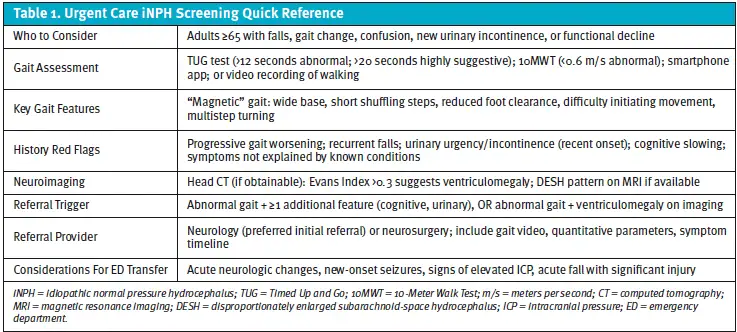
A focused history clarifies the picture: the duration and progression of gait difficulty; the frequency, circumstances, and injuries of any falls; urinary symptoms, distinguishing iNPH-type urgency and incontinence from stress incontinence or prostatic disease; cognitive changes reported by the patient or family, emphasizing slowing over amnesia; and a medication review to exclude drugs that impair gait or cognition.
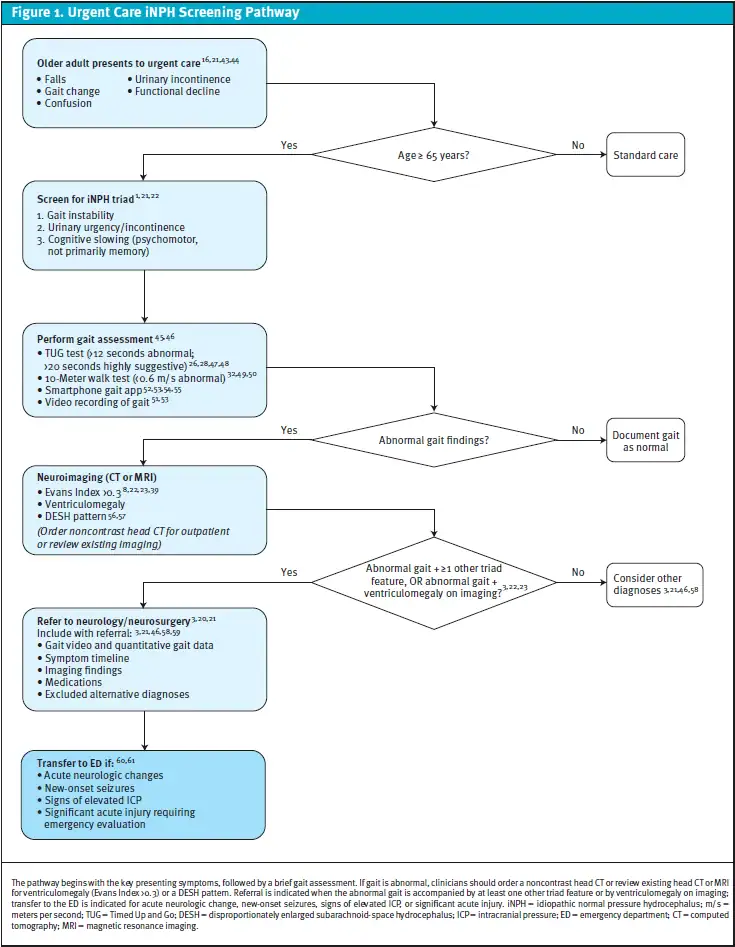
Two thresholds should be kept distinct. The threshold for urgent care screening is low. A concerning gait pattern in an older adult—with or without the other triad features—warrants a structured gait assessment. Referral is indicated when an abnormal gait is accompanied by at least 1 other triad feature or by ventriculomegaly on new or existing imaging. Formal diagnostic classification is a specialist task. Current criteria grade iNPH as possible or probable according to which triad elements are present, whether ventriculomegaly is confirmed, and whether another condition explains the findings,22–24 and gait disturbance alone can satisfy the “possible” category. The urgent care clinician’s job is to recognize the candidate, not to assign the label.
Physical Exam
The examination centers on gait. The characteristic pattern—often called “magnetic”—features short, shuffling steps, a widened base, reduced foot clearance as though the feet were glued to the floor, difficulty initiating movement, and turns completed through multiple small steps rather than a smooth pivot.25 These features can be appreciated within seconds of direct observation. Several brief, low-cost tools can help quantify the impression:
- Timed Up and Go (TUG). The patient rises from a chair, walks 3 meters, turns, returns to the chair, and sits. A time over 12 seconds suggests impairment; patients with iNPH frequently exceed 20 seconds.26-27 Demonstration videos are available from the Centers for Disease Control and Prevention (CDC) STEADI initiative28 and the American Medical Association.29
- Gait speed. Timed over the middle 6 meters of a 10-meter walk at normal pace, velocity below 0.6 meters/second (m/s) indicates clear gait impairment in community-dwelling older adults.30-31 A less stringent threshold near 0.8 m/s is not itself diagnostic of a gait disorder but identifies slower walkers at elevated risk of functional decline and shortened survival.32 So the 2 cutoffs answer different questions: 0.6 m/s flags an abnormal gait worth evaluating; while 0.8 m/s stratifies prognosis.
- Smartphone gait analysis. Validated applications are available to compute gait velocity, stride length, and cadence from the phone’s accelerometer with clinical-grade accuracy.33-36
When quantitative tools are unavailable, observational gait analysis has value, and a brief smartphone video can capture the abnormality more faithfully than any written description while providing documentation a specialist can review.25,33 Structured gait assessment also has value well beyond iNPH, contributing to fall-risk stratification, neurologic evaluation, and disposition decisions across a range of urgent care presentations.37
Evaluation and Diagnosis
One supportive investigation is neuroimaging, indicated once the history and gait examination raise suspicion of iNPH.23 A noncontrast head computed tomography (CT) scan is widely accessible and reliably demonstrates the key finding: ventriculomegaly out of proportion to cortical atrophy. It is quantified by the Evans Index, the ratio of maximal frontal-horn width to maximal internal skull diameter, with values >0.3 indicating significant ventricular enlargement.38 In older adults, that threshold is nonspecific as nearly one-third of healthy elderly exceed it.39 As such, imaging supports rather than confirms the diagnosis, and CT findings must be interpreted alongside the clinical picture. MRI, which better characterizes the disproportionately enlarged subarachnoid-space hydrocephalus (DESH) pattern and excludes mimics, is generally obtained during specialist evaluation rather than at the urgent care visit.
Imaging may be warranted when a patient aged 65 years or older shows an abnormal gait, whether or not other triad features are present. Referral is indicated when an abnormal gait is accompanied by at least 1 other triad feature or when ventriculomegaly is found on imaging. Imaging need not precede referral, but when readily available, ordering a noncontrast head CT through outpatient channels accelerates the downstream assessment. In some cases, relevant imaging may already exist—obtained during a prior fall or headache evaluation. Reviewing those reports for mention of ventriculomegaly, hydrocephalus, or ventricular enlargement out of proportion to atrophy, and correlating such findings with the clinical picture, should prompt patient referral rather than dismissal of the complaint as an age-related change.
Management
The urgent care role in iNPH is to recognize the syndrome, document it, and refer—not to establish the definitive diagnosis or provide treatment. What makes timely referral worthwhile is the strength of the outcomes. Systematic reviews find that approximately 75% of appropriately selected patients improve meaningfully after shunt surgery.19,40 A recent randomized trial supports gait-velocity gains beyond the threshold for functional benefit.41 Delay also carries a survival cost. In a Swedish single-center cohort in which shunt surgery was postponed 6–24 months for administrative reasons, 4-year mortality was 39% among delayed patients vs 10% among those treated within 3 months (adjusted hazard ratio 2.6), an association that persisted after adjustment for confounders.10
An effective referral is specific. It should include:
- Quantified gait data (TUG time, gait speed) or a short video
- Symptom timeline with onset and progression
- Any neuroimaging findings, with the Evans Index if measurable
- Contributing medications
- Alternative diagnoses already considered and excluded
A neurologist is usually the appropriate initial referral, though a neurosurgeon may be preferred in some settings.23 Structured, data-rich referrals are more readily accepted than vague consultation requests,42 and they shorten the path to confirmatory steps performed during specialist workup.4
The message to the patient can be simple and honest: Their walking pattern and associated symptoms may point to a condition—normal pressure hydrocephalus—that is sometimes treatable, and evaluation by a neurologist is the next step. The visit has identified a possibility worth pursuing, not a confirmed diagnosis.
Figure 1 summarizes the full recognition-to-referral pathway, including when to bypass outpatient referral for immediate transfer to the emergency department due to acute neurologic change, new-onset seizures, signs of elevated intracranial pressure, or a significant acute injury.
Takeaway Points
- When an older adult presents to urgent care with falls, unsteadiness, urinary incontinence, or confusion, the reflex to attribute each complaint to aging is precisely what causes clinicians to miss a potential iNPH diagnosis.
- Keeping the syndrome on the differential and spending the few minutes required for a structured gait assessment can be valuable.
- When an abnormal gait is paired with another triad feature or with ventriculomegaly on imaging, urgent care clinicians can redirect a patient toward specialized assessment and treatment that restores independence.
Manuscript submitted March 21, 2026; accepted September 10, 2026.
References
- Hakim S, Adams RD. The special clinical problem of symptomatic hydrocephalus with normal cerebrospinal fluid pressure. J Neurol Sci. 1965;2(4):307-327.
- Bubenikova A, Procházka V, Vacínek D, et al. From the past to the present: evolving theories in the pathophysiology of normal pressure hydrocephalus. J Neurol Neurosurg Psychiatry. Published online July 30, 2025. doi:10.1136/jnnp-2025-336076
- Williams MA, Relkin NR. Diagnosis and management of idiopathic normal-pressure hydrocephalus. Neurol Clin Pract. 2013;3:375-385.
- Marmarou A, Bergsneider M, Klinge P, et al. The value of supplemental prognostic tests for the preoperative assessment of idiopathic normal-pressure hydrocephalus. Neurosurgery. 2005;57(3 suppl):S17-S28.
- Malm J, Graff-Radford NR, Ishikawa M, et al. Influence of comorbidities in idiopathic normal pressure hydrocephalus. Fluids Barriers CNS. 2013;10:22.
- Hebb MO, Cusimano MD. Idiopathic normal pressure hydrocephalus: a systematic review of diagnosis and outcome. Neurosurgery. 2001;49:1166-1186.
- Toma AK, Papadopoulos MC, Stapleton S, Kitchen ND, Watkins LD. Systematic review of the outcome of shunt surgery in idiopathic normal-pressure hydrocephalus. Acta Neurochir (Wien). 2013;155(10):1977-1980.
- McGirt MJ, Woodworth G, Coon AL, et al. Diagnosis, treatment, and analysis of long-term outcomes in idiopathic normal-pressure hydrocephalus. Neurosurgery. 2008;62(suppl 2):670-677.
- Golz A, Faustmann PM, Behnke-Mursch J. Long-term outcomes in normal pressure hydrocephalus. Neurosurg Focus. 2016;41:E4.
- Andrén K, Wikkelsø C, Hellström P, et al. Early shunt surgery improves survival in idiopathic normal pressure hydrocephalus. Eur J Neurol. 2021;28:1153-1159.
- Newman-Toker DE, Schaffer AC, Yu-Moe CW, et al. Serious misdiagnosis-related harms in malpractice claims: the “Big Three.” Diagnosis (Berl). 2019;6(3):227-240.
- Schiff GD, Hasan O, Kim S, et al. Diagnostic error in medicine: analysis of 583 physician-reported errors. Arch Intern Med. 2009;169(20):1881-1887.
- Croskerry P. The importance of cognitive errors in diagnosis and strategies to minimize them. Acad Med. 2003;78(8):775-780.
- Cohen RA, Briones EM. Urgent Care Center and Retail Health Clinic Use: United States, 2024. National Center for Health Statistics; 2026. NCHS Data Brief No. 562.
- Hydrocephalus Association. Normal pressure hydrocephalus (NPH). Accessed October 4, 2025. https://www.hydroassoc.org/normal-pressure-hydrocephalus-nph/
- Jaraj D, Rabiei K, Marlow T, et al. Prevalence of idiopathic normal-pressure hydrocephalus. Neurology. 2014;82:1449-1454.
- Constantinescu C, Wikkelsø C, Westman E, et al. Prevalence of possible idiopathic normal pressure hydrocephalus in Sweden: a population-based MRI study. Neurology. 2024;102:e208037.
- Picone S, Nucera P, Valentini A, et al. Idiopathic normal pressure hydrocephalus: the real social and economic burden of a possibly enormous underdiagnosis problem. Diagnostics (Basel). 2023;13:3562.
- Salih A, Arif A, Varadpande M, et al. The effectiveness of various CSF diversion surgeries in idiopathic normal pressure hydrocephalus: a systematic review and meta-analysis. EClinicalMedicine. 2024;77:102891.
- Halperin JJ, Kurlan R, Schwalb JM, et al. Practice guideline: idiopathic normal pressure hydrocephalus: response to shunting and predictors of response. Neurology. 2015;85(23):2063-2071.
- Williams MA, Malm J. Diagnosis and treatment of idiopathic normal pressure hydrocephalus. Continuum (Minneap Minn). 2016;22(2 Dementia):579-599.
- Relkin N, Marmarou A, Klinge P, et al. Diagnosing idiopathic normal-pressure hydrocephalus. Neurosurgery. 2005;57(3 suppl):S4-S16.
- Nakajima M, Yamada S, Miyajima M, et al. Guidelines for management of idiopathic normal pressure hydrocephalus (third edition): endorsed by the Japanese Society of Normal Pressure Hydrocephalus. Neurol Med Chir (Tokyo). 2021;61(2):63-97.
- Razay G, Wimmer M, Robertson I. Incidence, diagnostic criteria and outcome following ventriculoperitoneal shunting of idiopathic normal pressure hydrocephalus in a memory clinic population. BMJ Open. 2019;9(12):e028103.
- Sudarsky L, Simon S. Gait disorder in late-life hydrocephalus. Arch Neurol. 1987;44:263-267.
- Podsiadlo D, Richardson S. The timed “Up & Go”: a test of basic functional mobility for frail elderly persons. J Am Geriatr Soc. 1991;39:142-148.
- Shumway-Cook A, Brauer S, Woollacott M. Predicting the probability for falls in community-dwelling older adults using the Timed Up & Go Test. Phys Ther. 2000;80:896-903.
- Centers for Disease Control and Prevention. STEADI: older adult fall prevention: STEADI materials for healthcare providers. Accessed September 10, 2026. https://www.cdc.gov/steadi/index.html
- American Medical Association Ed Hub. Administering the Timed Up and Go Test for fall risk assessment. Video. Accessed October 15, 2025. https://edhub.ama-assn.org/jn-learning/video-player/18865552
- Cesari M, Kritchevsky SB, Penninx BW, et al. Prognostic value of usual gait speed in well-functioning older people. J Am Geriatr Soc. 2005;53:1675-1680.
- Bohannon RW. Comfortable and maximum walking speed of adults aged 20-79 years: reference values and determinants. Age Ageing. 1997;26(1):15-19.
- Studenski S, Perera S, Patel K, et al. Gait speed and survival in older adults. JAMA. 2011;305:50-58.
- Brognara L. Gait assessment using smartphone applications in older adults: a scoping review. Geriatrics (Basel). 2024;9(4):95.
- Gait Analyzer. Accessed October 15, 2025. https://www.gaitanalyzer.com
- Silsupadol P, Teja K, Lugade V. Reliability and validity of a smartphone-based assessment of gait parameters across walking speed and smartphone locations. Gait Posture. 2017;58:516-522.
- Schütz N, Büchi B, Strebel V, et al. Validity and reliability of the Apple Health app on iPhone for measuring gait parameters in children, adults, and seniors. Sci Rep. 2023;13:5350.
- Hulleck AA, Menoth Mohan D, Abdallah N, et al. Present and future of gait assessment in clinical practice. Front Med Technol. 2022;4:901331.
- Evans WA Jr. An encephalographic ratio for estimating ventricular enlargement and cerebral atrophy. Arch Neurol Psychiatry. 1942;47(6):931-937.
- Brix MK, Westman E, Simmons A, et al. The Evans’ Index revisited: new cut-off levels for use in radiological assessment of ventricular enlargement in the elderly. Eur J Radiol. 2017;95:28-32.
- Shaw R, Everingham D. A review of clinical outcomes for gait and other variables in the surgical treatment of idiopathic normal pressure hydrocephalus. Mov Disord Clin Pract. 2016;3:331-341.
- Luciano MG, Williams MA, Hamilton MG, et al. A randomized trial of shunting for idiopathic normal-pressure hydrocephalus. N Engl J Med. 2025;393:1015-1026.
- Fernández-Méndez R, Meek T, Dias-Dougan B, et al. Knowledge of idiopathic normal pressure hydrocephalus among healthcare professionals. Sci Rep. 2025;15(1):29947.
- Andersson J, Rosell M, Kockum K, Lilja-Lund O, Söderström L, Laurell K. Prevalence of idiopathic normal pressure hydrocephalus: a prospective, population-based study. PLoS One. 2019;14(5):e0217705. doi:10.1371/journal.pone.0217705
- Zaccaria V, Bacigalupo I, Gervasi G, et al. A systematic review on the epidemiology of normal pressure hydrocephalus. Acta Neurol Scand. 2020;141(2):101-114. doi:10.1111/ane.13182
- Iddon JL, Pickard JD, Cross JJ, Griffiths PD, Czosnyka M, Sahakian BJ. Specific patterns of cognitive impairment in patients with idiopathic normal pressure hydrocephalus and Alzheimer’s disease: a pilot study. J Neurol Neurosurg Psychiatry. 1999;67(6):723-732. doi:10.1136/jnnp.67.6.723
- Picascia M, Zangaglia R, Bernini S, Minafra B, Sinforiani E, Pacchetti C. A review of cognitive impairment and differential diagnosis in idiopathic normal pressure hydrocephalus. Funct Neurol. 2015;30(4):217-228. doi:10.11138/FNeur/2015.30.4.217
- Bischoff HA, Stähelin HB, Monsch AU, et al. Identifying a cut-off point for normal mobility: a comparison of the timed ‘up and go’ test in community-dwelling and institutionalised elderly women. Age Ageing. 2003;32(3):315-320. doi:10.1093/ageing/32.3.315
- Sundström N, Rydja J, Virhammar J, Kollén L, Lundin F, Tullberg M. The timed up and go test in idiopathic normal pressure hydrocephalus: a nationwide study of 1300 patients. Fluids Barriers CNS. 2022;19(1):4. doi:10.1186/s12987-021-00298-5
- Fritz S, Lusardi M. White paper: walking speed: the sixth vital sign. J Geriatr Phys Ther. 2009;32(2):46-49. doi:10.1519/00139143-200932020-00002
- Middleton A, Fritz SL, Lusardi M. Walking speed: the functional vital sign. J Aging Phys Act. 2015;23(2):314-322. doi:10.1123/japa.2013-0236
- Stolze H, Kuhtz-Buschbeck JP, Drücke H, Jöhnk K, Illert M, Deuschl G. Comparative analysis of the gait disorder of normal pressure hydrocephalus and Parkinson’s disease. J Neurol Neurosurg Psychiatry. 2001;70(3):289-297. doi:10.1136/jnnp.70.3.289
- Yamada S, Aoyagi Y, Ishikawa M, Yamaguchi M, Yamamoto K, Nozaki K. Gait assessment using three-dimensional acceleration of the trunk in idiopathic normal pressure hydrocephalus. Front Aging Neurosci. 2021;13:653964. doi:10.3389/fnagi.2021.653964
- Yamada S, Aoyagi Y, Iseki C, et al. Quantitative gait feature assessment on two-dimensional body axis projection planes converted from three-dimensional coordinates estimated with a deep learning smartphone app. Sensors (Basel). 2023;23(2):617. doi:10.3390/s23020617
- Taishaku A, Yamada S, Iseki C, et al. Development of a gait analysis application for assessing upper and lower limb movements to detect pathological gait. Sensors (Basel). 2024;24(19):6329. doi:10.3390/s24196329
- Kamalian A, Zheng A, Moghekar A. Smartphone monitoring of multidomain gait parameters to facilitate remote monitoring of gait in idiopathic normal pressure hydrocephalus. Neurology. 2024;102(suppl):6322. doi:10.1212/WNL.0000000000206395
- Hashimoto M, Ishikawa M, Mori E, Kuwana N; Study of INPH on Neurological Improvement (SINPHONI). Diagnosis of idiopathic normal pressure hydrocephalus is supported by MRI-based scheme: a prospective cohort study. Cerebrospinal Fluid Res. 2010;7:18. doi:10.1186/1743-8454-7-18
- Kockum K, Lilja-Lund O, Larsson EM, et al. The idiopathic normal-pressure hydrocephalus Radscale: a radiological scale for structured evaluation. Eur J Neurol. 2018;25(3):569-576. doi:10.1111/ene.13555
- Espay AJ, Da Prat GA, Dwivedi AK, et al. Deconstructing normal pressure hydrocephalus: ventriculomegaly as early sign of neurodegeneration. Ann Neurol. 2017;82(4):503-513. doi:10.1002/ana.25046
- 2023 American Geriatrics Society Beers Criteria Update Expert Panel. American Geriatrics Society 2023 updated AGS Beers Criteria for potentially inappropriate medication use in older adults. J Am Geriatr Soc. 2023;71(7):2052-2081. doi:10.1111/jgs.18372
- Kahle KT, Kulkarni AV, Limbrick DD Jr, Warf BC. Hydrocephalus in children and adults. Lancet. 2016;387(10020):788-799. doi:10.1016/S0140-6736(15)60694-8
- American College of Emergency Physicians Clinical Policies Subcommittee (Writing Committee) on Mild Traumatic Brain Injury; Valente JH, Anderson JD, Paolo WF, et al. Clinical policy: critical issues in the management of adult patients presenting to the emergency department with mild traumatic brain injury. Ann Emerg Med. 2023;81(5):e63-e105. doi:10.1016/j.annemergmed.2023.01.014
Author Affiliations: Kenneth V. Iserson, MD, MBA, FACEP, FAAEM, Department of Emergency Medicine, The University of Arizona, Tucson. Disclosure: Kenneth V. Iserson has disclosed stock ownership in Medtronic and other healthcare-related companies. In accordance with Accreditation Council for Continuing Medical Education requirements, all relevant financial relationships were reviewed and mitigated by Master Clinicians through an independent content review. No relevant conflicts of interest or commercial bias were identified in the development of this article.