
Published on
Urgent Message: While most headache presentations are not life-threatening, urgent care providers must remain vigilant in identifying patients with potentially serious conditions who require transfer to a higher level of care.
Elizabeth Minchau, DNP, APRN-BC; Saira George, MD; Stephanie Rellick, PhD; Carmen N. Burrell, DO
Keywords: headache; glioblastoma; aphasia; hypertension; personality changes; brain mass
Abstract
Introduction: Patients often present to urgent care (UC) clinics for headaches. While most headaches are non-life-threatening, the urgent care provider must remain vigilant in identifying patients with potentially serious conditions who require expedited evaluation at a higher level of care.
Case Presentation: A 53-year-old man with a history of cervical strain for 4 months from a motor vehicle accident presented to the urgent care with worsening headaches that were increasing in both frequency and severity. The patient also complained of speech difficulties.
Physical Exam: Exam findings included a blood pressure of 150/100 mm Hg, right eye ptosis, and right pupillary dilation. The patient demonstrated difficulty with speech and displayed signs of emotional lability during the encounter.
Diagnosis: The urgent care provider referred the patient to the emergency department where imaging and subsequent biopsy revealed a multifocal glioblastoma in the left hemisphere.
Case Resolution: Neurosurgery performed a subtotal resection, and following surgery, the patient transferred care to an out-of-state facility. His oncology team there performed a second resection, but unfortunately, he succumbed to his disease approximately 5 months following the initial UC presentation.
Conclusion: UC providers play a critical role in helping to identify patients presenting with vague symptoms. It remains important to gather a thorough patient-specific history, perform a comprehensive exam, and consider a broad differential diagnosis, especially in patients who complain of headache.
Introduction
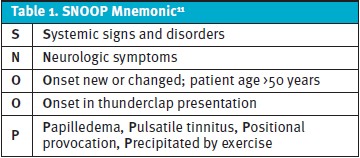
The presentation of patients to an acute care setting with “headache” is quite common, with the majority of cases being benign (~96%).1 There are 3 classifications of headaches, which must be differentiated at presentation: primary, including migraines or cluster headaches; secondary, where there is a known or suspected underlying causative factor; and lastly, neuropathies, facial pains, and other headaches.2 It is the role of the urgent care (UC) provider to identify which patients may be at risk for a more serious, underlying condition and to decide what further actions are necessary. The SNOOP mnemonic (Table 1) can be used to identify warning signs and symptoms as well as “red flags” during the patient evaluation.3
Case Presentation
A 53-year-old man presented alone to the UC clinic with complaint of a worsening headache. In a rear-end motor-vehicle incident 4 months earlier, he sustained a cervical strain. A computed tomography (CT) scan of the brain at the time of his car accident was normal. On the day of the UC visit, he reported feeling that his neck was still “out of place,” and he believed that it may be contributing to his headache.
The patient described the location of his headaches as localized to the frontal and left temporal regions and described his pain as “intermittent” and like a “dull toothache.” His headaches had recently increased in frequency and were now occurring daily. The patient also reported 3 weeks of difficulty with speaking, specifically, “getting out what I want to say.” He reported that his friends and family had also noted that he seemed confused and was having difficulty with his speech. They had even become concerned that he may be using drugs or alcohol, which he denied. The patient also reported that he had felt more “emotional” lately and that he was having trouble controlling new-onset tearful outbursts. Due to the headaches, his primary care provider (PCP) had him start checking his blood pressure at home, and he reported that it had been “higher than normal.”
On the day of the visit, he denied numbness, syncope, weakness, blurred vision, chest pain, shortness of breath, and facial drooping.
Physical Exam Findings
At the UC visit, vital signs were normal except for a blood pressure of 150/100 mm Hg and a body mass index of 34. The patient was well appearing and personable. There was a subtle right eyelid droop and a slightly dilated right pupil, which had a normal reaction to light. The remainder of the cranial nerve exam was normal. A neurological exam found the patient alert and oriented to person, place, and time. He showed no mobility deficits or evidence of unilateral weakness. He demonstrated difficulty recalling words and appeared to be stuttering at times. He had difficulty finishing sentences and seemed frustrated with his inability to speak clearly and coherently. He had several crying spells over the course of the physical exam.
Medical Decision Making
The provider recognized several red flags including age greater than 50, labile emotions, right eyelid and pupillary abnormalities, personality changes, dysphasia, and a worsening headache pattern. The provider recommended immediate transfer to the emergency department (ED) for evaluation.
Differential Diagnosis
The differential diagnoses at the time of transfer included hypertensive emergency, cerebrovascular accident, normal pressure hydrocephalus, brain mass, affective disorder, and substance use disorder.
Final Diagnosis
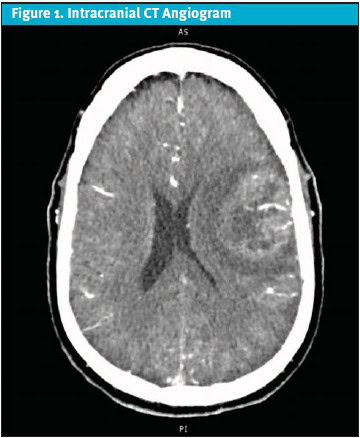
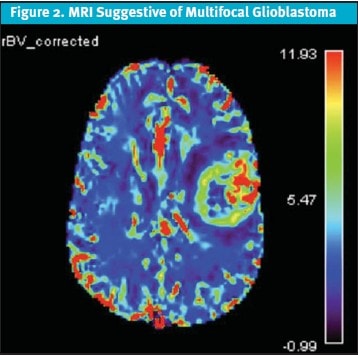
A CT angiogram with and without contrast showed a 4.5 cm ill-defined left frontal lobe mass with mass effect and vasogenic edema (Figure 1). Magnetic resonance imaging (MRI) was suggestive of multifocal glioblastoma in the left hemisphere with compression of the right ventricle (Figure 2). Dexamethasone, famotidine, and levetiracetam were started. A biopsy result showed a “high-grade astrocytoma, favor glioblastoma.” Neurosurgery performed a subtotal resection 10 days after initial presentation and temozolomide and ondansetron were started. The patient had pending appointments with local neuro-oncology and neuro-radiation clinics but opted to transfer his care to an out-of-state facility where a second resection was performed 8 weeks later. We were notified of his death almost 5 months after initial UC presentation.
Discussion
Glioblastoma multiforme is an aggressive form of a central nervous system glioma with a median survival rate of 14 to 15 months from diagnosis. Glioblastoma multiforme accounts for 60% of all brain tumors in adults.4,5 Interestingly, this patient had undergone a head CT scan due to a motor vehicle crash 4 months prior to his headache presentation at the UC clinic. That CT scan was normal.
Some of the earliest symptoms reported at diagnosis of glioblastoma include cognitive deficits, dizziness, altered motor function, and headaches.6,7 While rare, tumor-related headaches can mimic more common headaches, including tension headaches, migraine, and others.8 The lifetime risk of developing a malignant tumor in the brain or spinal cord is less than 1%.9 However, providers must consider tumor and other secondary causes in situations where symptoms are atypical. Some research studies have reported that preceding any visible or pronounced symptoms, subtle changes are noticed by loved ones or the patient themselves.7 Patients may describe themselves as “feeling off,”7 or as in this case, “having difficulty getting out what I want to say.” The patient reported that his loved ones also noticed these changes and had shared their concerns related to the patient seeming “confused” when speaking several weeks before his first medical encounter. This highlights the need for providers to remind patients of the importance of seeking care when uncharacteristic changes in behavior or ability to function are noticed, as well as for providers themselves to be aware of these early warning signs of a more serious underlying condition.7
Patients often present to the UC clinic for a complaint of headache. Clinic evaluation and treatment resources vary, but all UCs should be able to consider concerning secondary causes of headache.10 In addition, UC clinics, when integrated within larger health systems, can rapidly communicate with a patient’s PCP and ED providers to efficiently refer the patient for further evaluation or emergent follow-up care.
Although a chief complaint of headache is common across spheres of care, the incidence of the “worst-case scenario,” remains rare.9 Prompt evaluation of headache is vital in identifying all potential critical causes and initiating timely treatment. Providers must remain diligent in gathering patient-specific history and performing a comprehensive examination during encounters for complaints of headache.
Ethics Statement
We contacted next of kin and obtained verbal permission for publication of this case, allowing for the completion of a system-required, Authorization for Medical Case Study and Publication for the Use of Deidentified Medical Informationform, placed in the patient’s electronic health record by the provider.
Takeaways for Urgent Care Providers
- Perform a thorough history and physical examination to evaluate for headache “red flags.”
- Headaches associated with neurological symptoms should prompt further investigation.
- Prompt evaluation of headache is vital in identifying concerning secondary causes and initiating timely treatment.
- Although rare, glioblastoma and other central nervous system malignancies must remain on the differential diagnoses of UC providers as they evaluate patients with headache.
Manuscript submitted August 13, 2025; accepted March 11, 2026.
References
- Raam R, Tabatabai RR. Headache In The Emergency Department: Avoiding Misdiagnosis Of Dangerous Secondary Causes, An Update. Emerg Med Clin North Am. 2021;39(1):67-85. doi:10.1016/j.emc.2020.09.004
- Headache Classification Committee of the International Headache Society. The International Classification Of Headache Disorders, 3rd Edition. Accessed June 10, 2025. https://ichd-3.org/
- Hansen P. More Than A Simple Headache: Using The SNNOOP10 Criteria To Screen For Life-Threatening Headache Presentations. J Urgent Care Med. 2023;17(8):18-21.
- Koshy M, Villano JL, Dolecek TA, et al. Improved Survival Time Trends For Glioblastoma Using The SEER 17 Population-Based Registries. J Neurooncol. 2012;107(1):207-212. doi:10.1007/s11060-011-0738-7
- Hanif F, Muzaffar K, Perveen K, Malhi SM, Simjee SU. Glioblastoma Multiforme: A Review Of Its Epidemiology And Pathogenesis Through Clinical Presentation And Treatment. Asian Pac J Cancer Prev. 2017;18(1):3-9. doi:10.22034/apjcp.2017.18.1.3
- IJzerman-Korevaar M, Snijders TJ, de Graeff A, Teunissen SCCM, de Vos FYF. Prevalence of symptoms in glioma patients throughout the disease trajectory: a systematic review. J Neurooncol. 2018;140(3):485-496. doi:10.1007/s11060-018-03015-9
- Walter FM, Penfold C, Joannides A, et al. Missed Opportunities For Diagnosing Brain Tumours In Primary Care: A Qualitative Study Of Patient Experiences. Br J Gen Pract. 2019;69(681):e224-e235. doi:10.3399/bjgp19X701861
- Dancy J. Evaluation Of Headaches In Urgent Care Part 1: Emergent Headaches. J Urgent Care Med. 2014;8(8):9-17.
- American Cancer Society. Key Statistics For Brain And Spinal Cord Tumors. Accessed November 9, 2025. https://www.cancer.org/cancer/types/brain-spinal-cord-tumors-adults/about/key-statistics.html
- Minen MT, Khanns D, Guiracocha J, et al. The Role Of Urgent Care Centers In Headache Management: A Quality Improvement Project. BMC Health Serv Res. 2022;22(1):162. doi:10.1186/s12913-021-07457-2
- Do TP, Remmers A, Schytz HW, et al. Red And Orange Flags For Secondary Headaches In Clinical Practice: SNNOOP10 List. Neurology. 2019;92(3):134-144. doi:10.1212/WNL.0000000000006697
Author Affiliations: Elizabeth Minchau, DNP, APRN-BC, West Virginia University School of Nursing; Department of Emergency Medicine, West Virginia University. Saira George, MD, Department of Emergency Medicine, West Virginia University. Stephanie Rellick, PhD, Department of Emergency Medicine, West Virginia University. Carmen N. Burrell, DO, Department of Emergency Medicine, West Virginia University. Authors have no relevant financial relationships with any ineligible companies.

Elizabeth Minchau, DNP, APRN-BC

Carmen N. Burrell, DO
