
Published on
Download the article PDF: The Effect Of Computer Use In The Exam Room On Patient Satisfaction In Urgent Care
Urgent Message: The use of a computer in the urgent care examination room does not significantly impact patient satisfaction. As such, clinicians can use medical technologies in the exam room while maintaining confidence in the clinician-patient relationship.
Justin Bowles, MD; Mitchell Lopes, MS4; Chaya Pflugeisen, MSc, MEd
Keywords: electronic health records; physician-patient relations; patient satisfaction; ambulatory care facilities; communication; surveys and questionnaires
Abstract
Objectives: Primary care literature has shown that the use of technology in the examination room does not impact patient satisfaction. The purpose of this study was to evaluate the effects of medical provider exam-room computer use on patient satisfaction and patient perceptions of provider interpersonal skills in an urgent care setting.
Methods: In a single urgent care setting in suburban Puget Sound (Washington), care days were randomized to in-room computer use or non-use, with all providers staffing a given day adhering to randomization status. Following the visit, patients were surveyed to assess the provider’s ability to make eye contact, listen, talk, understand their concerns, empathize, foster a healing relationship, collect information, and provide information, as well as overall satisfaction with their provider and their urgent care experience. Mann-Whitney U tests were performed to evaluate the relationships between each measure and computer use/non-use.
Results: Across intervention days, 302 patients per group (use/non-use; n=604) responded to the survey, representing roughly 50% of patients seen in the clinic on the study days. All relationships were nonsignificant (each p≥0.33), suggesting the provider’s computer use leads to no difference in patient satisfaction with provider interpersonal behaviors or overall satisfaction with the provider/encounter. Spearman correlations showed especially strong (r>0.9) relationships between several interpersonal behavior measures, but only moderate (0.4 ≤ r ≤ 0.69) relationships between measures of overall satisfaction and interpersonal behavior measures.
Conclusion: This study is consistent with previous findings in other medical settings that technology use by medical providers does not significantly impact patient satisfaction. As such, urgent care clinicians can use medical technologies in the exam room without impacting patient satisfaction.
Introduction
The use of an electronic health record (EHR) during the clinical encounter is a standard part of modern medical practice,[1] and using a computer during the information gathering segments of the visit is widely considered to be both “appropriate and expected by patients.”[2] EHRs are designed to optimize the quality and efficiency of healthcare delivery.1They facilitate collection and analysis of patient information, diagnosis, decision making, development of treatment plans, and sharing of medical information in ways not previously possible.[3],[4] However, using the EHR in a way that preserves a satisfying clinical experience for both the patients and the healthcare provider can be challenging.1
Physicians report spending 42% of their consultation time in contact with the computer.[5] This has led some to view the EHR as a “third agent” in the exam room,[6] shifting the traditional doctor-patient dyad into a triadic relationship.[7] With the many popups, alerts, messages, warnings, flags, and alarms, the price a provider pays for the EHR is distraction.1 Multitasking clinicians may miss opportunities for authentic engagement with their patients due to demands from the EHR.2 Many medical providers are concerned about the impact of the EHR on their ability to look at, listen to, and understand the patient’s concerns.5 Conversely, providers who do not occasionally enter information into the computer during the encounter risk patients questioning if their concerns are being taken seriously.2 Additionally, they carry the extra cognitive load of recalling correct details later.
Despite physicians’ concerns regarding the impact of computer use on patient-physician communication, patients’ perceptions of the same interaction are mostly positive.5 Patients’ attitudes toward the EHR occasionally have generational, cultural, and socioeconomic differences,[8] however, meta-analyses of patient perceptions of EHR use show almost exclusively positive or neutral effects on both patient satisfaction and patient–physician communication.1,7,[9],[10] Patients’ estimates are lower than those of their physicians regarding the amount of time the computer is used for completing the chart review, recording patient data, prescribing treatments, placing referrals, internet research, and internal communication.5
A meta-analysis of 53 studies on the impact of EHR use on the patient–physician relationship and communication concluded that since patient perceptions are not affected by their providers computer use, medical providers should embrace these technologies in a patient centered way.10 An intervention as small as a 1-hour lecture on patient centered EHR use with a structured debrief made a significant difference on medical students’ performance on a clinical skills examination.[11]
Urgent care is a unique and expanding medical specialty.4 According to the Urgent Care Association’s 2022 Benchmarking Report, the percentage of urgent care centers that operate in retail spaces nearly doubled from 2019 to 2022.[12] In recent years, many acute care clinics have adopted a “retail health” model, with a heavy focus on the consumer experience, adhering to the philosophy that the key to success in urgent care is providing patient experiences that yield “positive reviews and word-of-mouth referrals.”[13]
A majority of studies regarding the impact of EHR on patient satisfaction were conducted in adult, outpatient, primary care settings.2,3 It has been proposed that patient’s acceptance of their provider’s EHR use may be due to a previously established, strong patient–physician relationship,10 confounding the interpretation of the impact of technology use. Thus, the next step to understanding the impact of computer use in the exam room should be investigation at low-continuity and medical-specialty settings.10 As urgent care is often viewed by patients as more transactional than traditional medical settings, primary care literature exploring the impact of computer use in the exam room on patient satisfaction may not be generalizable to this clinical setting. The aim of this study was to evaluate the effect of computer use in the exam room on patient perceptions of the medical provider’s ability to communicate, empathize, foster a healing relationship, and balance their attention in an urgent care setting.
Methods
Setting and Participants
This study was conducted in a single, free-standing urgent care clinic situated in a suburban retail space in the South Puget Sound region of Washington State. Each provider averages 3-4 patient encounters an hour. A total of 13 providers (3 physicians, 6 nurse practitioners, 4 physician assistants) participated in the study. Study days were selected according to the principal investigator’s (PI) clinic schedule to ensure appropriate and consistent study oversight and management. These days were randomly assigned as “computer use” or “no computer use” using a balanced design. All providers working that day were assigned to the same group, and all patients seen on these days were invited to participate in the study by completing a brief survey at the time of discharge. The medical providers were not blinded to the objectives of the study or the survey instrument. Parents completed surveys with or on behalf of minors.
Instrument
A 10-item survey inventory was adapted from relevant previous studies.2,5 The impact of computer use was evaluated using a 6-point Likert-type scale question without a neutral response option (Very Satisfied to Very Unsatisfied) and assessed the patient’s perception of the provider’s ability to make eye contact, listen, talk, understand their concerns, empathize, foster a healing relationship, collect information, and provide information. Patients were also asked to rate their general satisfaction with their medical provider and their overall experience before self-reporting basic demographic information including age, gender, and race. Built and distributed using a REDCap survey,[14] the questionnaire did not collect any patient identifying information, was not tied to a specific encounter or provider, and responses were not accessible to the providers. The study was reviewed by our organization’s Institutional Review Board and approved as exempt (IRB number 2024/08/01).
Data Collection
An a priori power calculation identified a sample of 600 participants (300 per group) to have a 99% power to detect a small-medium effect size using Cohen’s d (d=0.3).[15] During the morning huddle on intervention days, the principal investigator (JB) shared the day’s randomization status with the providers staffing the clinic that day and reminded them of the study protocols. He ensured that QR codes were accessible in the clinic rooms to facilitate survey completion following the encounter. At the time of discharge, patients were invited to scan the QR code to access the survey on their personal phone to be completed at that time or later. Survey result data were accessible only to the research team.
Data Analysis
We used descriptive statistics to explore patient demographic distributions and assessed these for significant differences between the computer-use and no-use groups using Fisher’s Exact, t-tests, and z-tests, as appropriate. Frequency distributions by intervention group were generated for each of the 10 core measures (8 interpersonal skills, satisfaction with provider, and overall satisfaction). We used the nonparametric Mann-Whitney U test to assess each of those distributions for significant differences by group with a significance threshold of ⍺<0.01 to account for multiple testing.
We also examined Spearman correlations between measures to better understand the relationship between the 8 assessed interpersonal-skills and between those skills and satisfaction with the provider and the encounter. We then used Fisher’s r-to-z transformation to calculate z test statistics and compare these correlations between groups. Any absolute z>2.576 was considered significant at the 0.01 level. Randomization and all data analysis was performed in the R statistical computing environment.14
Results
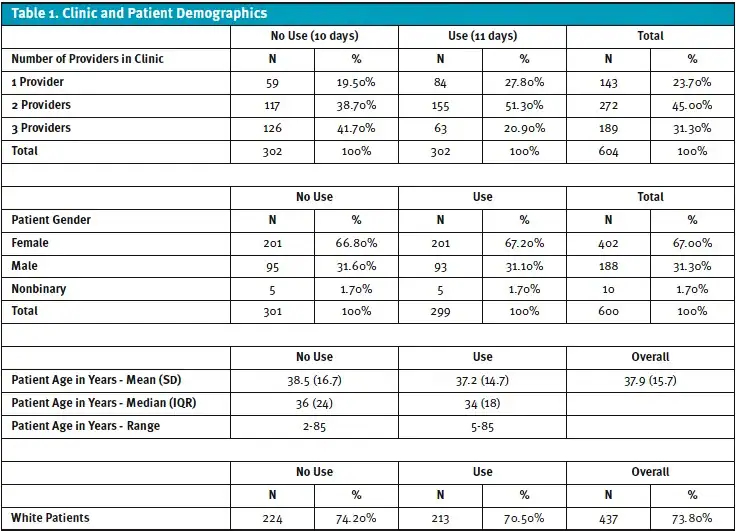
The study captured 10 days without provider computer use in the exam room (“no use”) and 11 days with computer use (“use”). Across these intervention days, 302 patients completed surveys from each group, representing 53.8% and 52.3% of patients seen on those days, respectively. Participants were 67.0% female and 1.7% nonbinary with no difference in gender distribution between groups (Fisher’s Exact test, p=0.85). Ages ranged from 2–85 years old at the time of the encounter, with a mean age of 37.9 ±15.7 years and no significant difference in age distribution between groups (Student’s t-test, p=0.31). Self-reported race/ethnicity also did not differ significantly between groups, with 73.8% of the respondents self-reporting as Non-Hispanic White (z-test, p=0.36) (Table 1).
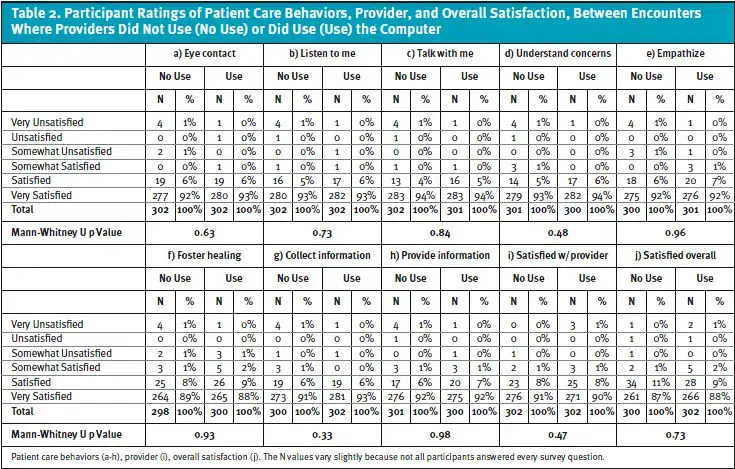
Respondents generally reported very high satisfaction across the 10 measures, with 97-100% of respondents indicating that they were satisfied or very satisfied with any given measure across intervention groups. All Mann-Whitney U p-values were ≥0.33, suggesting no difference in satisfaction with provider interpersonal behaviors, overall satisfaction with the provider, or overall satisfaction with the encounter among patients whose providers used the computer during the encounter and those whose providers did not (Table 2).
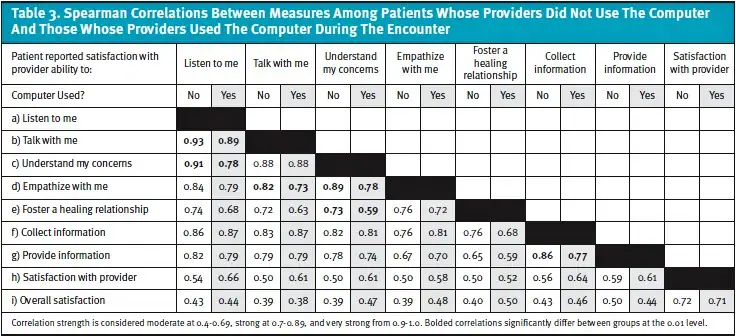
Each interpersonal measure was strongly (0.7 ≤ r ≤ 0.89) to very strongly (0.9 ≤ r ≤ 1.0) correlated with the others (Table 3). Correlations between the interpersonal behaviors and overall satisfaction with the provider or the encounter were moderate (0.4 ≤ r ≤ 0.69). Several significant differences in correlations between computer use and no computer use did exist (Table 3, bold). Although no statistical difference in satisfaction was identified (Table 2), we saw stronger correlations in the no-use group in the relationships between providers listening and talking with the patient, listening and understanding, empathizing and talking with the patient, understanding and fostering a healing relationship, and the provider’s ability to both collect and provide information to the patient.
Discussion
This study is consistent with the current body of literature1,6,7,9,10 in finding that there is no significant difference in overall experience or any of the 8 interpersonal behaviors when providers use or don’t use the computer in the exam room. Since providers’ technology use is not associated with patient satisfaction, urgent care providers can feel confident in using the clinical interaction style that they find most efficient.
This topic has been well studied, including several meta-analyses7,9,10 in the outpatient primary care setting. However, a previously established patient–physician relationship may function as a confounder.10 This study expands the body of work to the retail health urgent care setting, where pre-existing patient-provider relationships frequently do not exist, thus removing it as a possible confounder.
A recent study, involving nearly 33 million patient encounters from a nationwide urgent care network in 2024, found that “more than half of net promoter score (NPS) is likely determined by non-quantifiable” factors that are described as “intangibles.”13 This study makes an additional contribution to the literature by exploring the relationship between key interpersonal skills used by our providers. A very strong correlation was found between the patient’s perception of the provider’s abilities to listen and talk with them, as well as listen and understand their concerns. These correlations were significantly higher when the provider was not using a computer in the room. Similarly, computer non-use showed significantly higher correlations between providers listening and talking with the patient, listening and understanding the patient, empathizing and talking with the patient, understanding and fostering a healing relationship, and the provider’s ability to both collect and provide information to the patient. This finding suggests that even though patient satisfaction was not statistically different between the computer-use and no-use groups, it’s possible that there are less tangible, yet meaningful, differences in urgent care clinical interactions when the computer is used in the examination room.
Studies have shown that providers who deliberately apply skills like screen sharing,1 looking more frequently at their patients,6 maintaining eye contact,6 limiting EHR use during difficult and emotional topics,1 and employing other nonverbal cues when patients are describing their complaints6 can increase the amount of sensitive information shared with them. These providers are also perceived by patients as more trustworthy and genuine.1 It is reassuring for all providers to remember these skills can improve the patient interaction,6 and that these skills can be learned.11
This study has several notable limitations. First, the patients surveyed received their care at a single urgent care clinic, limiting generalizability to other urgent care centers or regions. Much of the previous literature included only experienced primary care physicians, which limits comparability. Ideally, each of the 13 providers included in the study would have completed an equal number of encounters with and without using the computer in the room, however, this was not feasible in this real-world setting. Furthermore, the medical providers were not blinded to the intervention or assessment tool. It is possible that they behaved differently during different study protocol days.
Conclusion
In a healthcare market where urgent care clinics are required to ensure a positive consumer experience, medical providers must accept that much of the patient’s satisfaction will be derived from the patient-physician interaction13 and use of the EHR. This study is consistent with previous findings that technology use by medical providers does not affect patient satisfaction and expands this finding to the urgent care setting. Therefore, urgent care clinicians can use medical technologies in the exam room without impacting patient satisfaction.
Manuscript submitted July 14, 2025; accepted March 23, 2026.
References
- [1]. Wolfe L, Chisolm MS, Bohsali F. Clinically excellent use of the electronic health record: review. JMIR Hum Factors. 2018;5(4):e10426. doi:10.2196/10426
- [2]. Ratanawongsa N, Barton JL, Lyles CR, Wu M, Yelin EH, Martinez D, Schillinger D. Association between clinician computer use and communication with patients in safety-net clinics. JAMA Intern Med. 2016;176(1):125-128. doi:10.1001/jamainternmed.2015.6186
- [3]. Makoul G, Curry R, Tang P. The use of electronic medical records. J Am Med Inform Assoc. 2001;8:610-615.
- [4]. Urgent Care Association. 2021 UCA Urgent Care data summary. https://urgentcareassociation.org/about/urgent-care-data/. Accessed June 2025.
- [5]. Sobral D, Rosenbaum M, Figueiredo-Braga M. Computer use in primary care and patient physician communication. Patient Educ Couns. Published online July 8, 2015. doi:10.1016/j.pec.2015.07.002
- [6]. Rathert C, Mittler JN, Banerjee S, McDaniel J. Patient-centered communication in the era of electronic health records: what does the evidence say? Patient Educ Couns. 2017;100(1):50-64. doi:10.1016/j.pec.2016.07.031
- [7]. Pearce CM, Kumarapeli P, de Lusignan S. Effects of exam room EHR use on doctor-patient communication: a systematic literature review—triadic and other key terms may have identified additional literature. Inform Prim Care. 2013;21(1):40-42. doi:10.14236/jhi.v21i1.39
- [8]. Shachak A, Reis S, Pearce C. Patient-physician interactions and electronic health records. JAMA. 2013;310(17):1857-1858. doi:10.1001/jama.2013.277969
- [9]. Rozenblum R, Donzé J, Hockey PM, Guzdar E, Labuzetta MA, Zimlichman E, Bates DW. The impact of medical informatics on patient satisfaction: a USA-based literature review. Int J Med Inform. 2013;82(3):141-158. doi:10.1016/j.ijmedinf.2012.12.008
- [10]. Alkureishi MA, Lee WW, Lyons M, Press VG, Imam S, Nkansah-Amankra A, Werner D, Arora VM. Impact of electronic medical record use on the patient-doctor relationship and communication: a systematic review. J Gen Intern Med. 2016;31(5):548-560. doi:10.1007/s11606-015-3582-1
- [11]. Lee WW, Alkureishi ML, Wroblewski KE, Farnan JM, Arora VM. Incorporating the human touch: piloting a curriculum for patient-centered electronic health record use. Med Educ Online. 2017;22(1):1396171. doi:10.1080/10872981.2017.1396171
- [12]. Urgent Care Association. 2022 UCA benchmarking report. https://urgentcareassociation.org/resources/2022-uca-operations-benchmarking-report/. Accessed June 2025.
- [13]. Ayers AA. Shorter visits drive greater patient satisfaction in urgent care. J Urgent Care Med. 2025;19(6):37-43.
- [14]. R Core Team. R: a language and environment for statistical computing. R Foundation for Statistical Computing; 2023. https://www.R-project.org. Accessed June 2025.
- [15]. Cohen J. Statistical power analysis for the behavioral sciences. 2nd ed. Routledge; 1988. doi:10.4324/9780203771587