
Published on
Download the article PDF: Leveraging Physician Patient Relationships To Increase Patient Portal Access During An Urgent Care Visit
Urgent Message: Urgent care physicians can leverage the physician-patient relationship established during a visit to improve patient portal enrollment and use in a healthcare system.
Sandy Wang, MD, MPH; Carolyn Stern, MD; Kevin Fiscella, MD, MPH; Amaya Sanders, BS; Erik Herbert, BS; Rosie Booker, BS; Tyra Barton, LPN; Mechelle Sanders, PhD
Key Words: Electronic Health Records, Patient Portals, Urgent Care, Quality Improvement
Abstract
Background: Patient portals for accessing electronic health records are useful for easy communication and for keeping patients informed and engaged in their medical care. However, in a large healthcare system, busy primary care and emergency department visits usually don’t offer opportunity to address patient portal enrollment. As urgent care centers (UCCs) tend to focus on a single, acute complaint, they may be well-suited to engage patients and enroll them in their healthcare system’s patient portal.
Methods: We conducted a 2-month performance improvement (PI) project designed to promote enrollment in a patient portal. The project involved 10 family medicine physicians who worked at 7 UCCs with a comparison between the outcomes of 6 physicians involved in the study (intervention group) and 4 clinicians who did not participate (control group). When the intervention group physicians opened a patient’s chart, they were instructed to check the patient’s portal status. If a patient had either no access or an inactive account (defined as no access in >6 months), participating physicians spent an additional 2-3 minutes assisting the patient in enrolling. If indicated following discharge, student volunteers contacted patients to offer further assistance. Our primary outcome was the percentage of patients who enrolled in the patient portal, comparing the intervention group to the control group. The secondary outcome was defined as the percentage of patients with whom the student volunteers intervened.
Results: At the conclusion of the project, there were 125 patients among the intervention group physicians’ visits. Of these patients, 101 (81%) did not have a patient portal account, and 24 (19%) had not used their account in >6 months. Postintervention, 57 (46%) of the 125 had active patient portal accounts. Additionally, of the 24 inactive profiles in the intervention group, 14 patients (58% of inactive profiles) re-engaged with their portal, becoming active users. Student volunteers faced challenges in reaching patients by phone, resulting in low success rates. There were 65 patients in the control group, and by the end of the study, 1 (1.5%) patient had enrolled in the patient portal.
Conclusions: Clinicians often delegate patient portal enrollment to ancillary staff members. However, our PI project demonstrated that physicians can leverage the physician-patient relationship established during a visit to improve patient portal enrollment and use. These findings can be used in larger healthcare systems to bridge gaps in patient portal use.
Introduction
Urgent care clinics (UCCs), first introduced in the 1970s, have been instrumental in helping to divert nonemergency cases from overcrowded emergency departments (EDs) while offloading some acute care visits from limited same-day primary care appointments.1 Because UCC visits typically focus on 1 acute complaint, they may be well-suited opportunities to engage patients and enroll them in the patient portal. Patient portals of electronic health records (EHRs) allow for easy communication and for keeping patients informed and engaged in their medical care. Research indicates that patient portal engagement influences health behaviors by providing access to lab results and medication renewals and by facilitating communication with providers.2 Moreover, if a patient is enrolled in the patient portal, the communication features may shorten the UCC visit time, as patients would not have to wait for after-visit summaries, instead viewing their documents online. Patient portals are widely used due to their user-friendly interface, convenience in real-time test results release, clear and fast communication between patients and providers, patients’ ability to schedule appointments, and other helpful functions.
Despite these known benefits, not all patients sign up for a patient portal account. Some reasons for low usage may include patients’ lack of understanding, access, or interest.3 While disparities in portal use due to socioeconomic factors are well-documented, research on system-level interventions remains limited.4 Specifically, there is little data on the clinician-driven patient portal enrollment process in UCCs.
Our team implemented a performance improvement (PI) project to incorporate patient portal (MyChart) use advocacy by physicians during UCC visits to see if this would boost enrollment rates. We also included student volunteers who followed up with nonusers to identify reasons why and provide additional assistance. Our primary outcome was the percentage of patients who enrolled in the patient portal. The secondary outcome was defined as the percentage of patients with whom the student volunteers intervened.
Methods
This PI project was conducted in a Western New York healthcare system that utilizes Epic (Madison, Wisconsin) and the MyChart patient portal. The project involved 7 UCC sites and qualified for maintenance of certification credit for the American Board of Family Medicine certified family physicians. Physicians were given the option to participate in the project, with 6 choosing to contribute (intervention group), while 4 clinicians did not participate (control group). Based on our health system’s Institutional Review Board guidelines, this PI project did not meet the definition of research and was determined to be exempt.
We reviewed the charts of patients without MyChart use during the 2-month time frame (June 2024-July 2024). In this urgent care system, baseline MyChart promotion was limited to the front desk staff providing the patient with a password at check-in or during triage with no promotion by the clinician. Physicians saw patients in the order they arrived without prior knowledge or self-selection, consistent with usual care in the practice. While the physicians were not blinded in this project, they did not know ahead of time if the patient had MyChart access.
In the intervention group, physicians were instructed to check for patients with inactive MyChart access (defined as those with no usage since January 2024) and those with no MyChart access. January 2024 was chosen as it represented greater than 6 months since a patient accessed their account, concerning for loss to follow-up.
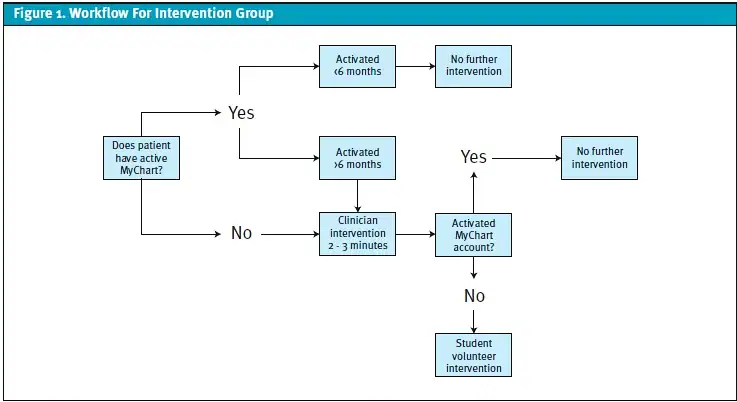
In the intervention group, for patients without an active MyChart account, each physician spent an additional 2-3 minutes during the visit explaining the benefits of MyChart usage, sending a MyChart activation code to the patient’s phone, and confirming that the patient had attempted to sign up for MyChart prior to leaving the clinic. Physicians obtained verbal permission from patients to be contacted by telephone by student volunteers for further assistance with sign-up if needed. As part of the PI project, the team developed a SmartPhrase for documentation that could be added to visit notes. This SmartPhrase also alerted the team to which patients required intervention, and physicians completed a RedCap form to communicate with the student volunteers. The entire process took less than 5 minutes of physician time. Once the patient left the UCC, the student volunteers attempted to phone identified patients and offered MyChart troubleshooting help for those who required further assistance. The workflow is summarized in Figure 1.
Patients who were seen by non-participating physicians were the control group, and they only received the typical baseline MyChart promotion.
Results
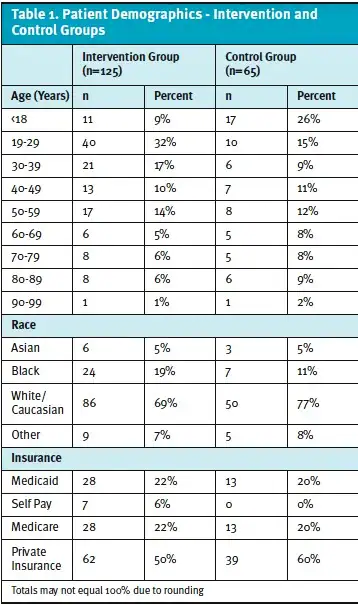
By the end of the 2-month period, there were 125 patients in the intervention group and 65 patients in the control group. For those in the intervention group, most patients were between 19-39 years old, white, and had private insurance. Twenty-two percent of patients had Medicaid coverage. The control group had overall similar demographics for race and insurance but had more pediatric patients <18 years old. Patient demographics are summarized in Table 1.
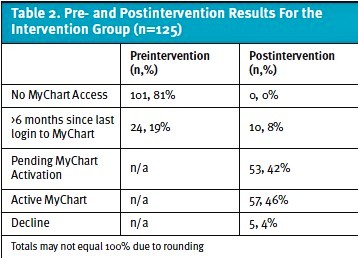
In the intervention group, initially, 101 of the 125 (81%) patients did not have MyChart access. After the intervention, 53 (42%) patients started but did not complete the full enrollment process (pending), and 57 (46%) patients completed enrollment and had an active MyChart account. Fifty-two of the 57 active patients successfully signed up for MyChart with assistance from physicians; the other 5 patients signed up after student intervention. Before the intervention, 24 (19%) of the 125 patients had not used their MyChart >6 months, compared to only 10 (8%) after the intervention (2 months later). These results are in Table 2.
In the control group, initially, 37 (57%) of the 65 patients had no MyChart access, and 28 (43%) had “inactive” accounts, again defined as not being used >6 months. When these charts were reviewed again 2 months later, only 1 (1.5%) patient had progressed to an active account.
Student volunteers phoned 104 patients, but 54 (52%) of the calls went to voicemail, and 18 (17%) had incorrect or non-functional phone numbers. Two patients (2%) declined interest in accessing the portal when asked, 3 (3%) still had technical issues despite assistance from the student, 10 patients (10%) asked to reschedule the call for another time, and 2 (2%) hung up during the call. The remaining 10 (10%) had already signed up on their own since leaving the urgent care center. Only 5 (5%) of the intervention patients were enrolled by students.
Discussion
Clinicians often delegate patient portal enrollment tasks to ancillary staff, perceiving these tasks as time-consuming and less relevant to their role. However, our PI project demonstrated that additional physician encouragement facilitated patient enrollment. Physician-patient engagement in explaining the benefits and establishing portal access only took 2-5 minutes per encounter, excluding data collection (for project evaluation purposes). This approach capitalized on the rapport established between the patient and physician during the visit, thereby solidifying a partnership in care. These findings may be helpful for healthcare organizations looking to improve patient engagement.
Patients who did not activate MyChart after clinician encouragement were difficult to reach by phone and showed less interest in learning about the portal. This may stem from distrust of unknown calls (students made these calls off-site using a phone number that was different from the UCC number). Research indicates that only 19% of Americans answer calls from unfamiliar numbers, and the rate of unanswered calls can be particularly high among older adults, white individuals, and women.5 A potential solution could involve informing patients in advance about the designated number from which they would receive calls or using tools to display a recognizable clinic name and phone number on the caller ID.
In the urgent care setting, there may be visit-specific variables that increase patient portal engagement, including lab results, imaging results, or follow-up messages regarding a referral. Additionally, patients may be more likely to engage if they receive other aspects of their care within the same healthcare system. If patients do not have an incentive to follow up, there may not be a reason to create a patient portal account; for example, if the patient is from out of town or is utilizing the UCC as a 1-time visit.
This project is potentially scalable and replicable for other healthcare systems given its low cost and multidisciplinary approach, which involves physicians, student volunteers, and researchers. Expanding the project to include a larger patient population and additional community partners could further validate its findings and impact. Additionally, clinicians may find addressing patient portal access more appealing if they could bill for the extra time using a time-based billing code, ensuring fair compensation. For workflow purposes, if patients sign up for the patient portal, sending result messages to the patient can save time for the provider. Offices that have scribes can also facilitate access during the provider visit by sending sign up requests and verifying phone numbers or email addresses.
Limitations
The findings of this project are subject to several limitations. Data were collected over a 2-month summer period, which may introduce seasonal variation in the types of patients seeking care at UCCs. Future projects with extended duration could provide more robust insights into patient responses across different times of the year. The intervention sample size of 125 patients across 7 urgent care locations may limit the generalizability of the findings. Variability in staffing, resources, electronic health record systems, patient demographics, and workflows across urgent care centers may further impact the scalability of this project.
The project involved 6 of the 10 available physicians in the urgent care system, therefore, selection bias could be present. It is unclear whether outcomes would differ if all physicians participated. Success in similar initiatives may depend on physician motivation and healthcare systems’ priorities. While our study showed that enrollment required 2-3 minutes of a physician’s time, enrollment may be perceived as a lower priority in some high acuity visits. Educating physicians on the benefits and functionality of patient portals could help them better explain their utility to patients.
We did not evaluate patient differences based on frequency of urgent care use, which may have impacted the results. Finally, while student volunteers were instrumental in postdischarge patient contact, not all practices may have access to such resources. Collaboration with academic medical centers and community partners could help address this limitation for future projects.
Conclusion
Clinicians typically delegate patient portal enrollment to support staff members. Our PI project demonstrates that clinicians can quickly enroll patients in the patient portal during urgent care visits in order to bridge the digital divide. Next steps to further explore this concept would include larger and randomized studies.
Acknowledgements
Authors wish to thank participating physicians in this project: Bohdan Klymochko, DO, Suzanne Brendze, MD, Suzanne Piotrowski, MD, Marie Vitale, MD.
Manuscript submitted March 3, 2025; accepted November 18, 2025.
References
- Pope C, McKenna G, Turnbull J, Prichard J, Rogers A. Navigating and making sense of urgent and emergency care processes and provision. Health Expect. 2019;22(3):435-443. doi:10.1111/hex.12866
- Horvath M, Levy J, L’Engle P, Carlson B, Ahmad A, Ferranti J. Impact of health portal enrollment with email reminders on adherence to clinic appointments: a pilot study. J Med Internet Res. 2011;13(2):e41. Published 2011 May 26. doi:10.2196/jmir.1702.
- Goel MS, Brown TL, Williams A, Cooper AJ, Hasnain-Wynia R, Baker DW. Patient reported barriers to enrolling in a patient portal. J Am Med Inform Assoc. 2011;18 Suppl 1(Suppl 1):i8-i12. doi:10.1136/amiajnl-2011-000473
- Grossman LV, Masterson Creber RM, Benda NC, Wright D, Vawdrey DK, Ancker JS. Interventions to increase patient portal use in vulnerable populations: a systematic review. J Am Med Inform Assoc. 2019;26(8-9):855-870. doi:10.1093/jamia/ocz023
- McClain C. Most Americans don’t answer cellphone calls from unknown numbers. Pew Research Center. December 14, 2020. Accessed July 5, 2025. https://www.pewresearch.org/short-reads/2020/12/14/most-americans-dont-answer-cellphone-calls-from-unknown-numbers/.
Author Affiliations: Sandy Wang, MD, MPH, University of Rochester Medical Center. Carolyn Stern, MD, University of Rochester Medical Center. Kevin Fiscella, MD, MPH, University of Rochester Medical Center. Amaya Sanders, BS, Howard University. Erik Herbert, BS, Wegmans School of Pharmacy at St. John Fisher University. Rosie Booker, BS, New York University, School of Global Public Health. Tyra Barton, LPN, AmeriCorps Programs. Mechelle Sanders, PhD, University of Rochester Medical Center. Authors have no relevant financial relationships with any ineligible companies.