
ED Crowding Adversely Affects Patient Satisfaction Key point: Dissatisfaction lasts throughout entire hospital stay. Citation: Pines JM, Iyer S, Disbot M, et al. The effect of emergency department crowding on patient satisfaction for admitted patients. Acad Emerg Med. 2008;15:825-831. Recent studies on emergency department overcrowding have shown adverse patient outcomes when patients are boarded in the emergency department. To address how patient satisfaction relates to ED overcrowding, these authors retrospectively reviewed Press Ganey satisfaction surveys …
Read MoreClinical Challenge: December, 2008
The patient is a 55-year-old female who experienced a blow to the back when she fell while riding a bus. She complains of pain in her neck, shoulder, and back. On examination, you find that her vitals are stable and she has no significant past medical history. View the x-ray taken (Figure 1) and consider what your diagnosis and next steps would be. Resolution of the case is described on the next page. (Hint: this …
Read MoreThe Herd Mentality and Occupational Health Sales
The Merriam-Webster dictionary defines herd as “a group of individuals usually having a common bond” or “a number of animals kept under some type of human control.” So let us think bulls (to some, a fitting metaphor for a piece on sales). For every early adaptor or contrarian, there seem to be 10 other people who prefer to follow the leader. For every buyer of urgent care occupational health services who buys offensively out of …
Read MoreStrategies on Responding to Variable Patient Acuity and Flow
JOHN SHUFELDT, MD, JD, MBA, FACEP Over the years, I have worked with a variety of providers who exhibited significantly disparate skill levels in their ability to manage patient flow. Practicing good medicine is a given; some have been amazingly intelligent providers who make House look like a PG1 psychiatry resident from a non-accredited medical school. Their only downside was that they were pathetically slow, or communicated at the level of a mollusk. Effective and …
Read More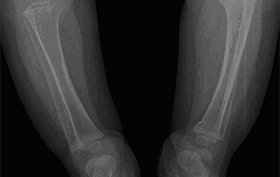
10-month old child with 3 day history of pain
The patient is a 10-month-old child who presents with the parents, upon referral by the pediatrician, with a history of three days of pain but no history of trauma. The child refuses to stand, presumably due to pain, and resists crawling. View the x-ray taken and consider what your diagnosis and next steps would be.
Read More
56-year-old man experiencing chest pain, fevers and rash
The patient is a 56-year-old man who emigrated from Mexico to Texas two months ago. He first presented about two weeks ago with a dry cough, chest pain, fevers, and night sweats. Chest x-ray showed a focal consolidation. He had received BCG vaccination as a child, so a PPD was not placed. He was started on isoniazid, rifampin, and ethambutol for tuberculosis. Now, he presents complaining of the same symptoms, plus a rash that erupted …
Read More
November 2008
Developing Data: November, 2008
In early 2008, UCA revamped its annual survey in conjunction with researchers at Massachusetts General Hospital and Harvard University with the goal of assuring that the UCA Benchmarking Committee’s efforts produced a scientifically valid report. Over the coming months in Developing Data, JUCM will present some of the findings from this landmark survey, to which 436 urgent care centers responded. In this issue: How large are urgent care centers? It is important to note that …
Read MoreICD-9 Changes in 2008
DAVID STERN, MD (Practice Velocity) Q.I noticed that I am getting rejections for the code for fever (780.6). Do I need to add another diagnosis code to get paid? A.There are numerous separate issues related to this code: First, every year ICD-9 updates go into effect on Octo- ber This year was no exception. This code is now sub- categorized as follows: 60 Fever, unspecified 61 Fever presenting with conditions classified elsewhere 62 Postprocedural fever …
Read MoreAbstracts In Urgent Care: November, 2008
San Francisco Syncope Rule: Less Sensitive Than Previously Reported Key point: An independent validation study demonstrated a sensitivity of only 74% for predicting serious outcomes. Citation: Birnbaum A, Esses D, Bijur P, et al. Failure to validate the San Francisco Syncope Rule in an independent emergency department population. Ann Emerg Med. 2008;52(2):151-159. Most patients who present with syncope have benign etiologies, but, for some, syncope is caused by a potentially life-threaten- ing condition. Differentiating between …
Read More