
Published on
Download the article PDF: Clinical Image Challenges July August 2026 1
Differential Diagnosis
- ST-elevation myocardial infarction
- Ventricular pre-excitation
- Junctional rhythm
- Normal sinus rhythm
Diagnosis
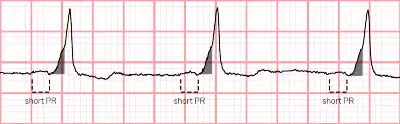
The diagnosis in this case is ventricular pre-excitation. The ECG reveals a normal sinus rhythm. The findings on this ECG are classic for ventricular pre-excitation): a delta wave, a shortened PR interval, and a slightly widened QRS (Figure 2).
Discussion
Ventricular pre-excitation occurs when an accessory pathway connects the atria and the ventricles. When the accessory pathway conducts in an anterograde (forward) direction, bypassing the atrioventricular (AV) node, the ventricles are “pre-excited,” yielding the characteristic delta wave on the ECG (Figure 2).
Patients with an accessory pathway are at risk of developing reentrant tachycardias. With orthodromic tachycardia, conduction moves down the atrioventricular node and returns via the accessory pathway, creating a narrow-complex rhythm. With antidromic tachycardia, impulses travel down the accessory pathway into the ventricles and then back up through the atrioventricular node, resulting in a wide-complex rhythm (Figure 3).
When arrhythmia occurs involving the accessory pathway, it is referred to as the Wolf-Parkinson-White (WPW) syndrome. These abnormal conduction pathways are formed during cardiac development and can exist in a variety of anatomical locations.
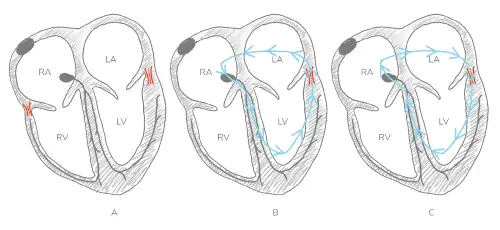
RA— right atrium; RV,—right ventricle; LA,—left atrium; LV,—left ventricle.
Accessory pathways can transmit atrial tachyarrhythmias to the ventricles at dangerously high rates. Unlike the AV node, which limits ventricular conduction by delaying and filtering impulses, an accessory pathway can conduct signals with little or no restraint. The highest-risk situation is atrial fibrillation in WPW syndrome, in which disorganized atrial activity is relayed rapidly and irregularly to the ventricles. Ventricular rates may reach 200–300 beats per minute, raising the risk of progression to ventricular fibrillation. Rarely, the accessory pathway conducts only retrograde (ventricle-to-atrium) while antegrade conduction continues normally through the AV node. As a result, the resting sinus-rhythm ECG lacks evidence of pre-excitation though re-entrant tachycardia may still occur.1–3
When pre-excitation is discovered incidentally, no urgent action needs to be taken. However, when the patient (as in this case), is symptomatic, transfer to an electrophysiology-capable center is indicated.
What To Look For
- Pre-excitation is caused by an accessory pathway that bypasses the AV node.
- Patients with accessory pathways are at risk for developing reentrant tachycardias that can be narrow (orthodromic) or wide (antidromic).
- Pre-excited atrial fibrillation may result in dangerously fast ventricular rates.
Pearls For Initial Management, Considerations For Transfer
- Symptomatic patients with evidence of pre-excitation should be transferred to a cardiac care center.
- Asymptomatic patients with evidence of pre-excitation can follow up in the outpatient setting.
- Narrow re-entrant tachycardias can be managed like supraventricular tachycardia with adenosine or cardioversion.
- Avoid AV nodal blocking agents with pre-excited atrial fibrillation, as it can precipitate ventricular fibrillation.
- Place defibrillation pads on patients awaiting transport and electrically cardiovert if unstable.
References
- Wagner GS, Strauss DG. Marriott’s Practical Electrocardiography. 12th ed. Lippincott Williams & Wilkins; 2014.
- Benson DW, Cohen MI. Wolff-Parkinson-White syndrome: Lessons learnt and lessons remaining. Cardiol Young. 2017;27(S1):S62-S67. doi:10.1017/S1047951116002250
- Moore EN, Spear JF, Boineau JP. Recent Electrophysiologic Studies on the Wolff-Parkinson-White Syndrome. New England Journal of Medicine. 1973;289(18):956-963. doi:10.1056/nejm197311012891808

Read More