
Published on
Download the article PDF: Clinical Image Challenges April 2026
Differential Diagnosis
- Hypokalemia
- Hypocalcemia
- Atrial flutter
- Brugada syndrome
- Normal sinus rhythm with no other changes
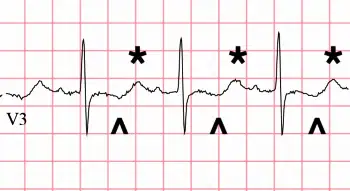
The diagnosis in this case is hypokalemia. This ECG demonstrates normal sinus rhythm with a rate of 84 beats per minute. In V3, there are T wave inversions with prominent U waves, creating a wavy repolarization pattern suggestive of severe hypokalemia (Figure 2).
Discussion
ECG findings in hypokalemia include U-waves, T-wave flattening or inversion, ST depression, prolonged PR interval, and prolonged QT interval.1,2 In severe hypokalemia, prominent U-waves may merge with inverted T-waves, producing a biphasic TU fusion complex that first deflects downward and then upward, as seen in this case (Figure 2). When the T wave and U wave fuse, the QT interval should encompass the entire, fused TU complex.
A prolonged QT interval increases the risk of Torsade de Pointes (TdP), a potentially fatal arrhythmia. TdP occurs when part of the ventricular myocardium depolarizes while other regions remain in the repolarization phase—an “early afterdepolarization” or “triggered activity.” This “R-on-T phenomenon” can precipitate the polymorphic ventricular tachycardia known as TdP. In acquired long QT syndrome (as with electrolyte disturbances such as hypokalemia), tachycardia is protective, and overdrive pacing—pharmacologic or electrical—can be an effective treatment.3 Other causes of acquired long QT include hypocalcemia, hypomagnesemia, hypothermia, and various QT-prolonging medications.4
Symptoms of hypokalemia vary depending on severity and etiology but may include muscle weakness, fatigue, cramping, palpitations, and constipation. Treatment includes oral and parenteral potassium supplementation, along with identification and correction of the underlying cause. If the patient is symptomatic or with ECG changes, transfer to a telemetry-capable facility.
Hypocalcemia prolongs the QT interval by lengthening the ST segment. Atrial flutter produces a characteristic sawtooth pattern of atrial activity, most visible in the inferior leads. Brugada syndrome is a rare cause of sudden cardiac death and is characterized by a pseudo–right bundle branch block pattern with down-sloping ST-segment elevation in leads V1 and V2.
What To Look For
- Hypokalemia causes delayed repolarization, leading to broad T waves that may fuse with U waves and generate wavy repolarization complexes across the precordium.
- Ventricular ectopy can precipitate an “R-on-T” phenomenon, triggering Torsade de Pointes.
- Bradycardia in the setting of acquired long QT increases the risk of TdP.
Pearls For Initial Management, Considerations For Transfer
- Identify the underlying cause of hypokalemia and treat with oral and parenteral supplementation.
- Hypokalemia is often accompanied by hypomagnesemia; replace both electrolytes.
- Patients with a severely prolonged QT or QU interval (>500 msec) should be transferred for electrolyte repletion and monitoring.
References
- Diercks DB, Shumaik GM, Harrigan RA, Brady WJ, Chan TC. Electrocardiographic manifestations: Electrolyte abnormalities. J Emerg Med. 2004;27(2):153-160. doi:10.1016/j.jemermed.2004.04.006
- Chua CE, Choi E, Khoo EYH. ECG changes of severe hypokalemia. QJM. 2018;111(8):581-582. doi:10.1093/qjmed/hcy046
- Al-Khatib SM, Stevenson WG, Ackerman MJ, et al. 2017 AHA/ACC/HRS Guideline for Management of Patients With Ventricular Arrhythmias and the Prevention of Sudden Cardiac Death. J Am Coll Cardiol. 2018;72(14):e91-e220. doi:10.1161/CIR.0000000000000549
- Isbister GK. Risk assessment of drug-induced QT prolongation. Aust Prescr. 2015;38(1):20-24. doi:10.18773/austprescr.2015.003
