
Published on
Download the article PDF: Clinical Image Challenges June 2026
Differential Diagnosis
- Iliopsoas tear
- Lesser trochanter avulsion fracture
- Hip labrum tear
- Hip joint dislocation
- Proximal femur fracture
- Pelvic ring fracture
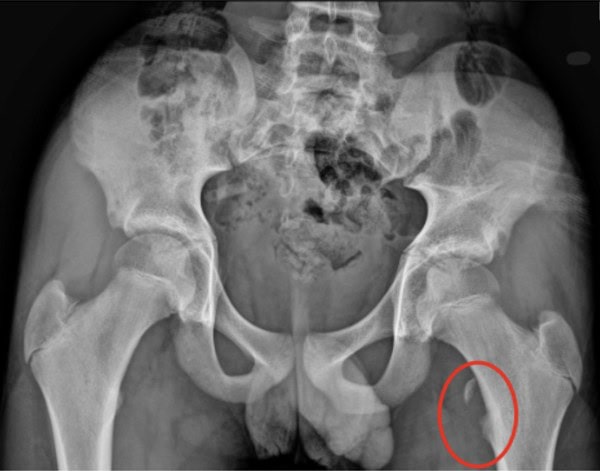
Diagnosis
Radiographic interpretation reveals an avulsion fracture of the left lesser trochanter with a displaced apophyseal fragment visible. The lesser trochanter lies on the posteromedial aspect of the proximal femur, inferior to the femoral neck, and is the insertion point for the iliopsoas which is primarily responsible for hip flexion. Isolated trochanteric fractures are typically avulsion fractures resulting from resisted hip flexion, leading to a strong contraction of the iliopsoas which avulses the lesser trochanter. These fractures occur most often in active adolescents and young adults involved in sports which include sprinting or jumping. In older adults, spontaneous avulsion is concerning for pathologic fracture caused by malignancy and is often considered a sign of metastasis until proven otherwise.
What to Look For
- History of involvement in sports including sprinting or jumping, patients will present with sudden groin pain and an antalgic gait.
- Lesser trochanteric fractures generally cause pain in the groin but also may present with knee or posterior thigh pain that is worse with hip flexion and rotation.
- On radiographs, look for fracture fragments displaced medially and superiorly to the lesser trochanter.
Pearls For Urgent Care Management
- Acute management includes rest and non-weight bearing with crutches for 3-4 weeks.
- Non-steroidal anti-inflammatory medications (NSAIDS) and acetaminophen are used for pain management.
- Less trochanteric avulsion fractures rarely require surgical intervention. Urgent orthopedic consultation is indicated if displacement is greater than 1 cm, if there is painful nonunion on follow up imaging, or if the patient is a high level athlete.
- Otherwise, non-urgent follow up with orthopedics is appropriate to monitor healing and evaluate for uncommon complications such as nonunion, ischiofemoral impingement and chronic hip flexor weakness.
Image Acknowledgement: Experity Teleradiology