
Published on
Download the article PDF: Who Can Take X Rays In An Urgent Care Center A 50 State Framework
Urgent Message: This 50-state framework details who can legally operate x-ray equipment, as these laws dictate whether the industry’s predominant advanced practice provider-staffing model remains operationally and financially viable.
Alan A. Ayers, MBA, MAcc
Keywords: urgent care; radiography; radiologic technologists; licensure; nurse practitioners; physician assistants
According to the Urgent Care Association (UCA), on-site plain-film radiography is a defining feature of urgent care and is among the criteria for UCA Certification.¹ Yet across the 50 states and the District of Columbia, the regulations governing who may operate that equipment vary so dramatically that a staffing model fully compliant in one state may be operationally impossible in the next.
This update,2 compiled in May 2026, provides a framework built around how urgent care operators actually think about staffing, rather than how regulators classify training or certification. While most existing analyses organize the law by statute or profession, this approach starts with the operator’s primary question: Given my state and my staffing model, can I practically offer x-ray services?
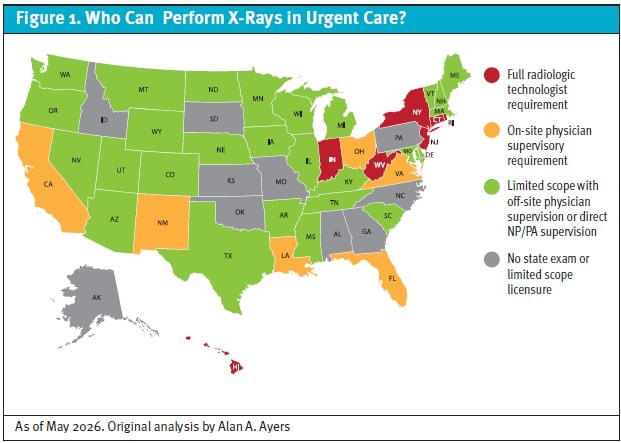
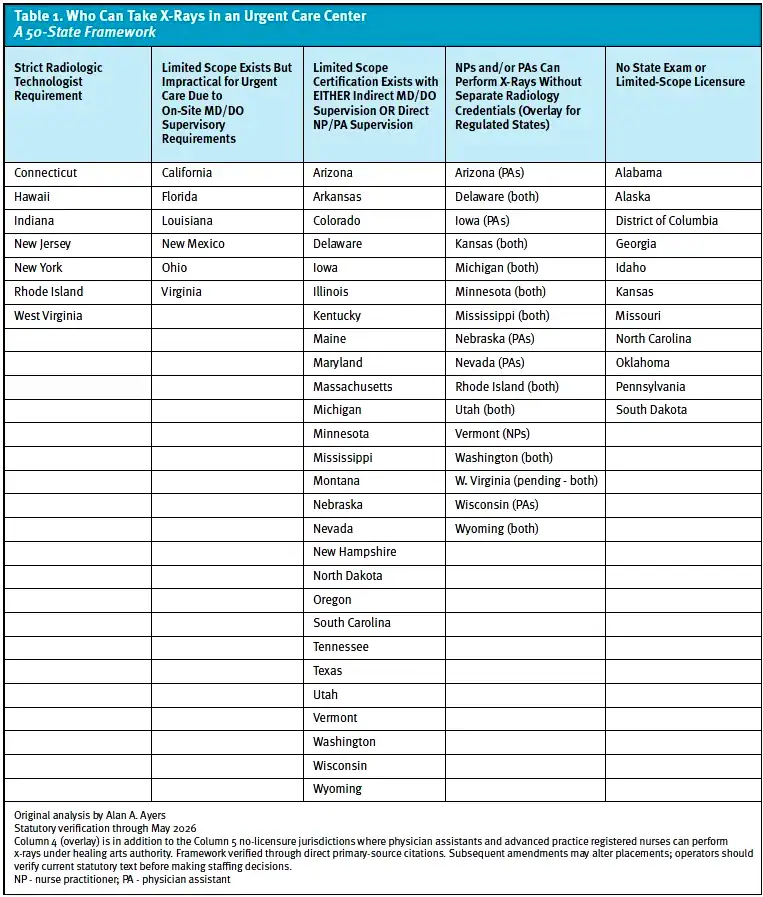
The framework sorts every jurisdiction into 1 of 4 mutually exclusive structural categories (Figure 1). The status of each state is further outlined in Table 1.
The Foundational Categories
- Strict Radiologic Technologist (RT) Requirement: Seven states require a fully credentialed Radiologic Technologist without exception (Connecticut, Hawaii, Indiana, New Jersey, New York, Rhode Island, West Virginia). While Indiana and New Jersey nominally permit a limited-scope credential, those licenses do not cover the body areas a typical urgent care needs to image.
- On-Site Physician Supervision: Six states permit limited-scope operators but require an MD or DO physician to be physically on-site (California, Florida, Louisiana, New Mexico, Ohio, Virginia). For an urgent care staffed primarily by physician assistants (PAs) or nurse practitioners (NPs), this is operationally equivalent to Column 1.
- Off-Site Supervision: Twenty-seven states permit limited-scope operators under off-site MD/DO direction or on-site PA/NP supervision. This is the operational sweet spot for the industry.
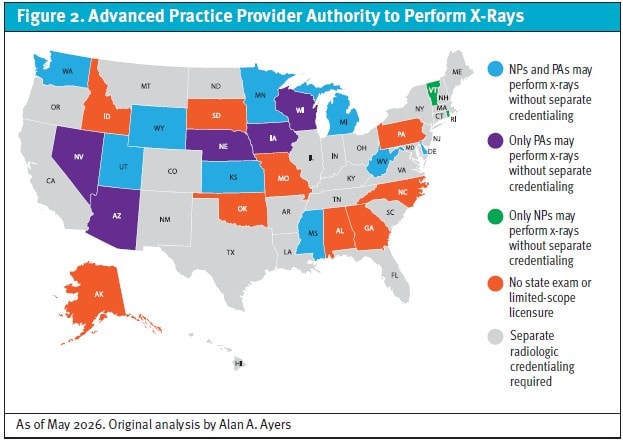
- Overlay—Advanced Practice Providers (APPs) Direct Authority: Sixteen states (plus pending legislation in West Virginia) permit APPs to operate x-ray equipment under their own licenses. Nine of these states, along with West Virginia, which has rules pending, recognize both PAs and NPs.
- No State Licensure: Eleven jurisdictions require no individual operator credential; on-the-job training is acceptable in most of these states.
This structural pattern has documented operational consequences. Urgent care centers in restrictive states frequently adopt limited-scope models with reduced hours, often forgoing x-ray entirely—disqualifying them from UCA Certification—or going dark on nights and weekends when an RT cannot be staffed.
Furthermore, the labor pool is finite. RT salaries in restrictive states must compete with hospitals and high-volume imaging centers, meaning the math often does not work for urgent care margins.
The push toward modernization is clear. States that have updated their radiologic technology statutes within the past decade—such as Kansas, Michigan, Minnesota, Mississippi, Utah, Washington, Wyoming, and Delaware—now recognize PAs and advanced practice registered nurses as licensed practitioners alongside physicians, dentists, podiatrists, and chiropractors (Figure 2). The regulatory momentum is unidirectional; no state has ever removed APPs from a licensed practitioner definition once they have been added.
However, the legislative work is not finished. Ohio Senate Bill 324, West Virginia Senate Bill 580, and New York Assembly Bill A2685A/Senate Bill S684A are actively pending in their 2026 sessions. Each would significantly expand operational flexibility for PA/NP-staffed centers. The urgent care industry—through the UCA, regional associations, state coalitions, and individual operator advocacy—has a vital role to play in ensuring these bills receive a fair hearing.
Finally, operators must remember that this framework addresses only the legal baseline. Centers for Medicare and Medicaid Services’ federal supervision rules (42 CFR 410.32), commercial payer credentialing, and liability insurance agreements often impose stricter standards than state law, and operational reality may be tighter than statutory text suggests.
References
- 1. Urgent Care Association. Certification criteria. Urgent Care Association. Accessed May 12, 2026. https://urgentcareassociation.org/quality/certification/certification-criteria/
- 2. Ayers AA. Who can take x-rays in an urgent care center? J Urgent Care Med. Published October 30, 2022. Accessed May 12, 2026. https://www.jucm.com/who-can-take-x-rays-in-an-urgent-care-center/
