
Published on
Download the article PDF: Pediatric Vaccine Hesitance In Families Seeking Case In Urgent Care Centers
Urgent Message: Despite national recommendations regarding childhood vaccination, some parents are hesitant or refuse to vaccinate their child. This survey assessment presents parents’ perceptions of vaccination and the scope of undervaccination in a pediatric urgent care population.
Stacy B. Buchanan, DNP, APRN, CPNP-PC; Brooke Cherven, PhD, MPH, RN; Betsy Dye, MS, CPNP-PC, NPD-BC, EBP-C; Temima Oratz, BSN, RN, EBP-C; Margaret Gettis, DNP, APRN, CPNP-PC, EBP-C
Keywords: vaccine hesitancy; childhood immunization; undervaccination; measles-mumps-rubella vaccine; varicella vaccine; pediatric urgent care
Abstract
Background: Adherence with the standard practice of vaccinating pediatric patients remains a challenge for healthcare providers. Despite national recommendations regarding childhood vaccination, some parents are hesitant or refuse to vaccinate their child. In this assessment, vaccine hesitancy is defined as a refusal, delay, or modification of the recommended vaccine schedule.
Aims: The primary aim of this assessment was to understand parent perceptions of their child’s immunization status, barriers to vaccination, and utilization of a primary care provider (PCP). The secondary aim was to assess the scope of undervaccination in the pediatric urgent care population.
Methods: Parents who presented with their child (birth–21.99 years of age) at either of 2 urgent care centers between May 2024–July 2024 were invited to complete a web-based 7-item questionnaire assessing their child’s immunization status, perception of and barriers to vaccination, and the primary medical care source for their child. Convenience sampling was used, and parents were approached while in the urgent care waiting room; non-English-speaking parents were excluded. To assess the scope of undervaccination in the urgent care population, an electronic health record review was completed including all urgent care visits for patients 6.00–21.99 years of age during the same period to assess vaccination status for the measles, mumps, rubella (MMR) and varicella vaccine series.
Results: Of 91 parents approached for participation: 64 completed the survey; 12 were excluded due to non-English speaking language; and 15 declined participation. Nearly all (93%) parents who completed the survey reported routinely vaccinating their child, and most had not declined (91%) or delayed (89%) recommended vaccines. Eighty-eight percent of patients had a medical home or PCP. When their child needs routine acute care, 81% of parents reported taking their child to the PCP, 19% to the emergency department (ED), and 61% to urgent/immediate care clinics. Most parents were uncertain whether their PCP would or would not see their child if they refused vaccinations (64%). Reasons for declining/delaying vaccines were: too many vaccines at once; prematurity; concerns related to autism; or immunocompromised child. Of the 10,043 urgent care encounters during the project time period, 9.47% and 8.39% were incomplete for MMR and varicella vaccine series, respectively.
Conclusion: Most parents had their child vaccinated at the recommended time and had a PCP. Opportunities exist to inform parents about the importance of vaccines for unimmunized or underimmunized children seeking care at urgent care clinics.
Introduction
Immunizations for vaccine-preventable diseases have been one of the most successful public health accomplishments in medical science according to the World Health Organization (WHO) and the Centers for Disease Control and Prevention (CDC).1The introduction of vaccinations for children has resulted in the prevention of serious illness for an estimated 322 million people, hospitalizations for 21 million, and death for 732,000 from 1994–2013.2 Vaccines have long been the standard of care for all communities; however, the pediatric population receives the most immunizations, often within the first 3 years of their lives and often receiving multiple vaccinations in a single visit.3
Parents often feel the burden of healthcare decision-making with a desire to protect their children from perceived harm. This has led substantial numbers of parents to delay immunizations or decline them altogether.4 While this is not an entirely new phenomenon, there is growing reluctance on the part of parents to adhere to vaccine recommendations.4-6Developments that may be driving reluctance include a flawed study claiming a link between the measles, mumps and rubella (MMR) vaccine and autism (the 1998 study was retracted and its results were discredited).7 Fear of the MMR vaccine persists to this day.8More recently,the WHO has documented vaccine hesitancy as a worldwide issue that threatens previous eradication of certain diseases. Unfortunately, the growing public distrust of immunizations that coincided with the COVID-19 pandemic has exacerbated the vaccine hesitancy issue.1 Fear of potential side effects, adverse events, or long-term impacts are some of the reasons parents express for not wanting to follow the standard guidelines and have their children immunized.3,8 Online, accessible health information that may or may not be accurate as well as skepticism about healthcare providers and the legitimacy of medical science, including the guidance from CDC, compounds the issue.8,9
Health needs in children may be addressed in a visit to a pediatric primary care provider (PCP). However, parents also utilize local urgent/immediate care centers or emergency departments (EDs) for their child’s healthcare needs. Pediatric primary care settings are well suited for immunizations as they can align the recommended vaccine schedule with comprehensive well-child visits or sick visits. In contrast, urgent and immediate care centers often provide discrete acute care services for mild-to-moderately ill patients, and EDs are designed to offer the highest levels of care. In both urgent care and ED settings, nonacute/preventive services such as immunizations may not be offered even if desired.3,10Meanwhile, childhood immunization rates remain suboptimal.4,6,8,10,14 However, there may be opportunities in the urgent/immediate care setting to identify unimmunized or underimmunized children and offer vaccine information as a strategy for improving childhood vaccination rates.
The goal of this initiative was to explore caregiver vaccine hesitancy and vaccination status in the urgent care population as an initial step toward development of future quality improvement or process improvement strategies. In this assessment, vaccine hesitancy is defined as a refusal, delay, or modification of the recommended vaccine schedule. The primary aim was to survey families in the urgent/immediate care setting about their decisions regarding their child’s immunization status. The secondary aim was to identify the number of encounters where patients had documentation of fewer than the age-based recommended doses of the MMR and varicella vaccine series. Lastly, we also sought to identify sociodemographic factors associated with incomplete vaccination in this population.
Methods
This initiative included 2 metropolitan urgent care centers that are part of a large pediatric healthcare organization located in the southeastern United States with multiple hospitals and urgent care locations serving pediatric patients up to the age of 21.99 years. One center sees an average of 30,000 visits/year, and the other averages 18,000 visits/year. The impetus for this initiative was the observed increasing number of parents answering “no” when queried by the healthcare provider regarding their child’s vaccine status. The institutional review board (IRB) reviewed the project and gave it a non-human subject determination (IRB# 00001863).
In collaboration with urgent care leaders, we developed a plan to assess parental perspectives on vaccination for children presenting to the urgent care. Using a 7-item investigator-developed questionnaire, the survey was conducted in the 2 urgent care locations from May 2024–July 2024. The questionnaire was developed to measure vaccine administration status, parents’ perceptions, barriers, and the use of primary medical care for their child. Parents of patients presenting to the urgent care were eligible; however, non-English-speaking parents were excluded. This questionnaire was accessible to parents electronically via a QR code, and the results were stored in the organization’s Research Electronic Data Capture (REDCap), a secure, password protected database.12 Child age was abstracted from the medical record.
For the second aim of the study, data was abstracted from all encounters of patients aged 6.00–21.99 years with a completed visit to either of 2 urgent care centers during the timeframe of the survey. The age range for the chart review was limited to aged 6.00–21.99 years because the first 2 doses of MMR and varicella vaccines would have been administered by age 6, indicating up-to-date vaccine status. Age at encounter, race/ethnicity, insurance type (public, private/military, self-pay), and documented PCP were abstracted from the medical record. Dates for doses of the MMR and varicella vaccines were also abstracted from the medical record, which is linked to the Georgia Registry for Immunization Transactions and Services (GRITS).13 All immunizations administered in the state of Georgia are required by law to be recorded in GRITS within 30 days of administration, and in 2023, >95% of children across the state were represented in the registry.13
Any patient encounter with <2 doses of either the MMR or varicella vaccine series documented was considered to represent underimmunization and an opportunity for vaccine counseling based on the Advisory Committee on Immunization Practices (ACIP) recommendation that both vaccine series be completed by 6 years of age.13 Multivariable logistic regression was performed to calculate odds ratios (OR) with 95% confidence intervals (95% CI) for demographic characteristics associated with underimmunization for MMR and varicella separately.
Results
Urgent Care Survey
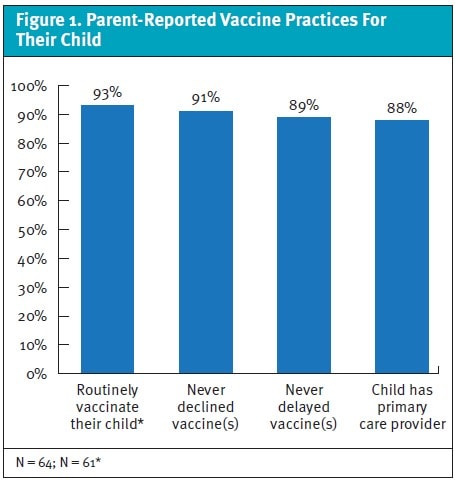
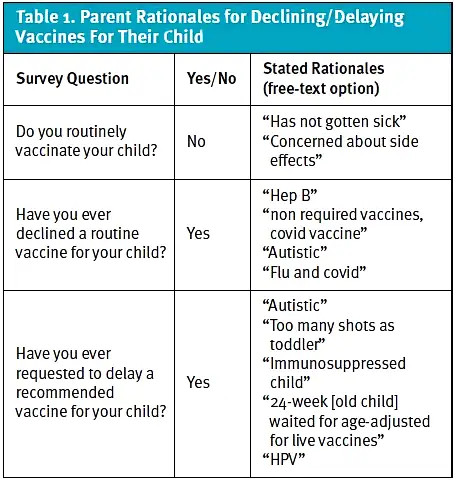
A total of 91 parents were approached between the 2 urgent care locations. Sixty-four parents completed the survey; 12 were excluded due to a language barrier and 15 declined participation. The median age of the child was 4 years and 10 months of age (range: 7 weeks–19 years). Most (n=57 [93%]) parents reported routinely vaccinating their child, and most parents had not declined (n=58 [91%]) or delayed (n=57 [89%]) recommended vaccines (Figure 1). Parents were asked if they had a medical home or pediatric PCP, and 56 (88%) responded yes. Regarding where parents take their child if they need care, 81% (n=52) of parents who responded to the survey said they take their child to a PCP, 19% (n=12) said the ED, and 61% (n=39) said an urgent/immediate care clinic. Most parents were uncertain whether their provider would or would not see their child if they refused vaccinations (n=41 [64%]). If parents responded no to routinely vaccinating their child or yes to delaying a vaccine, they were asked to provide a rationale. Reasons for declining/delaying vaccines included: too many vaccines; prematurity; immunosuppressed child; and autism-related concerns—although it is unclear in the free-text responses whether the parents’ concerns were related to a perceived risk of autism from a vaccine or because the child had a current autism diagnosis (Table 1).
Most (n=52 [81%]) parents responding to the survey sought care for their child with the pediatric PCP. There were 8 parents who reported not having an identified primary medical home or pediatric PCP. Among this subset of parents, 2 of the 8 did not routinely vaccinate their child, and 1 parent reported declining a vaccine in the past.
Retrospective Chart Review
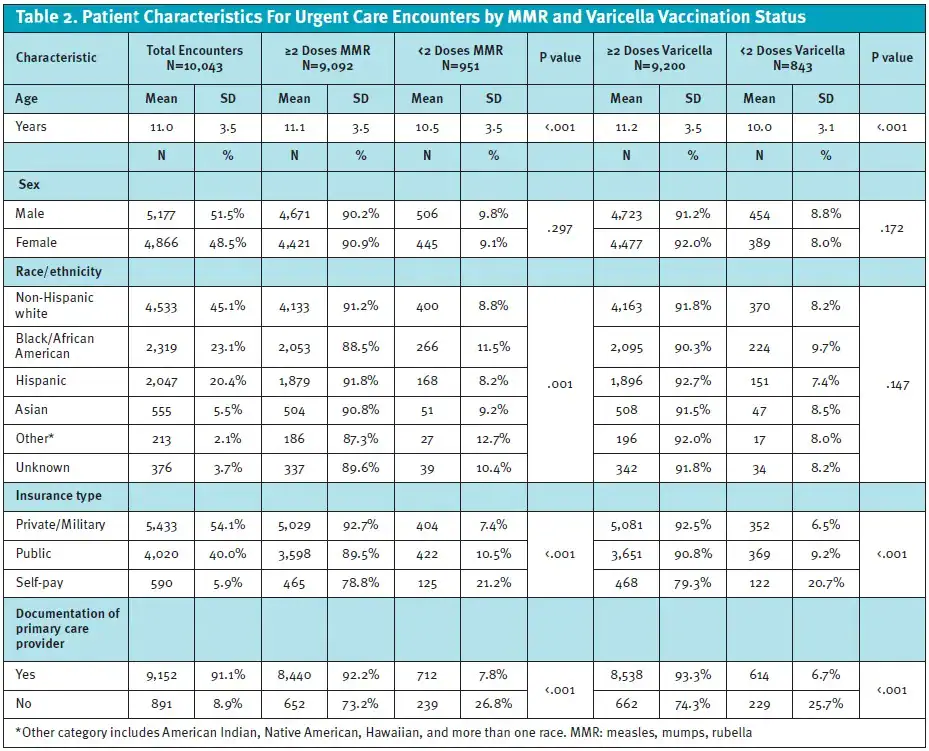
A total of 10,043 urgent care encounters occurred during the project time period. Of patients seen during these encounters: 51.5% were male; 45.1% were non-Hispanic white; 54.1% had private insurance; and 91.1% had a PCP documented within the urgent care medical record (Table 2). Among all encounters, 951 (9.47%) included patients undervaccinated for MMR with 568 (5.65%) having no documented MMR doses. Similarly, 843 encounters (8.39%) included patients undervaccinated for varicella, with 551 (5.48%) having no documented varicella vaccine doses.
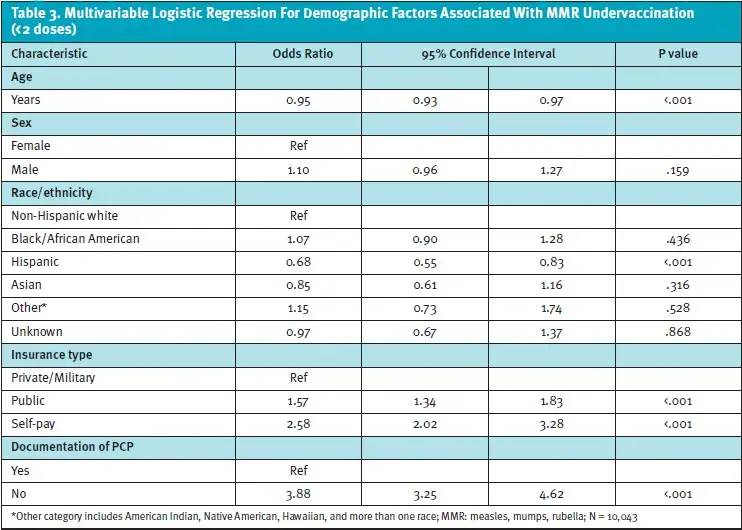
Factors associated with MMR undervaccination included public insurance or self-pay (OR 1.57, 95% CI 1.34–1.83, p<.001 and OR 2.58, 95% CI 2.02–3.28, p<.001, respectively) and lack of documentation of a PCP (OR 3.88, 95% CI 3.25–4.62, p<.001) (Table 3). Older age and Hispanic ethnicity (compared to non-Hispanic white) were less likely to be associated with undervaccination (OR 0.95, 95% CI 0.93–0.97, p<.001 and OR 0.68, 95% CI 0.55–0.83, p<.001, respectively) (Table 3).
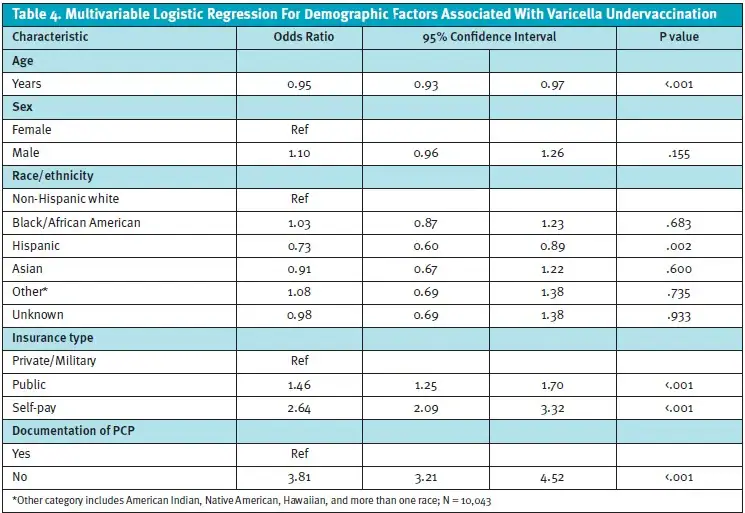
Similarly, factors associated with varicella undervaccination included public insurance or self-pay (OR 1.46, 95% CI 1.25–1.70, p<.001 and OR 2.64, 95% CI 2.09–3.32, p<.001, respectively) and lack of documentation of a PCP (OR 3.81, 95% CI 3.21–4.52, p<.001) (Table 4). For varicella vaccination, older age and Hispanic ethnicity (compared to non-Hispanic white) were less likely to be associated with undervaccination (OR 0.95, 95% CI 0.93–0.97, p<.001 and OR 0.73, 95% CI 0.60-0.89, p=.002, respectively) (Table 4).
Discussion
Most parents in the United States are vaccinating their children.14,15 Consistent with that trend, most pediatric patients in the chart review had documentation of recommended MMR and varicella series completion. While this is an encouraging statistic, it remains critical to collaborate with parents who question vaccine safety and address their concerns whenever possible.15-17 For the MMR and varicella vaccine series, we found that 8%–9% of patients did not have documentation of series completion. For the MMR vaccine, it is recommended that 95% of the population is vaccinated to maintain community immunity.15 Any provider caring for pediatric populations is encouraged to assess the vaccine status of their patients, particularly with the resurgence of vaccine preventable diseases.19
Children with a pediatric PCP are likely to see their provider when sick but may also visit an urgent/immediate care center or ED. Parents remain confident in their healthcare provider when these relationships are built on trust, which develops over time as the provider cares for the child and interactions with the parents accumulate.17,18 Vaccine conversations naturally occur in a pediatric primary care office, however the opportunity to reinforce the need to vaccinate can also occur in other healthcare settings, such as urgent care.
Methods to reinforce the need to vaccinate include using electronic prompts to encourage provider conversations, leveraging clinician reminders, or including vaccine information sheets with discharge instructions.20-21 Not all urgent care centers have access to a statewide vaccine registry; however, provider recommendation for vaccination via discussion or written handout is predictive of vaccine initiation.22-23 We believe there is opportunity for some of those on the vaccine hesitancy spectrum to be guided toward immunization through conversation with a healthcare professional.
As another option, a vaccine champion could be employed, or an existing staff member could serve as a champion in an urgent care setting.21-23 Clinical leaders who serve as vaccine champions can provide peer education and real-time support to promote vaccination and/or recommendations to families.24 The availability of a vaccine champion to identify and address missing immunizations may help close the gaps in immunization rates for communities. The vaccine champion could have conversations with families about immunizations and potentially administer vaccines if the service is available, or otherwise, encourage them to seek vaccination from a PCP. Documentation of any vaccine administered could be completed in the immunization registry or updated vaccine records given to the parent as well.20
Parental vaccine hesitancy often prevents children from maintaining up-to-date vaccine status. One of the major drivers of vaccine delay or refusal of the MMR vaccine continues to be concerns about autism. Debunked myths surrounding a causal link between the MMR vaccine and the development of autism led to a decline in MMR vaccine uptake, and this misinformation continues to impact parental decision making when questioned about acceptance of the MMR vaccine.7 Among our small survey project, autism concerns—whether fear of a vaccine causing autism or the child presenting with a current diagnosis—was one of the cited reasons for a parent not to vaccinate their child in a free-text response in this small survey.
Limitations
The survey data was collected during the summer months when the urgent/immediate care centers were experiencing a lower-than-expected volume of patients. Conducting this survey in the fall/winter season when there is greater utilization of the urgent care center may reveal different results. Only 2 centers were used for survey recruitment, which limits the generalizability of results. Additionally, the small sample size is not representative of all patients seen systemwide in urgent care. This survey excluded non-English speaking populations and therefore may not be generalizable to these populations. Future studies should include larger sample sizes, more care sites and languages spoken as well as additional demographic factors (eg, parental education and income) to better identify underlying reasons for the differences in vaccine uptake observed in chart review.
Conclusion
Urgent/immediate care providers and staff have an opportunity to assess the vaccine status of each child under their care and remind parents about the need for a recommended vaccine. If parents express hesitancy, urgent care team members or a vaccine champion may address vaccine questions. While not every urgent care center may be able to administer scheduled pediatric vaccines, referral back to the pediatric PCP or other source could be an acceptable method to support efforts to bring a child’s vaccine status up to date.
Acknowledgements
The authors wish to thank Usha Sathian, MD, and the urgent care leadership for their support of this initiative.
Manuscript submitted October 29, 2025; accepted June 29, 2026.
References
- Miller JM, Carroll RS. An informed approach to vaccine hesitancy and uptake in children. Delaware J Public Health. 2022;8(1): 60–64. https://doi.org/10.32481/djph.2022.03.009
- Whitney CG, Zhou F, Singleton J, Schuchat A; Centers for Disease Control and Prevention (CDC). Benefits from immunization during the vaccines for children program era – United States, 1994-2013. MMWR Morb Mortal Wkly Rep. 2014;63(16):352–355
- American Academy of Pediatrics.Vaccine recommendations by the AAP. PublishedSeptember 16, 2024. Accessed October 29, 2025. https://www.aap.org/en/patient-care/immunizations/vaccination-recommendations-by-the-aap/
- Larson HJ, Gakidou E, Murray CJL. The vaccine-hesitant moment. N. Engl J Med. 2022;387(1):58–65. https://doi.org/10.1056/NEJMra2106441
- Tuckerman J, Kaufman J, Danchin M. (2022). Effective approaches to combat vaccine hesitancy. Pediatr Infect Dis J. 2022;41(5): e243–e245. https://doi.org/10.1097/INF.0000000000003499
- Ryan J, Malinga T. Interventions for vaccine hesitancy. Curr Opin Immunol. 2021;71: 89–91. https://doi.org/10.1016/j.coi.2021.05.003
- Eggertson L. Lancet retracts 12-year-old article linking autism to MMR vaccines. CMAJ. 2010;182(4):E199-E200. doi:10.1503/cmaj.109-3179
- Lafnitzegger A, Gaviria-Agudelo C. Vaccine hesitancy in pediatrics. Adv Pediatr. 2022;69(1):163–176. https://doi.org/10.1016/j.yapd.2022.03.011
- Centers for Disease Control and Prevention. Vaccine-specific recommendations. ACIP vaccine recommendations and guidelines. Published July 18, 2024. Accessed October 29, 2025. https://www.cdc.gov/acip-recs/hcp/vaccine-specific/?CDC_AAref_Val=https://www.cdc.gov/vaccines/hcp/acip-recs/index.html
- Talbird SE, Carrico J, et al. Impact of routine childhood immunization in reducing vaccine-preventable diseases in the United States. Pediatrics. 2022;150(3): e2021056013. https://doi.org/10.1542/peds.2021-056013
- Hughes R IV. Vaccine politics. Health Aff. 2024;43(7):1047–1051. https://doi.org/10.1377/hlthaff.2024.00636
- Harris PA, Taylor R, Thielke R, Payne J, Gonzalez N, Conde JG. Research electronic data capture (REDCap)-A metadata-driven methodology and workflow process for providing translational research informatics support. J Biomed Inform. 2009;42(2):377-381. https://doi.org/10.1016/j.jbi.2008.08.010
- Georgia Department of Public Health.(2024, February 6). Georgia immunization registry (GRITS). Accessed October 29, 2025. https://dph.georgia.gov/immunizations/providers-and-healthcare/georgia-immunization-registry-grits
- Centers for Disease Control and Prevention. Information on 2023 IISAR data participation rates. Published November 20, 2024. Accessed October 29, 2025. https://www.cdc.gov/iis/annual-report-iisar/2023-data.html
- Novilla MLB, Goates MC, Redelfs AH, et al. Why parents say no to having their children vaccinated against measles: a systematic review of the social determinants of parental perceptions on MMR vaccine hesitancy. Vaccines, 2023;11(5):926. https://doi.org/10.3390/vaccines11050926
- Nguyen KH, Srivastav A, Lindley MC, et al. Parental vaccine hesitancy and association with childhood diphtheria, tetanus toxoid, and acellular pertussis; measles, mumps, and rubella; rotavirus; and combined 7-series vaccination. Am J Prev Med. 2022;62(3):367–376. https://doi.org/10.1016/j.amepre.2021.08.015
- National Association of Pediatric Nurse Practitioners, Immunization Special Interest Group, Buchanan, SB, Cwynar, CM, et al. NAPNAP position statement on communicable disease prevention through immunization. Published 2025. Accessed October 29, 2025. https://www.jpedhc.org/action/showPdf?pii=S0891-5245%2825%2900068-9
- Mbaeyi S, Fisher A, Cohn A. Strengthening vaccine confidence and acceptance in the pediatric provider office. Pediatr Ann. 2020;49(12):e523–e531. https://doi.org/10.3928/19382359-20201115-02
- Naureckas Li C, Kaplan SL, Edwards KM, et al. What’s old is new again: measles. Pediatrics. 2025;155(6):e2025071332. doi:10.1542/peds.2025-071332
- Gordon DM, Vega T, Aulakh S, et al. Implementation of immunization services through a pediatric urgent care clinic. Pediatrics. 2024;154(6):e2023064079. https://doi.org/10.1542/peds.2023-064079
- Stinchfield P, Almeida K. Improving vaccination rates in the clinical setting. Pediatr Ann. 2023;52(3):e89-e95. https://doi.org/10.3928/19382359-20230119-02
- Oh NL, Biddell CB, Rhodes BD, Brewer NT. Provider communication and HPV vaccine uptake: a meta-analysis and systematic review. Prev Med. 2021;148:106554. doi:10.1016/j.ypmed.2021.106554
- Lu PJ, Yankey D, Jeyarajah J, et al. Impact of provider recommendation on Tdap vaccination of adolescents aged 13-17 years. Am J Prev Med. 2017;53(3):373-384. doi:10.1016/j.amepre.2017.03.022
- Landier W, Bhatia S, Richman JS, et al. Implementation of a provider-focused intervention for maximizing human papillomavirus (HPV) vaccine uptake in young cancer survivors receiving follow-up care in pediatric oncology practices: protocol for a cluster-randomized trial of the HPV PROTECT intervention. BMC Pediatr. 2022;22(1):541. https://doi.org/10.1186/s12887-022-03562-1
Author Affiliations: Stacy B. Buchanan, DNP, APRN, CPNP-PC, Children’s Healthcare of Atlanta, Georgia; Nell Hodgson Woodruff School of Nursing, Emory University, Atlanta, Georgia.Brooke Cherven, PhD, MPH, RN, Children’s Healthcare of Atlanta, Atlanta, Georgia; Aflac Cancer and Blood Disorders Center, Emory University School of Medicine, Atlanta, Georgia. Betsy Dye, MS, CPNP-PC, NPD-BC, EBP-C, Children’s Healthcare of Atlanta, Atlanta, Georgia. Temima Oratz, BSN, RN, EBP-C, Children’s Healthcare of Atlanta, Atlanta, Georgia. Margaret Gettis, DNP, APRN, CPNP-PC, EBP-C, Children’s Healthcare of Atlanta, Atlanta, Georgia. Disclosures: Stacy B. Buchanan discloses a past relationship with Moderna that ended prior to manuscript submission. The relationship has been reviewed and determined not to present an ongoing conflict related to the content of this article. All other authors report no relevant financial relationships with any ineligible companies.
Read More
- We Must Meet Our Patients Where They Are
- Patients Still Struggling with Vaccine Hesitancy? See if Facts Can Cut Through the Fog
- More Than One-Third of Individuals Will Skip Flu and COVID Vaccines