
Published on
Download the article PDF: Algorithmic Prediction Of Utilization And Financial Viability Modeling For Point Of Care Ultrasound Pocus In Adult Urgent Care Patients
Urgent Message: The prediction model developed for this study suggests that point-of-care ultrasound implementation could have both clinical utility and fiscal viability in an average urgent care center. Future work should validate the prediction model in a real-world urgent care setting.
Key Words: point-of-care ultrasound; POCUS utilization; urgent care ultrasound; return on investment; financial modeling; implementation planning
John Weissert; Joshua Russell, MD, MSc, ELS, FCUCM, FACEP; Tatiana Havryliuk, MD
Abstract
Introduction: Point-of-care ultrasound (POCUS) use has increased rapidly in emergency department settings in the evaluation of a wide variety of acute complaints. However, POCUS has yet to experience similar adoption in urgent care (UC) settings, despite significant overlap in patient complaints and suitability for the UC environment (portable and relatively low cost). We aimed to assess the frequency of clinically indicated POCUS exams in adult UC visits, and to assess the financial viability of POCUS in UC centers with a variety of different patient volumes.
Methods: This was a retrospective, observational study of simulated POCUS utility in 10,000 randomly selected, de-identified adult UC patient encounters from sites across 4 U.S. states which were collected with structured clinical intake software with artificial intelligence reasoning. A prediction model to identify cases in which POCUS would be clinically indicated was developed using rule-based criteria and refined through expert physician review. Rates of expected POCUS use were evaluated for 6 UC indications. Reimbursement estimates were calculated using a straightforward financial model incorporating various cost assumptions.
Results: The software predicted that POCUS would have been clinically indicated in 922 of the 10,000 randomly selected adult UC encounters (9.2%), with most predicted indications (78%) being for lung/thoracic diagnoses. Other indications for POCUS included assessment for ureteral stone, cutaneous abscess, gallbladder pathology, soft tissue foreign bodies, and deep vein thrombosis. The estimated reimbursement for POCUS in this study totaled $55,239 per 10,000 total patient encounters—indicating UC centers would need between 1,258 and 3,354 POCUS-use encounters annually to achieve budget neutrality.
Conclusion: In adult UC patients, POCUS was predicted to be clinically indicated in 9.2% of cases. Lung ultrasound represented the highest yield use case. Financial modeling projected that POCUS implementation could be revenue neutral or positive in a hypothetical UC center with volumes typical for many real-world UC settings. Scalable implementation of POCUS—especially with handheld devices—could offer both clinical utility and financial upside in settings with average volumes.
Introduction
Point-of-care ultrasound (POCUS) is a practical but still relatively underutilized imaging modality in urgent care (UC) settings. With a modest amount of training, clinicians can begin to use POCUS for specific indications when considering many diagnoses relevant to common UC scenarios. The American College of Emergency Physicians (ACEP) recommends at least 16 hours of instruction and 25 or more quality-reviewed scans per clinical indication (or 150 total scans across applications) for initial competency in emergency medicine.[1] No similar guidelines exist yet to establish clinician competency in UC settings.
The accuracy of POCUS is comparable or better than that of x-ray for many indications. Both emergency department (ED) and primary care-based studies have demonstrated that POCUS is more accurate for the diagnosis of a variety of acute pulmonary conditions when compared to chest radiography (CXR).1,[2],[3] POCUS availability could also mitigate the imaging conundrum many UC centers face with the current shortage of radiologic technologists in the United States.[4],[5]
Historically, financial considerations have been cited as a common objection to ultrasound (US) use in UC centers.[6] These arguments were more cogent with earlier generations of ultrasound machines, which were large and expensive. However, over the past several decades, improvements in technology have led to increasingly portable, versatile, and affordable handheld POCUS devices.6,[7],[8] These improvements have also included artificial intelligence (AI) assistance for image acquisition. These AI-assistance features have been shown to dramatically reduce training required for clinicians—previously 1 of the largest barriers to UC adoption—allowing for proficiency in obtaining diagnostic quality images with as little as 2-3 hours of hands-on training.[9] These AI features have also been shown to significantly increase clinicians’ use of POCUS and improve their confidence with image acquisition.[10]
With these technological improvements, POCUS now arguably represents a viable revenue opportunity for UC centers as POCUS exams can be billed separately from evaluation and management (E/M) codes.1,[11],[12],[13],[14] Additionally, the integration of POCUS into diagnostic workflows correlates with higher patient satisfaction in both primary care and ED settings.1,[15],[16] Higher patient experience scores are particularly desirable in UC as they are associated with improved patient retention and higher visit volumes.[17] Furthermore, POCUS could be reasonably hypothesized to reduce ED referrals thereby reducing risk and expense for patients associated with delays in diagnosis and unnecessary ED visits respectively. The absence of published peer reviewed studies addressing these hypotheses, however, has contributed to the current state of protracted reluctance among UC operators towards implementing POCUS in their centers.
The primary objective of this study was to estimate the frequency with which POCUS would be clinically indicated in a hypothetical UC setting through simulation using real-world cases. The secondary objective was to assess the hypothetical financial viability if POCUS were appropriately implemented in the UC setting.
Methods
This was a retrospective observational study of 10,000 randomly selected UC patient encounters from 62 UC centers across 4 states. Charts were eligible for inclusion in adult patients (>17 years of age) and were randomly selected from a pool of more than 380,000 adult patient encounters from UC centers using Intellivisit (IV) (UCP-Merchant Medicine, Minneapolis, Minnesota) from June 2023-November 2024. IV is an algorithmic clinical support software tool designed to enhance efficiency in UC settings. It collects de-identified data, including patient demographics, vital signs, chronic conditions, and pertinent symptoms (both present and absent), via a guided medical interview administered by a non-clinician staff member at the time of patient rooming.
Prediction Model Development
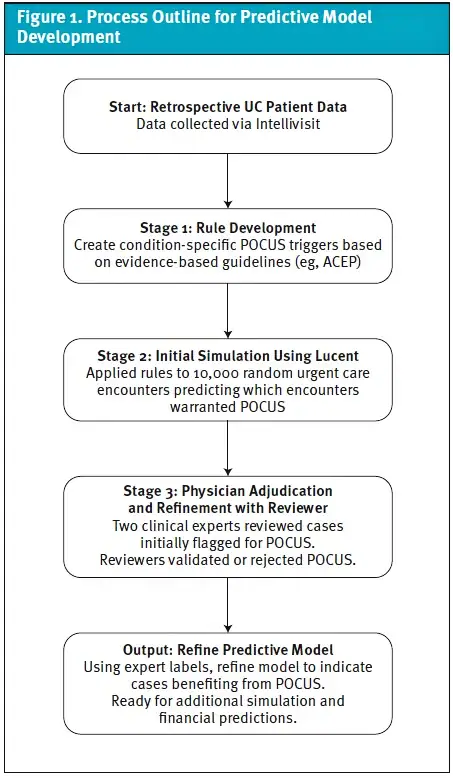
A prediction model (Figure 1) to categorize which patients would be candidates for POCUS assessment was developed using Lucent (UCP-Merchant Medicine, Minneapolis, Minnesota) software, which used an iteratively refined algorithm to process patient responses to a series of “yes/no” questions. The algorithm then used the patient’s answers to the guided interview, vital signs, chronic conditions, and demographic data to predict (ie, “recommend”) various diagnostic procedures, including ultrasound. These criteria were formulated using evidence-based guidelines and tailored to symptoms for conditions such as hydronephrosis, deep vein thrombosis (DVT), and soft tissue foreign body.1,[18],[19],[20] (Appendix on jucm.com).
Lucent was used to simulate the prediction output from the initial rule development for the 10,000 cases randomly selected. It was refined through a structured process of clinical evaluation and feedback to ensure the system aligns with medical best practices beginning with real-world cases that are labeled by physicians to create test-cases. These test-cases are then used to validate that the predictions remain appropriate as the system incorporates an increasingly large number of real-world UC cases.
The recommended procedures (ie, the model’s “output”) were iteratively refined through a physician-in-the-loop review process. This process of model training—which incorporates both machine learning (ML) and human expertise—allows for the IV algorithm to predict output that increasingly approaches that of a physician. Using Reviewer software (UCP-Merchant Medicine, Minneapolis, Minnesota), physician adjudication was performed by 2 physicians with extensive expertise in acute care and POCUS to determine the clinical appropriateness of POCUS for each case. This review occurred 3 times on 87 POCUS cases to ensure appropriateness prior to the program being applied to the entire sample. This process ensured that only patients with a verifiably high likelihood of benefiting from POCUS were predicted to undergo the procedure.
Financial Model Methodology
For this analysis a fee-for-service (FFS) model was assumed. In this model, each POCUS exam is presumed to be billed separately using Current Procedural Terminology (CPT) codes. Medicare reimbursement rates were used as a conservative baseline, acknowledging that private payer rates vary but rarely are less than those of Medicare.[21] To reflect current staffing trends in UC, we assumed that 75% of exams would be performed by advanced practice clinicians (APCs) and reimbursed at 0.85x the rate of a physicians’ rate. The remaining 25% of exams were assumed to be performed by physicians and billed at the full Centers for Medicare & Medicaid Services (CMS) rate.[22] Billing was assumed to begin only after clinicians were fully credentialed. A conservative 12-month delay for realization of reimbursement was also assumed to account for credentialing time.
Financial Overview and Break-Even Analysis
Implementing new technologies, such as POCUS, in UC settings involves significant financial considerations of varying complexity (eg, equipment costs, training expenses). Understanding these costs and the potential revenue from ultrasound procedures is crucial for UC centers’ ability to evaluate their financial implications.
UC centers initially incur costs from the purchase of ultrasound equipment, software, and staff training. Our cost model assumed purchasing a midrange handheld device with a cloud-based storage solution and incorporated expenses for initial training, refresher sessions, and image review. These costs were averaged over 3 years and calculated across scenarios ranging from a single clinic with 3 providers to large organizations with up to 100 clinics, demonstrating both upfront and ongoing investments as well as economies of scale. These assumptions resulted in annual costs ranging from $6,000/year/clinic for large organizations (approximately 100 centers) to $16,000/year for a single center over 3 years.
Statistical Methods
Logistic regression analysis was performed to assess associations between patient characteristics and POCUS indication recommendations, providing odds ratios with 95% confidence intervals. A chi-square test was used for initial proportion comparisons. Cohen’s Kappa was used to evaluate interrater agreement.[23] P-value for significance was set at <0.05. All analyses were performed in Python version 3.12 using scikit-learn package.[24],[25]
Ethics Statement
This modeling analysis used only de-identified patient data and therefore did not require Institutional Review Board review per Department of Health and Human Services regulations (45 CFR 46.102) as it did not constitute human subject research.
Table 1. Study Population Chief Complaints by Sex
| Chief Complaint | Patient Sex | Count (n) | Percent of Population (%) |
| Cough | Female | 944 | 9.44 |
| Male | 510 | 5.1 | |
| Sore Throat | Female | 873 | 8.73 |
| Male | 378 | 3.78 | |
| Sinus Problem | Female | 281 | 2.81 |
| Male | 125 | 1.25 | |
| Ear Pain | Female | 218 | 2.18 |
| Male | 85 | 0.85 | |
| Rash | Female | 155 | 1.55 |
| Male | 98 | 0.98 | |
| Urinary Frequency | Female | 222 | 2.22 |
| Male | 18 | 0.18 | |
| Urinary Problem | Female | 170 | 1.7 |
| Male | 27 | 0.27 | |
| Nasal Congestion | Female | 114 | 1.14 |
| Male | 73 | 0.73 | |
| Fever | Female | 104 | 1.04 |
| Male | 76 | 0.76 | |
| Eye Problem | Female | 110 | 1.1 |
| Male | 65 | 0.65 | |
| Abdominal Pain | Female | 90 | 0.9 |
| Male | 59 | 0.59 | |
| Back Pain | Female | 80 | 0.8 |
| Male | 65 | 0.65 | |
| Headache | Female | 92 | 0.92 |
| Male | 46 | 0.46 | |
| Urinary Tract Infection | Female | 120 | 1.2 |
| Male | 6 | 0.06 | |
| Skin Problem | Female | 61 | 0.61 |
| Male | 46 | 0.46 | |
| Productive Cough | Female | 55 | 0.55 |
| Male | 46 | 0.46 | |
| Dental Problems | Female | 48 | 0.48 |
| Male | 50 | 0.5 | |
| Left Ear Pain | Female | 65 | 0.65 |
| Male | 24 | 0.24 | |
| Flu Symptoms | Female | 57 | 0.57 |
| Male | 30 | 0.3 | |
| Ear Fullness | Female | 44 | 0.44 |
| Male | 42 | 0.42 | |
| Other | Female | 2,638 | 26.38 |
| Male | 1,590 | 15.9 | |
| Total | Female | 6,541 | 65.41 |
| Male | 3,459 | 34.59 |
Results
Of the 10,000 adult UC patient encounters analyzed by the algorithm, 922 (9.22%) were predicted to be candidates for at least 1 POCUS exam based on the diagnoses of concern. POCUS for lung assessment was significantly more likely to be recommended than any other exam by a wide margin (78.7%, χ² = 3138.68, p-value = < 0.0001). (Tables 1-3)
Table 2. Age Distribution of Study Population
| Patient Age (years) | Proportion of Study Population (%) |
| < 35 | 38.17 |
| 35 – 55 | 33.03 |
| 55 – 65 | 12.33 |
| 65 – 85 | 14.95 |
| ≥85 | 1.52 |
Logistic regression was used to evaluate the association between patient demographics (age, gender) and vital sign findings associated with greater odds for POCUS exam prediction. For lung/chest ultrasound, temperature >38ºC (odds ratio [OR] 2.11, 95% confidence interval [CI] 1.22-3.35), oxygen saturation <95% (OR 6.76, 95% CI 4.99-8.87), heart rate >120 beats per minute (OR 1.75, 95% CI 1.03-2.75), respiratory rate >20 breaths per minute (OR 1.96, 95% CI 1.60-2.39) were statistically significant predictors of POCUS being indicated. Remaining POCUS exams had too few predicted cases to evaluate whether these covariates were predictive for other exam types.
Table 3. Distribution of POCUS Recommendations by Indication
| Indication/Exam Type | Count (n) | Proportion Among All POCUS Studies (%) |
| Chest/Lung Ultrasound | 726 | 77.73 |
| DVT Rule-Out | 19 | 2.03 |
| Soft Tissue Foreign Body | 36 | 3.85 |
| Biliary Pathology | 38 | 4.07 |
| Hydronephrosis | 52 | 5.57 |
| Abscess | 63 | 6.75 |
| Total | 934 | 100 |
There was a high level of agreement (94%) between the expert physician reviewers on which cases warranted the use of POCUS (Cohen’s kappa=0.82). Guidelines suggest that a Cohen’s kappa greater than 0.81 represents near perfect agreement.10
Reimbursement Analysis for Projected Ultrasound Utilization
Based on our prediction model, POCUS exams performed for common UC conditions—such as hydronephrosis, gallbladder pathology, foreign bodies, and deep vein thrombosis (DVT) rule-out—would be expected to generate total reimbursement of $55,239 per 10,000 adult encounters or approximately $5.52 per encounter when using the physician global fee schedule (Table 4). If estimating revenue based on current staffing trends in UC using APCs more frequently, the total reimbursement estimate would be approximately $47,750 per 10,000 patient encounters or $4.77 per encounter.
Table 4. Ultrasound Billing Details
| POCUS Exam | CPT Code | Indication | Frequency | CMS Global Physician Fee | APC (85% Physician Fee) | Total Billable Amount | Adjusted Billable Amount |
| Renal | 76775 | Hydronephrosis | 52 | $59 | $50 | $3,068 | $2,600 |
| Soft tissue | 76882 | Abscess | 63 | $62 | $58 | $3,906 | $3,654 |
| Gallbladder | 76705 | Biliary Pathology | 38 | $84 | $71 | $3,192 | $2,698 |
| Soft Tissue | 76882 | Foreign body | 36 | $62 | $58 | $2,232 | $2,088 |
| Lower Extremity | 93971 | DVT | 19 | $115 | $98 | $2,185 | $1,862 |
| Lung | 76604 | Chest/Lung | 726 | $56 | $48 | $40,656 | $34,848 |
| TOTAL | 934 | $55,239 | $47,750 |
We calculated the “break-even” point—the number of encounters required for ultrasound-generated revenue to offset the program’s annual cost—using the following formula:
Break-Even Encounters = Annual Program Cost ÷ Reimbursement per Encounter
The “break-even” calculation assumes full reimbursement and accounts for the delay between initial financial outlay and realization of revenue. Achieving this number of encounters ensures that the initial and ongoing investments in ultrasound would not be expected to result in a financial loss. Based on this model for a single UC center, we estimate that initial expenses would be recouped after 3,354 visits utilizing POCUS; the same estimate projects initial expenses would be recouped for larger centers after 1,258 visits utilizing POCUS. (Table 5)
Table 5. Annual POCUS Exams Expected to Reach ‘Break-Even’ Point
| Scenario | 3-year Cost/Clinic (Annual) | Reimbursement/Visit | Break-Even Encounters |
| Large Organization (scaled costs) | $6,000 | $4.77 | 1,258 |
| Single Clinic (higher fixed costs) | $16,000 | $4.77 | 3,354 |
Discussion
The results of this study modeling the utility of POCUS among a real-world sample of 10,000 UC encounters suggests that POCUS could be both of relatively frequent clinical utility (with nearly 10% of UC cases predicted to have a POCUS indication) and financially viable. For the purposes of this study, POCUS indications were restricted to several of the most common clinical scenarios encountered in UC settings where POCUS can be billed as a separate procedure. As POCUS has myriad other clinical indications, the model likely underestimated the total aggregate proportion of cases in which POCUS might be used.
Clinical Relevance and Population Impact
POCUS utilization in UC may be influenced by access to alternative imaging modalities. Sites that have inconsistent radiology technologist staffing, for example, might not have the capability to provide urgent x-ray imaging consistently. POCUS, therefore, could be a solution to improve access to critical imaging, based on the relatively modest clinician training model.
High Prediction of Lung Ultrasound Utility: Implications
A notable finding from the analysis was that most cases in which POCUS use was predicted involved lung pathology, particularly pneumonia. This finding is important because the evidence supporting the accuracy of thoracic POCUS for diagnosis of pneumonia, especially at early stages of disease, is among the most robust.1,2,3,[26] The reproducibility of this finding across multiple studies was cited as justification by the American Thoracic Society (ATS) for recommending that POCUS be considered as a suitable alternative to CXR for evaluation of suspected pneumonia in adults.[27] Given the high proportion of respiratory complaints seen in UC centers, implementation of POCUS, even if limited to lung exams, could dramatically influence UC workflows[28] via expedited results, decreased patient movement within the UC, and revenue retention.
Financial Feasibility Analysis
The financial analysis revealed that implementing POCUS could be expected to be revenue neutral or better in average UC centers within approximately 1-2 years. Given the decreasing cost of handheld ultrasound devices, this financially viability calculation would be expected to become more favorable for UC centers over time.
Importantly, while the upfront and recurring costs of implementing POCUS are meaningful, an average UC operator predictably could reach the “break-even” point in 10.5 months (larger organizations) to 28 months (single centers) after billing is initiated. Achieving this financial return depends on sufficient patient volumes, timely clinician training and credentialing, and optimized billing practices. Additional budgetary benefits, which are less readily quantified, may also be realized by UC centers who differentiate themselves as early adopters of POCUS. These include improved clinician job satisfaction and retention and improved patient experience scores.15,[29] Conversely, it is also possible that there are other conceivable unmeasured costs as well that were unaccounted for (eg, possible increases in door-to-door times). These factors have not been studied in an UC setting and would be worthwhile focuses of future research.
Study Limitations
This study is limited by the assumptions involved in simulation-based research as well as the limitations of its retrospective and cross-sectional design. Additionally, while the prediction rule was developed with commonly used methodologies, it has not been externally validated, which would be a useful direction for future research.
Due to data limitations on injury severity, POCUS use in the assessment of the commonly considered musculoskeletal injuries seen in UC (eg, tendon rupture, fracture, joint effusions) was not included in the modeling predictions.[30] Our analysis also excluded children. POCUS has additional appeal in pediatrics as it obviates risks associated with ionizing radiation. The exclusion of both these groups suggests POCUS use cases could reasonably be higher with real-world UC implementation. Additionally, this study did not include high-acuity presentations as those would likely be immediately referred to an ED.
The limitations of the financial modeling include multiple assumptions including 100% FFS reimbursement using 2025 CMS Medicare rates. Many UC centers operate under mixed or capitated contracts where individual POCUS exams may not be separately reimbursed. We assumed 100% reimbursement, but in real-world practice this rate would certainly be somewhat lower for most UC operators. An assumption of 100% POCUS use among the indications was also used, however less universal use of POCUS by UC clinicians would be expected, at least initially.
Conclusion
In this analysis of 10,000 randomly sampled adult UC encounters, our model estimated that 9.2% of patients would be candidates for POCUS assessment as part of their UC evaluation. Lung ultrasound was the most common indication for POCUS use. Based on this level of use, our model suggests that POCUS could not only have clinical utility, but also generate revenue sufficient to offset costs in adult UC settings. While upfront investment and training are required, the “break-even” point projections from this modeling study suggest POCUS could be financial feasible in UC, even for smaller centers. As POCUS adoption in UC settings increases, future, real-world, UC-based studies focusing on POCUS implementation and its effects in UC will be critical for corroborating or refuting the predictions of this study’s model.
Manuscript submitted July 15, 2025; accepted December 3, 2025.
References
- [1]. American College of Emergency Physicians. Ultrasound guidelines: emergency, point-of-care and clinical ultrasound guidelines in medicine. Accessed September 15, 2025. https://www.acep.org/patient-care/policy-statements/ultrasound-guidelines-emergency-point-of–care-and-clinical-ultrasound-guidelines-in-medicine
- [2]. Andersen CA, Holden S, Vela J, Rathleff MS, Jensen MB. Point-of-care ultrasound in general practice: a systematic review. Ann Fam Med. 2019;17(1):61-69.
- [3]. Bhargava A, Bauml J, Goyal M. Point-of-care ultrasonography by family physicians. Am Fam Physician. 2018;98(3):200-202.
- [4]. Ayers AA. Who can take X-rays in an urgent care center? J Urgent Care Med. 2022;November:23-25. Accessed September 15, 2025. https://www.jucm.com/wp-content/uploads/2023/02/2022-17223-25-Health-Law.pdf
- [5]. Ayers AA. Benefits of limited-scope X-ray techs in the urgent care setting. J Urgent Care Med. 2022;December:39-40. Accessed September 15, 2025. https://www.jucm.com/wp-content/uploads/2023/02/2022-17339-40-Practice-Management2.pdf
- [6]. Hicks CM. Point-of-care ultrasound (POCUS) in urgent care. J Urgent Care Med. 2018;12(10):15-19. https://www.jucm.com/point-of-care-ultrasound-pocus-in-urgent-care/
- [7]. Eggleston AJ, Farrington E, McDonald S, Aziz S. Portable ultrasound technologies for estimating gestational age in pregnant women: a scoping review and analysis of commercially available models. BMJ Open. 2022;12(11):e065181. doi:10.1136/bmjopen-2022-065181
- [8]. Perez-Sanchez A, Johnson G, Pucks N, et al. Comparison of 6 handheld ultrasound devices by point-of-care ultrasound experts: a cross-sectional study. Ultrasound J. 2024;16:45. doi:10.1186/s13089-024-00392-3
- [9]. Baloescu C, Bailitz J, Cheema B, et al. Artificial intelligence–guided lung ultrasound by nonexperts. JAMA Cardiol. 2025;10(3):245-253. doi:10.1001/jamacardio.2024.4991
- [10]. Waldman, C, Tickes, R, Pelter, M. et al. Utility Of A Machine Learning Algorithm To Increase Physician Trainee Confidence In And Usage Of Point-Of-Care Echocardiography. JACC. 2022 Mar, 79 (9Supplement) 1824. https://doi.org/10.1016/S0735-1097(22)02815-7
- [11]. Flannigan MJ, Adhikari S. Point-of-care ultrasound work flow innovation: impact on documentation and billing. J Ultrasound Med. 2017;36(12):2467-2474. doi:10.1002/jum.14284
- [12]. Rong K, Chimileski B, Kaloudis P, Herbst MK. Impact of an epic-integrated point-of-care ultrasound workflow on ultrasound performance, compliance, and potential revenue. Am J Emerg Med. 2021;49:233-239. doi:10.1016/j.ajem.2021.06.009
- [13]. Zeidan A, Liu EL. Practical aspects of point-of-care ultrasound: from billing and coding to documentation and image archiving. Adv Chronic Kidney Dis. 2021;28(3):270-277. doi:10.1053/j.ackd.2021.06.004
- [14]. Capizzano JN, O’Dwyer MC, Furst W, et al. Current state of point-of-care ultrasound use within family medicine. J Am Board Fam Med. 2022;35(4):809-813. doi:10.3122/jabfm.2022.04.220019
- [15]. Balmuth AD, Tolan N, Patel N, et al. Point-of-care ultrasound in internal medicine: impact on patient satisfaction and diagnostic confidence. PLoS One. 2024;19(2):e0298665. doi:10.1371/journal.pone.0298665
- [16]. Andersen CA, Davidsen AS, Brodersen J. Patient experiences with point-of-care ultrasound in general practice: a qualitative study. BMC Fam Pract. 2021;22:125. doi:10.1186/s12875-021-01459-z
- [17]. Ayers AA. Six elements of a winning patient experience. J Urgent Care Med. 2015;May:19-24. Accessed September 15, 2025. https://www.jucm.com/wp-content/uploads/2021/02/2015-9819-24-Practice-Mgmt.pdf.
- [18]. Moore CL, Carpenter CR, Heilbrun ME, et al. Imaging in suspected renal colic: systematic review of the literature and multispecialty consensus. J Am Coll Radiol. 2019;16(9 Pt A):1132-1143. doi:10.1016/j.jacr.2019.04.004
- [19]. Park YH, Jung RB, Lee YG, et al. Does the use of bedside ultrasonography reduce emergency department length of stay for patients with renal colic?: a pilot study. Clin Exp Emerg Med. 2016;3(4):197-203. doi:10.15441/ceem.15.109
- [20]. Gottlieb M, Avila J, Chottiner M, Peksa GD. Point-of-care ultrasonography for the diagnosis of skin and soft tissue abscesses: a systematic review and meta-analysis. Ann Emerg Med. 2020;76(1):67-77. doi:10.1016/j.annemergmed.2020.01.004
- [21]. Trish E, Ginsburg P, Gascue L, Joyce G. Physician reimbursement in Medicare Advantage compared with traditional Medicare and commercial health insurance. JAMA Intern Med. 2017;177(9):1287-1295. doi:10.1001/jamainternmed.2017.2679
- [22]. Centers for Medicare & Medicaid Services. Search the Physician Fee Schedule. CMS website. Updated May 12, 2025. Accessed June 17, 2025. https://www.cms.gov/medicare/physician-fee-schedule/search
- [23]. Landis JR, Koch GG. The measurement of observer agreement for categorical data. Biometrics. 1977;33(1):159-174. doi:10.2307/2529310
- [24]. Pedregosa F, Varoquaux G, Gramfort A, et al. Scikit-learn: machine learning in Python. J Mach Learn Res. 2011;12:2825-2830.
- [25]. Python Software Foundation. Python Language Reference, version 3.12. Available at: https://www.python.org/
- [26]. Smith SM, Fahey T, Smucny J, Becker LA. Antibiotics for acute bronchitis. Cochrane Database Syst Rev. 2017;6(6):CD000245. doi:10.1002/14651858.CD000245.pub4
- [27]. Jones BE, Ramirez JA, Oren E, et al. Diagnosis and Management of Community-acquired Pneumonia. An Official American Thoracic Society Clinical Practice Guideline. Am J Respir Crit Care Med. Published online July 18, 2025. doi:10.1164/rccm.202507-1692ST
- [28]. Hart JH, Sakata T, Eve JR, et al. Diagnosis and treatment of pneumonia in urgent care clinics: opportunities for improving care. Open Forum Infect Dis. 2024;11(3):ofae096. doi:10.1093/ofid/ofae096
- [29]. Stewart de Ramirez S, Hammad A, Eichel R, et al. Patient satisfaction with the use of ultrasound for procedural guidance in the emergency department. J Emerg Med. 2014;47(5):527-532. doi:10.1016/j.jemermed.2013.05.045
- [30]. Motamedi D, Bauer AH, Patel R, Morgan TA. Problem solved: integral applications of musculoskeletal ultrasound. J Ultrasound Med. 2021;40(8):1693-1704. doi:10.1002/jum.15551
Author Affiliations: John Weissert, Intellivisit, UCP-Merchant Medicine, Minneapolis, Minnesota. Joshua Russell, MD, MSc, ELS, FCUCM, FACEP, Intellivisit, UCP-Merchant Medicine, Minneapolis, Minnesota. Tatiana Havryliuk, MD, HelloSono LLC, New York, New York. Authors have no relevant financial relationships with any ineligible companies.
