
Published on
Download the article PDF: Clinical Image Challenge December 2025
Differential Diagnosis
- Atrial fibrillation
- Normal sinus rhythm
- Complete heart block with ventricular escape
- Junctional rhythm
- Paced rhythm
Diagnosis
The diagnosis in this case is junctional rhythm. The ECG reveals regular and narrow QRS complexes with a ventricular rate of 60 beats per minute. There are no preceding P waves associated with the QRS complexes. Retrograde atrial activity can be seen immediately following the QRS complexes (Figure 2). There are no pacing spikes present to suggest a paced rhythm.
Discussion
This is a junctional rhythm with retrograde atrial conduction. Notice the retrograde P’ waves immediately following the QRS complexes (Figure 2). P waves conducted via normal, sinoatrial activity are negatively deflected in V1 and upright in the inferior leads (ie, depolarization occurs from superior to inferior); whereas retrograde conduction depolarizes the atria in the opposite direction, leading to upright P’ waves in V1 and negatively deflected P’ waves in the inferior leads (ie, depolarization occurs from inferior to superior).1
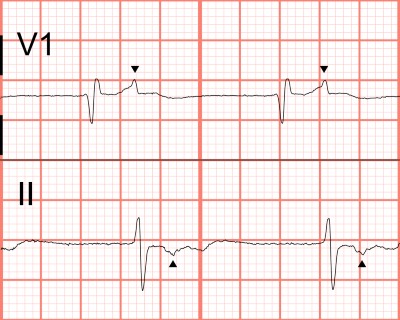
Under conditions of normal conduction, inferior pacemakers of the conduction system are suppressed by the most superior (and dominant) one – usually the sinoatrial node. When impulses from the dominant pacemaker fail to conduct distally or an ancillary pacemaker outpaces and usurps control, an “escape” rhythm results. When a superior pacemaker fails to generate impulses at a rate faster than an inferior one, then the faster, more inferior, one will “escape.”2
In our case, the sinus node failed to generate a rate that outpaced the junction, which led to a junctional escape rhythm with associated retrograde atrial conduction. Retrograde conduction occurs when the signal wavefront (which originates at the junction) extends superiorly throughout the atria. The escape rhythm will subside once the sinus node accelerates and regains control; however, if the sinus node is diseased (as was the case here), it may never regain control. This patient was referred to a nearby cardiac care center, where he received a permanent pacemaker.
What To Look For
- The atria normally depolarize from superior to inferior, creating negatively deflected P waves in V1 and positively deflected P waves in the inferior leads.
- Retrograde atrial conduction results in positively deflected P waves in V1 and negatively deflected P waves in the inferior leads.
- Inferior pacemakers will “escape” when a more superior pacemaker fails.
Pearls For Initial Management, Considerations For Transfer
- Unless young, healthy, and asymptomatic, patients with junctional rhythms should be referred to a nearby emergency department.
- If available, place pacing pads on the patient while awaiting transport.
References
- Cooper B, Giordano J, Fadial T, Reynolds C. ECG Stampede: Workbook. 1st ed. Null Publishing Group; 2024.
- Mattu A, Tabas J, Brady W. Electrocardiography in Emergency, Acute, and Critical Care. 2nd ed. The American College of Emergency Physicians; 2019.
