
Published on
Download the article PDF: Clinical Image Challenges January 2026
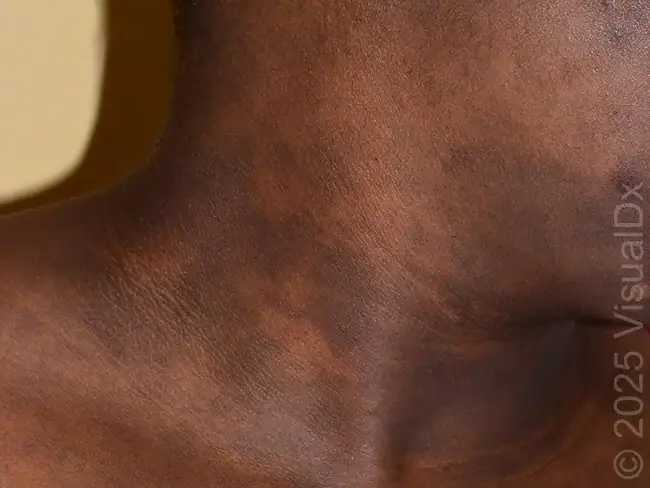
Differential Diagnosis
- Pellagra
- Pigmented contact dermatitis
- Lichen planus pigmentosus
- Post-inflammatory hyperpigmentation
- Lichenoid drug eruption
- Subacute cutaneous lupus erythematosus
Diagnosis
The correct diagnosis is lichen planus pigmentosus (LPP), a rare variant of lichen planus (LP). It is thought to be a hypersensitivity reaction to an unknown antigen leading to lichenoid inflammation and subsequent superficial dermal hyperpigmentation. LLP is most often a self-limiting disorder more commonly seen in adults over the age of 30, and among women and patients with darker skin tones. LPP typically presents with gray-brown or dark brown macules or patches most often found in sun-exposed or flexural areas, and pruritis is typically absent or minimal. Treatment is focused on accelerating resolution and managing pruritis, if present.
What to Look For
- A comprehensive history should be taken including a list of current medications, presence of oral or genital erosions, and dysphagia or odynophagia.
- The dermatologic exam should include the entire cutaneous surface, including the scalp, oral cavity and external genitalia.
- If available, a punch or shave biopsy reaching the depth of the mid-dermis is appropriate to confirm the diagnosis.
Pearls for Urgent Care Management
- Evidence suggests an association between LP and Hepatitis C (HCV) infection; testing for HCV infection may be appropriate if other risk factors are present.
- First line therapy is topical corticosteroids
- High potency cream or ointment twice daily for localized patches on the truck and extremities
- Mid or low potency cream or ointment twice daily on intertriginous or facial skin
- Efficacy should be assessed after two or three weeks.
- If pruritis is present, oral antihistamines may be helpful
- Patients should be cautioned about the risk for cutaneous atrophy with use of topical steroids
- Referral to dermatology is appropriate if topical steroids are not effective. Patients with refractory LP lesions may benefit from other treatments such as oral glucocorticoids, phototherapy and oral acitretin.
53-Year-Old Woman With Dark Patchy Spots on Face and Neck
1 2