
Published on
Download the article PDF: Clinical Image Challenges March 2026
Differential Diagnosis
- Rib fracture
- Chest wall contusion
- Pneumothorax
- Pulmonary contusion
- Intercostal muscle strain or tear
- Sternal fracture
- Hemothorax
Discussion
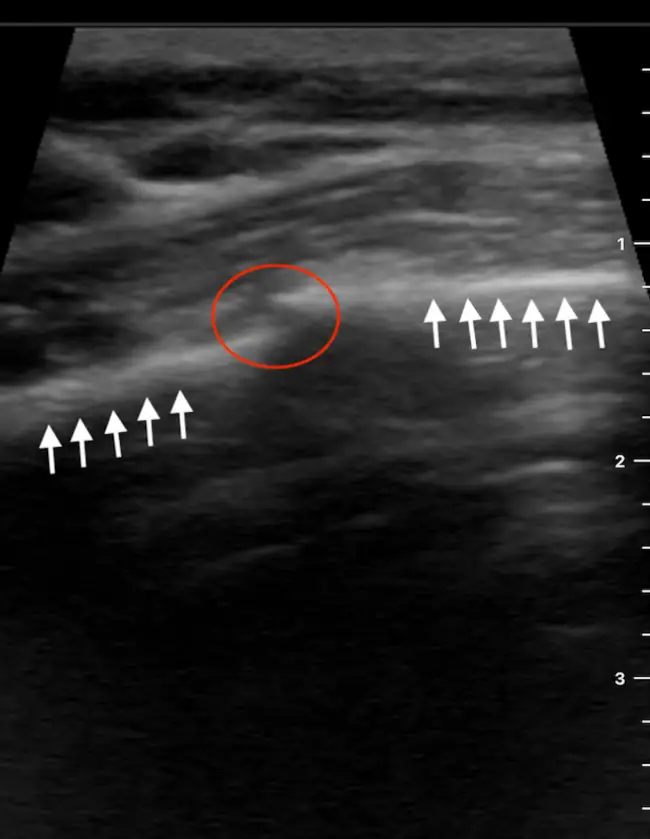
POCUS reveals a clear cortical interruption of the 4th anterior rib in the longitudinal plane. The linear hyperechoic bony cortex (white arrows) shows discontinuity with a minimal step-off (red circle) consistent with a nondisplaced rib fracture. There are no surrounding soft-tissue abnormalities, such as a hypoechoic mass suggestive of a hematoma or disruption of muscle architecture suggestive of a muscle tear.
POCUS demonstrates superior sensitivity (89-91%) and high specificity (98-99%) for detecting rib fractures compared to chest x-ray, which misses approximately 50-90% of rib fractures, especially if they are not displaced.1-3 In addition, POCUS is radiation-free and accessible at the bedside, unlike x-ray.
Ultrasound offers other advantages; it can be used to evaluate for soft tissue hematoma, muscle tears, cartilage injury and associated pulmonary complications, such as pneumothorax or hemothorax.1
In this case, a nondisplaced fracture was detected, while it was missed on a radiograph. This confirmed the provider’s suspicion and informed patient management. Management included nonsteroidal anti-inflammatory drugs for pain, activity modification, and counseling on the use of an incentive spirometer to prevent atelectasis. The patient was told to watch for signs of complications including worsening pain, dyspnea, or hemoptysis. He was discharged with outpatient follow-up.
What To Look For
- On a chest wall POCUS, a step-off or cortical discontinuity at the point of maximal tenderness is consistent with a rib fracture.
- Preserved lung sliding helps rule out pneumothorax.
- Interruption of muscle architecture suggests a muscle tear.
Pearls for Urgent Care Management
- Use POCUS in cases of chest wall trauma when x-rays are inconclusive, unavailable, or negative and clinical suspicion remains.
- Evaluate rib cortex, surrounding soft tissues, and lung sliding.
- Encourage use of incentive spirometry in patients with rib fractures to reduce pulmonary complications.
References
- Gilbertson J, Pageau P, Ritcey B, et al. Test Characteristics of Chest Ultrasonography for Rib Fractures Following Blunt Chest Trauma: A Systematic Review and Meta-analysis. Ann Emerg Med. 2022;79(6):529-539. doi:10.1016/j.annemergmed.2022.02.006
- Battle C, Hayward S, Eggert S, Evans PA. Comparison of the use of lung ultrasound and chest radiography in the diagnosis of rib fractures: a systematic review. Emerg Med J. 2019;36(3):185-190. doi:10.1136/emermed-2017-207416
- Expert Panel on Thoracic Imaging:, Henry TS, Donnelly EF, et al. ACR Appropriateness CriteriaRib Fractures. J Am Coll Radiol. 2019;16(5S):S227-S234. doi:10.1016/j.jacr.2019.02.019