
Published on
Download the article PDF: Wrist Pain Related To Rheumatoid Arthritis A Case Report
Urgent Message: Wrist pain and swelling are common presentations in urgent care. Several factors can help clinicians identify cases of rheumatoid arthritis in order to promptly refer patients to rheumatology.
Christina Williams, BS; Veronica Heitsch, MD
Keywords: rheumatoid arthritis; wrist pain; inflammatory arthritis; metacarpophalangeal joint; rheumatoid arthritis diagnosis; disease-modifying antirheumatic drugs
Questions for the Clinician at the Bedside
- When should rheumatoid arthritis be suspected in patients with wrist pain?
- What history and physical exam findings help differentiate rheumatoid arthritis from other etiologies of wrist pain?
- What labs could be done in urgent care to solidify a diagnosis of rheumatoid arthritis?
- What management can be initiated in urgent care for rheumatoid arthritis?
- Does time from presentation to treatment impact functional outcome?
Editor’s Note: While the images presented here are authentic, the patient case scenario is hypothetical.
Abstract
Rheumatoid arthritis (RA) is a chronic inflammatory disorder that presents with bilateral pain and stiffness, typically involving the proximal interphalangeal, metacarpophalangeal, and metatarsophalangeal joints. Diagnosis relies on the 2010 American College of Rheumatology criteria, which include components of history, physical examination, inflammatory markers (erythrocyte sedimentation rate, C-reactive protein), and radiologic evidence. Urgent care clinicians should consider RA in patients with compatible symptoms and promptly refer to rheumatology for early initiation of disease-modifying antirheumatic drugs to prevent progression.
Introduction
Rheumatoid arthritis (RA) is an autoimmune disease that is characterized by inflammation of the synovial membrane, destruction of articular cartilage, and bone erosion.1 The proximal interphalangeal joints (IPJ), metacarpophalangeal joints (MCPJ), and metatarsophalangeal joints (MTPJ) are usually affected first.2 Presentation typically starts with pain in the hands or feet that is worse in the morning and improves with activity. The pain can be accompanied by bogginess over the synovial membrane that usually responds well to nonsteroidal anti-inflammatory drugs (NSAIDs). RA can also be associated with systemic features including generalized weakness, exhaustion, and low-grade fever.3 As the disease progresses, it can cause joint space narrowing, joint pannus, and abnormal tissue growth, leading to physical abnormalities and decreased function of joints.1 In certain cases, systemic consequences of RA can include interstitial lung disease (ILD) and cardiovascular complications.1,2
Clinical Scenario
A 63-year-old woman presented to an urgent care center for 6 months of intermittent bilateral wrist pain, 15-pound unintentional weight loss, and fatigue. The wrist pain had increased 1 week prior to the visit and was accompanied by swelling, decreased range of motion, and stiffness. The symptoms were worse in the morning and were relieved with NSAIDs, warm compresses, and activity. She denied any numbness, tingling, injury, fever, weakness or pain in hips, weakness or pain in shoulders, swelling in feet or toes, rash, erythema in wrists, or wounds. The patient had used ibuprofen in the past; however, due to the worsening of symptoms, ibuprofen had not been working.
Physical exam revealed normal vital signs and boggy joints localized to the bilateral wrist joints and MCPJ. Tenderness to palpation was noted diffusely throughout both wrists and the first through fourth MCPJs. Neurovascular status was intact with 2+ bilateral symmetric radial pulses. There were no rashes.
An x-ray of the hands and wrists was performed, which showed joint space narrowing within MCPJs, bony erosions in the carpal bones, and periarticular osteopenia in the interphalangeal joints. When calculating a rheumatoid arthritis classification criteria score, it was positive for indication of rheumatoid arthritis.
Discussion
The differential diagnoses of wrist pain include overuse syndrome, carpal tunnel syndrome, malignancy (with weight loss), septic arthritis, polymyalgia rheumatica (PMR), osteoarthritis (OA), psoriatic arthritis, crystal arthritis (gout or calcium pyrophosphate deposition disease [CPPD]), or acute coronary syndrome (ACS) in the appropriate clinical situation. In this patient, the bilateral joint symptoms, weight loss, fatigue, and radiologic findings are consistent with a diagnosis of rheumatoid arthritis.
Pathophysiology
Although the cause of RA is unknown, genetic and environmental exposures have been considered risk factors.1 Some modifiable risk factors for RA include smoking cigarettes, obesity, and nulliparity. Smoking not only increases the risk of getting RA, but it also exacerbates the disease.3 Medical intervention for RA can be hindered by obesity.3 Genetic factors that increase the risk of RA include HLA class II genotypes (HLA-DR4, HLA-DRB1), autoantibodies against autoantigens such as anticitrullinated peptide antibodies (ACPA), and rheumatoid factor (RF) antibodies against immunoglobulin G.1,3 The HLA class II genotypes inflate the risk of RA when accompanied by smoking and obesity.3 Patients who are ACPA-positive but RF-negative typically exhibit a less pronounced inflammatory response, and symptom onset may be delayed for up to 10 years.¹ In contrast, patients who are positive for both ACPA and RF demonstrate a more robust inflammatory response, with clinical symptoms potentially emerging within months, even when only a subset of inflammatory factors is detectable.1
Epidemiology
RA is 1 of more than 100 conditions classified under the broader diagnosis of arthritis. In the United States (US), approximately 21.2% of adults aged 18 years and older have some form of arthritis.4 RA affects approximately 1% of the global population, with an estimated 1.3 million adults affected in the US, representing approximately 0.6% to 1% of the US adult population.5
The National Health and Nutrition Examination Survey (NHANES) is a nationally representative, self-reported survey that evaluates the health and nutritional status of adults and children in the US. Data from the 2005–2018 NHANES demonstrated fluctuating age-adjusted RA prevalence rates in both genders.5 During this period, a significantly higher risk of RA was observed among non-Hispanic African Americans and individuals from low-income families, whereas individuals with higher levels of education demonstrated a lower risk.5
RA can present at any age; however, incidence typically peaks in the late 40s to early 50s and occurs 2 to 3 times more frequently in women than in men.1,3 The incidence of RA has increased over time. Between 1990 and 1995, the incidence of RA in the United Kingdom (UK) was approximately 40 per 100,000 person-years.2 A 2023 study of 22 million individuals in the UK reported an increase in incidence from 50 per 100,000 person-years in 2000–2002 to 94 per 100,000 person-years in 2017–2019.2,6
A systematic review and meta-analysis utilizing ProQuest, MEDLINE, Web of Science, and EMBASE evaluated global RA prevalence between 1980 and 2019.7 The average point prevalence of RA was 51 per 10,000 individuals, and the average period prevalence was 56 per 10,000 individuals. Prevalence was higher in urban areas compared to rural areas; however, this difference may reflect reduced access to healthcare in rural regions as well as varying environmental risk factors.7
Diagnostic Criteria
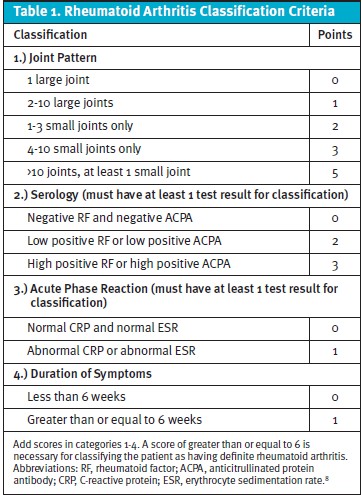
The 2010 American College of Rheumatology–European League Against Rheumatism (ACR-EULAR) Classification Criteria for Rheumatoid Arthritis assigns a numerical value to the number and size of affected joints, the duration of symptoms, and abnormal lab values to help determine if someone has RA. A score greater than 6 meets the criteria for RA (Table 1).8
Add scores in categories 1-4. A score of greater than or equal to 6 is necessary for classifying the patient as having definite rheumatoid arthritis. Abbreviations: RF, rheumatoid factor; ACPA, anticitrullinated protein antibody; CRP, C-reactive protein; ESR, erythrocyte sedimentation rate.8
Understanding The Anatomy
The joints most likely affected by RA are the MCPJ, IPJ, carpals, and MTPJ (Figure 1). These joints are synovial joints that have articular cartilage between the bones to prevent friction. The articular cartilage inner surface is lined by a thin synovial membrane, which secretes synovial fluid.9 RA causes chronic inflammation that destroys the articular cartilage, leading to bone erosion, and narrowing of the joint space. These modifications cause pain, deformities, and decrease function of the joints.1
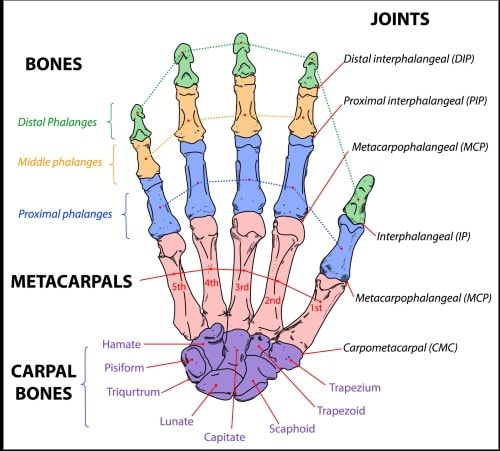
The wrist is composed of the distal radius, distal ulna, 8 carpal bones, and the base of the metacarpals.10, 11 From lateral to medial, the proximal row of the carpal bones includes scaphoid, lunate, triquetrum and pisiform. From lateral to medial, the distal row of the carpal bones includes trapezium, trapezoid, capitate, and hamate.11 The ligaments of the carpus consist of extrinsic and intrinsic ligaments that provide stability for the carpal bones. Six muscles of the forearm insert at the distal carpals of the wrist or the base of the metacarpal bones. These muscles consist of flexor carpi radialis, palmaris longus, flexor carpi ulnaris, extensor carpi ulnaris, extensor carpi radialis brevis, and extensor carpi radialis longus.11 These muscles are innervated by the median, ulnar, and radial nerves.
Patient History
Bilateral wrist pain and swelling are common presentations of RA. Further evaluation should include assessment of the duration of the pain, time of onset, and any alleviating or aggravating factors. Clinical features suggestive of RA include bilateral wrist pain, stiffness, and swelling that is worse in the morning and symptoms improve with movement and NSAIDs.1,3 The denial of fever, pain in shoulders and hip, pain or swelling in feet, and trauma helps guide the diagnosis. Decreased function of affected joints is often most noticeable in the morning in patients with RA. Asking open-ended questions can help identify this feature. It is important to ask about pain, swelling, and erythema in the feet to differentiate between gout and RA. Obtain a thorough history, including descriptions of pain (such as sharp, dull, or achy), the presence of weakness in the shoulders and hip girdles that may be associated with the pain, the site of any numbness or tingling in extremities, and range of motion changes. These questions can help rule out other causes and get an idea of the severity of RA. Also inquiring about trauma, fever, rash, and fatigue can help determine how to proceed with further evaluation. Documentation of the specific joints affected, and the extent of joint involvement is essential for guiding diagnosis as well.
The 2010 ACR-EULAR can further assist in defining the diagnosis. A thorough evaluation should also include screening for sensory changes, numbness, paresthesia in the extremities, chest pain, dyspnea, and cutaneous abnormalities. While these features are more commonly associated with advanced disease, they may also indicate extra-articular complications such as RA-associated cardiovascular disease, rheumatoid vasculitis, ILD, and necrotizing vasculitis affecting small- to medium-sized arteries.1
Physical Exam
Begin by assessing the hands and wrist joints, followed by the elbows, shoulders, knees, ankles, feet, and toes, looking for swelling and deformities. In severe RA, there may be deformities such as hyperextension of the distal interphalangeal joint (DIP) and flexion of the proximal interphalangeal joint (PIP) (boutonniere deformity), medial side bending of the phalanges (ulnar deviation), hyperextension of the PIP, and flexion of the DIP joints (swan neck). Swelling is generally palpated within the joint capsule along the joint line. During an RA flare, the joints may have an acute presentation, feeling warm and boggy (synovitis). Passive and active range of motion should be performed to evaluate joint stiffness. Pain usually is increased by palpation and movement of the affected joints. On exam, it is important to compare bilateral joints to determine if the symptoms are bilateral or unilateral. It is important to note which and how many joints are swollen, painful, and deformed, to help classify RA using 2010 ACR-EULAR classification criteria.
While examining the feet for swelling, also look for erythema and edema in the first metatarsophalangeal joint, which is a distinguishing characteristic for gout. In a patient with a subjective fever, make sure to use a reliable method to obtain the patient’s temperature to aide in evaluation of systemic infection. RA can cause decrease in range of motion, so assessing range of motion in all joints is necessary to evaluate the extent of damage.
Imaging
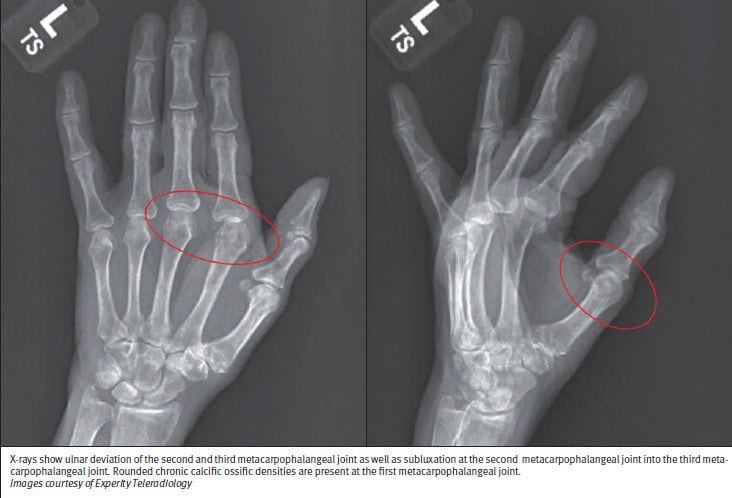
Radiographic imaging of the hands, wrists, feet, or knees will demonstrate the presence and extent of joint space narrowing, bony erosion, ankyloses (fusion), subluxation, and joint mutilation, all of which are characteristics of RA (Images 1-2).1 These images may include posteroanterior or anteroposterior, lateral, and oblique, however, a scaphoid view of the wrist may be ordered. Radiologically, RA often exhibits lateral erosion, distinguishing it from OA, which typically demonstrates central erosions. Bony erosion in early RA is not usually detectable on plain radiographs, therefore utilizing ultrasound or magnetic resonance imaging with contrast would be of better utility.1, 12
Differential Diagnosis
In this patient case, RA is the most likely diagnosis. RA classically manifests as symmetric, boggy joint swelling, prolonged morning stiffness, and joint pain that improves with activity, all of which were present during this visit. The involvement of the PIP joints and wrists further supports RA as the leading diagnosis.1,3
Septic arthritis is an emergent diagnosis of exclusion and should be on the differential of monoarthritis. Evaluating the patient for fever, monoarthritic joint pain and swelling, and erythema can help guide next steps. Risk factors for septic arthritis are open sores (such as diabetic or decubitus ulcers), penetrating injuries, and tuberculosis. It is important to treat and diagnose septic arthritis in early stages to decrease risk of cartilage and joint destruction. The presence of bilateral arthritis and absence of fever in septic arthritis is not likely.12
Psoriatic arthritis was also considered, as it can present with joint pain, morning stiffness, swelling, and fatigue like RA. However, the absence of characteristic psoriatic skin findings, such as gray or silver scaly plaques on the extensor surfaces, makes this diagnosis less likely.1,3
OA, a degenerative joint disease, typically presents with firm joint swelling and pain that worsens with activity and toward the end of the day. In contrast, this patient’s symptoms improved with activity and were associated with inflammatory features, making OA a less likely etiology.1,3
Crystal-induced arthropathies, including gout and CPPD, were also considered. These conditions are commonly characterized by acute onset of severe pain, erythema, and edema, most often affecting the first metatarsophalangeal joint. The absence of these hallmark features and the distribution of joint involvement in this patient make these diagnoses less likely than inflammatory arthritis.1,3
PMR is another inflammatory condition associated with stiffness and pain; however, it primarily affects the shoulder and hip girdles. Given that this patient’s symptoms predominantly involved the PIP joints of the hands and the wrists, PMR is unlikely in this case.1,3
Urgent Care Management
Initial management should focus on pain management, initiating an anti-inflammatory medication such as an NSAID and/or acetaminophen.1,2,3,13 Resistance exercises should be recommended as a meta-analysis has demonstrated that these decrease disease activity and erythrocyte sedimentation rate (ESR).14 A referral to a rheumatologist for continued care should be provided. A rheumatologist likely will manage and monitor disease modifying antirheumatic drugs (DMARDs) to improve the function of affected joints.
Next-Level Urgent Care Pearls
- In patients with nontraumatic wrist pain, RA should be on the differential diagnosis.
- RA can be distinguished from other degenerative joint diseases through history and physical examination.
- Radiological and laboratory values can help diagnose and determine the degree of joint damage.
- Treatment with DMARDs early can decrease the progression of RA.
- Septic arthritis must be urgently considered given its potential for rapid joint destruction. It can be ruled out through a thorough physical examination, arthrocentesis with synovial fluid analysis, appropriate laboratory studies, and ultrasound imaging.
Red Flags And Legal Pitfalls
- Include RA in the differential diagnoses of nontraumatic wrist pain.
- Consider other diagnoses including septic arthritis, osteoarthritis, polymyalgia rheumatica, psoriatic arthritis, crystal arthritis (gout or CPPD).
- Educate the patient on the importance of following up with a rheumatologist to obtain long-term treatment.
Clinical Scenario Conclusion
In the urgent care, radiographs demonstrated joint space narrowing within MCPJs, bony erosions in the carpal bones, and periarticular osteopenia in the interphalangeal joints. The 2010 ACR-EULAR score of 6 for this patient assisted with RA diagnosis. The patient was given ibuprofen and acetaminophen to decrease the inflammation in the joints and manage pain. She was given a referral to a rheumatologist and physical therapy to help with decreased range of motion. The rheumatologist ordered antinuclear antibodies, C-reactive protein, erythrocyte sediment rate, RF, and ACPA to set a baseline for disease and develop a treatment plan. The rheumatologist prescribed methotrexate monotherapy for the patient.
Takeaway Points
- RA typically presents in the IPJ, MCPJ, and MTPJ as pain and stiffness that is worse in the morning and improves with activity.
- Swelling in joints affected by RA may be boggy and warm—compared to OA, in which the swelling is firm.
- Anti-inflammatory medication may be successful in treating RA-associated swelling and pain.
- A referral to a rheumatologist is essential for consideration of DMARDs.
Manuscript submitted August 15, 2025; accepted February 16, 2026.
Author Affiliations: Christina Williams, BS, medical student, Ohio University Heritage College of Osteopathic Medicine. Veronica Heitsch, MD, Adena Health System. Authors have no relevant financial relationships with any ineligible companies.
References
- Aletaha D, Smolen JS. Diagnosis and Management of Rheumatoid Arthritis: A Review. JAMA. 2018;320(13):1360-1372. doi:10.1001/jama.2018.13103
- Brown P, Pratt AG, Hyrich KL. Therapeutic advances in rheumatoid arthritis. BMJ. 2024;384:e070856. Published 2024 Jan 17. doi:10.1136/bmj-2022-070856
- Cush JJ. Rheumatoid Arthritis: Early Diagnosis and Treatment. Rheum Dis Clin North Am. 2022;48(2):537-547. doi:10.1016/j.rdc.2022.02.010
- Almutairi KB, Nossent JC, Preen DB, Keen HI, Inderjeeth CA. The Prevalence of Rheumatoid Arthritis: A Systematic Review of Population-based Studies. J Rheumatol. 2021;48(5):669-676. doi:10.3899/jrheum.200367
- Xu Y, Wu Q. Prevalence Trend and Disparities in Rheumatoid Arthritis Among US Adults, 2005–2018. J Clin Med. 2021; 10(15):3289. https://doi.org/10.3390/jcm10153289
- Conrad N, Misra S, Verbakel JY, et al. Incidence, prevalence, and co-occurrence of autoimmune disorders over time and by age, sex, and socioeconomic status: a population-based cohort study of 22 million individuals in the UK. Lancet. 2023;401(10391):1878-1890. doi:10.1016/S0140-6736(23)00457-9
- Fallon EA, Boring MA, Foster AL, et al. Prevalence of Diagnosed Arthritis – United States, 2019-2021. MMWR Morb Mortal Wkly Rep. 2023;72(41):1101-1107. Published 2023 Oct 13. doi:10.15585/mmwr.mm7241a1
- Aletaha D, Neogi T, Silman AJ, et al. 2010 Rheumatoid arthritis classification criteria: an American College of Rheumatology/European League Against Rheumatism collaborative initiative. Arthritis Rheum. 2010;62(9):2569-2581. doi:10.1002/art.27584
- Betts GJ, Young KA, Wise JA, et al. Anatomy and Physiology 2e. OpenStax. Published April 20, 2022. Accessed February 22, 2026. https://openstax.org/books/anatomy-and-physiology-2e/pages/1-introduction.
- Reavey PL, Hammert WC. Examination of the Wrist. Plast Reconstr Surg. 2021;147(2):284e-294e. doi:10.1097/PRS.0000000000007520
- Eschweiler J, Li J, Quack V, et al. Anatomy, Biomechanics, and Loads of the Wrist Joint. Life (Basel). 2022;12(2):188. Published 2022 Jan 27. doi:10.3390/life12020188
- Ezzati F, Pezeshk P. Radiographic Findings of Inflammatory Arthritis and Mimics in the Hands. Diagnostics (Basel). 2022;12(9):2134. Published 2022 Sep 2. doi:10.3390/diagnostics12092134
- Fraenkel L, Bathon JM, England BR, et al. 2021 American College of Rheumatology Guideline for the Treatment of Rheumatoid Arthritis. Arthritis Care Res (Hoboken). 2021;73(7):924-939. doi:10.1002/acr.24596
- Wen Z, Chai Y. Effectiveness of resistance exercises in the treatment of rheumatoid arthritis: A meta-analysis. Medicine (Baltimore). 2021;100(13):e25019. doi:10.1097/MD.0000000000025019
Read More