
Published on
Download the article PDF: Wheezing As A Pneumothorax Presentation A Case Report
Urgent Message: For patients with presumed asthma exacerbation, clinicians must maintain a high index of suspicion for other etiologies, including pneumothorax. This may help avoid delays in potentially life-saving interventions when symptoms persist despite treatment or when physical exam findings are atypical.
Badi Eghterafi, DO; Nazanin Hazhir Karzar, MD
Keywords: asthma, wheezing, chest pain, pneumothorax, spontaneous pneumothorax
Abstract
Introduction: Large spontaneous pneumothorax is an uncommon but critical complication in patients with asthma. Clinicians evaluating presumed asthma exacerbations should maintain a broad differential diagnosis for the underlying cause of symptoms.
Case Presentation: A 34-year-old female with asthma and gastroesophageal reflux disease presented to urgent care with 2 weeks of progressive shortness of breath, chest pain, and cough. Despite temporary relief at home with nebulized albuterol, her symptoms worsened. On arrival, vital signs were stable. Physical exam demonstrated right-sided wheezing and significantly diminished airflow on the left. Standard therapy with corticosteroids and ipratropium-albuterol yielded minimal improvement.
Diagnostic Evaluation and Management: Due to persistent symptoms and chest pain, an electrocardiogram (ECG) and chest x-ray (CXR) were performed. The ECG showed normal sinus rhythm. The CXR revealed a large left-sided pneumothorax with complete lung atelectasis, and the patient was transferred to the emergency department for definitive management.
Conclusion: Chest radiographs are not routinely indicated in uncomplicated asthma exacerbations. However, they are essential when: 1) physical exam findings are suggestive (eg, unilateral diminished breath sounds or hyperresonance); 2) expected clinical improvement does not occur; or 3) diagnostic uncertainty exists.
Introduction
A pneumothorax is defined as gas in the pleural space and can be divided into 2 categories: spontaneous and nonspontaneous. Spontaneous pneumothoraces are further categorized into primary and secondary. Primary spontaneous pneumothoraces (PSPs) occur without an external event and in the absence of lung disease.1-3 Epidemiologically, males are 3 to 6 times more at risk (about 7 per 100,000 population per year in the United States) than females (1.2 per 100,000 population) in developing PSP. Incidences are higher between the ages of 15-30 years and 40-45 years.4-6 Risk factors for PSP include apical subpleural blebs (that rupture as a result of increasing negative pressure or greater mechanical alveolar stretch) and cigarette/marijuana smoking. Those who smoke more than 1 pack per day increase their risk by 102-fold.7-9 Genetics also play a role: Mutations in human leukocyte antigen, alpha-1 antitrypsin, and fibrillin-1 genes have been associated with a greater chance of developing PSP.10-12
In contrast to PSP, secondary spontaneous pneumothorax (SSP) is defined as a pneumothorax secondary to underlying lung disease (eg, cystic fibrosis, chronic obstructive pulmonary disease [COPD], asthma),1,13 infections (eg, tuberculosis, human immunodeficiency virus, Pneumocystis jiroveci, necrotizing pneumonia),14-16 congenital lung disease, interstitial lung disease (eg, sarcoidosis), connective tissue disease syndromes (eg, Marfan syndrome, Ehlers-Danlos syndrome, polymyositis, dermatomyositis, juvenile idiopathic arthritis), malignancy (whether primary lung cancer or metastatic disease), and airway obstruction secondary to foreign body aspiration.17-22 SSP also has a male predominance, however, and usually presents in patients greater than 55 years of age. The most common cause is COPD, accounting for approximately 50-70% of cases, while asthma accounts for approximately 5% of cases.1,2
The final category of pneumothoraces includes those that are nonspontaneous, which include traumatic pneumothorax (due to penetrating trauma or due to iatrogenic causes induced by medical procedures), anorexia nervosa, illicit drug use, and (less commonly) air travel and scuba diving.23-32
Case Presentation
A 34-year-old female with a past medical history significant for asthma and gastroesophageal reflux disease presented to the urgent care clinic with a 2-week history of shortness of breath and cough. She reported experiencing intermittent wheezing over the preceding several months, which typically resolved with the use of her albuterol inhaler, and her home regimen did not include a maintenance steroid inhaler. However, during the 2 weeks prior to urgent care presentation, her shortness of breath and cough had become constant and unresponsive to both her albuterol inhaler and nebulized albuterol treatments.
One day prior to presentation, the patient developed left-sided chest pain described as sharp and pleuritic in nature, which lasted several seconds and occurred intermittently without identifiable triggers or alleviating factors. She denied radiation of pain, diaphoresis, dizziness, or abdominal discomfort.
The patient had no known drug allergies. She denied smoking cigarettes, vaping, or illicit drug use and reported consuming alcohol socially. She denied any significant family history and had no prior surgical history.
Vital signs included:
- Temperature: 37.1°C
- Heart rate: 72 beats/minute
- Respiratory rate: 14 breaths/minute
- Blood pressure: 123/76 mm Hg
- Oxygen saturation: 98% on room air
Physical exam included:
- General: appeared mildly anxious; no use of accessory muscles or retractions
- Heart: regular rate and rhythm without murmurs, gallops, or rubs
- Lungs: wheezing on the right with diminished airflow on the left
- Abdomen: soft, no pain or pulsatile mass; bowel sounds were normal
- Lower extremities: no swelling
- Pulses: 2+ and equal bilaterally in carotid, radial, popliteal, and dorsalis pedis areas
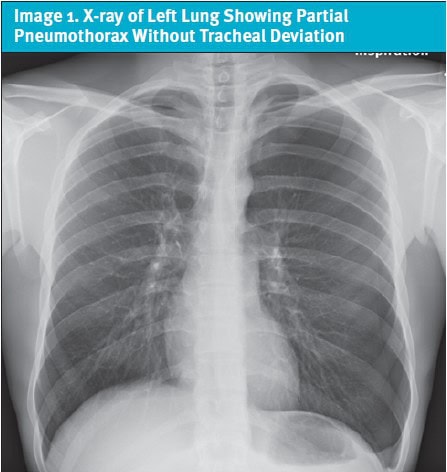
An electrocardiogram (ECG) was performed, which showed normal sinus rhythm. The patient was given 125 mg of methylprednisolone sodium succinate intramuscularly and started on 0.5-2.5 mg/3 mL ipratropium-albuterol nebulizer treatment. Upon re-evaluation 30 minutes later, the patient’s wheezing remained unchanged, and breath sounds remained unequal. She reported only marginal improvement and continued to complain of chest pain. As such, a chest x-ray (CXR) was ordered, which demonstrated a very large left-sided pneumothorax without tracheal deviation (Image 1).
Disposition
Due to these radiographic abnormalities, the patient was transferred to the emergency department (ED) via ambulance for further evaluation.
Discussion
Asthma exacerbations make up about 10% of visits to urgent care centers and EDs, although visits vary by state.33 CXR is not routinely indicated in the diagnostic evaluation or management of uncomplicated asthma. However, imaging becomes clinically relevant in specific scenarios where complications or alternative diagnoses must be considered. A chest x-ray should be obtained in cases of severe asthma exacerbation, particularly when hospitalization is required, to evaluate for potential complications such as pneumothorax, pneumonia, or pneumomediastinum.34,35 It is also appropriate when patients demonstrate an inadequate response to standard treatment with bronchodilators and corticosteroids. Additionally, imaging is warranted when atypical clinical features are present, including pleuritic chest pain, localized crackles, subcutaneous emphysema, persistent fever, leukocytosis, or hypoxemia, which may suggest an alternative or concurrent pathology.
In pediatric populations, chest radiography should be reserved for those with severe, atypical, or refractory presentations to differentiate asthma from other causes of wheezing or respiratory distress.34,35 Distinguishing between asthma symptoms and SSP poses a challenge as both can present with respiratory distress, tachycardia, tachypnea, desaturation, hyperexpansion, and decreased airway entry. Chest pain, shortness of breath, and ipsilateral hyper-resonance may help lead a clinician to suspect SSP; therefore, a CXR should be obtained to determine a possible cause other than an asthma exacerbation unresponsive to treatment.36,37
Of note, patients may have a normal physical exam with small pneumothoraces (involving less than 15% of the hemithorax).1 Asthma increases the risk of pleural bleb rupture and pneumothorax in susceptible individuals, as bronchospasm and hyperinflation elevate pleural pressures required for ventilation. Our case study highlights an unusual presentation of SSP in a patient who exhibited normal vital signs and only had asthma as a single risk factor.
Ethics Statement
Due to the rapid transfer of the patient to a higher level of care, patient consent and perspectives were not obtained. An effort was made to contact the patient, but it was unsuccessful. Details of the case have been changed to protect patient anonymity and confidentiality.
Takeaway Points
- Pneumothorax can mimic asthma exacerbations with overlapping symptoms.
- Asthma increases the risk for pneumothorax.
- Physical exam findings may be normal if a pneumothorax is small (less than 15% of hemithorax).
- Further evaluation with imaging is warranted when the asthma exacerbation presentation is atypical or unresponsive to treatment.
Manuscript submitted June 8, 2025; accepted January 14, 2026.
References
- Sahn SA, Heffner JE. Spontaneous pneumothorax. N Engl J Med. 2000;342(12):868-874.
- Gobbel WG Jr, Rhea WG Jr, Nelson IA, Daniel RA. Spontaneous pneumothorax. J Thorac Cardiovasc Surg. 1963;46:331-335.
- Lesur O, Delorme N, Fromaget JM, et al. Computed tomography in the etiologic assessment of idiopathic spontaneous pneumothorax. Chest. 1990;98(2):341-347.
- Light RW. Pleural diseases. 6th ed. Lippincott Williams & Wilkins; 2013.
- Comelli I, Bologna A, Ticinesi A, et al. Incidence of primary spontaneous pneumothorax is not associated with microclimatic variations: results of a seven-year survey in a temperate climate area. Monaldi Arch Chest Dis. 2017;87(1):7936.
- Mitani A, Hakamata Y, Hosoi M, et al. The incidence and risk factors of asymptomatic primary spontaneous pneumothorax detected during health check-ups. BMC Pulm Med. 2017;17:177.
- Bense L, Eklund G, Wiman LG. Smoking and the increased risk of contracting spontaneous pneumothorax. Chest. 1987;92(6):1009-1012.
- Cheng YL, Huang TW, Lin CK, et al. The impact of smoking in primary spontaneous pneumothorax. J Thorac Cardiovasc Surg. 2009;138(1):192-195.
- Hedevang Olesen W, Katballe N, Sindby JE, et al. Cannabis increased the risk of primary spontaneous pneumothorax in tobacco smokers: a case-control study. Eur J Cardiothorac Surg. 2017;52(4):679-685.
- Abolnik IZ, Lossos IS, Zlotogora J, Brauer R. On the inheritance of primary spontaneous pneumothorax. Am J Med Genet. 1991;40(2):155-158.
- Graham RB, Nolasco M, Peterlin B, Garcia CK. Nonsense mutations in folliculin presenting as isolated familial spontaneous pneumothorax in adults. Am J Respir Crit Care Med. 2005;172(1):39-44.
- Cardy CM, Maskell NA, Handford PA, et al. Familial spontaneous pneumothorax and FBN1 mutations. Am J Respir Crit Care Med. 2004;169(11):1260-1262.
- Flume PA, Strange C, Ye X, et al. Pneumothorax in cystic fibrosis. Chest. 2005;128(2):720-728.
- Afessa B. Pleural effusion and pneumothorax in hospitalized patients with HIV infection: the Pulmonary Complications, ICU Support, and Prognostic Factors of Hospitalized Patients With HIV (PIP) Study. Chest. 2000;117(4):1031-1037.
- Travis WD, Pittaluga S, Lipschik GY, et al. Atypical pathologic manifestations of Pneumocystis carinii pneumonia in the acquired immunodeficiency syndrome. Am J Surg Pathol. 1990;14(7):615-621.
- Wilder RJ, Beacham EG, Ravitch MM. Spontaneous pneumothorax complicating cavitary tuberculosis. J Thorac Cardiovasc Surg. 1962;43:561-568.
- Park MA, Shin SY, Kim YJ, et al. Vascular Ehlers-Danlos syndrome with cryptorchidism, recurrent pneumothorax, and pulmonary capillary hemangiomatosis-like foci: a case report. Medicine (Baltimore). 2017;96(50):e8853.
- Rigante D, Segni G, Bush A. Persistent spontaneous pneumothorax in an adolescent with Marfan syndrome and pulmonary bullous dysplasia. Respiration. 2001;68(6):621-624.
- Hoag JB, Sherman M, Fasihuddin Q, Lund ME. A comprehensive review of spontaneous pneumothorax complicating sarcoma. Chest. 2010;138(3):510-518.
- Karpman C, Aughenbaugh GL, Ryu JH. Pneumothorax and bullae in Marfan syndrome. Respiration. 2011;82(3):219-224.
- Shi X, Zhang Y, Lu Y. Risk factors and treatment of pneumothorax secondary to granulomatosis with polyangiitis: a clinical analysis of 25 cases. J Cardiothorac Surg. 2018;13:72.
- Srivastava GN, Prasad R, Meena M, Hussain M. Acute silicosis with bilateral pneumothorax. BMJ Case Rep. 2014;2014:bcr2014201323.
- Ciriaco P, Rossetti F, Carretta A, Sant’Angelo M, Arrigoni G, Negri G. Spontaneous pneumothorax in cocaine users. QJM. 2019;112(7):519-522. doi:10.1093/qjmed/hcz070
- Celik B, Sahin E, Nadir A, Kaptanoglu M. Iatrogenic pneumothorax: etiology, incidence, and risk factors. Thorac Cardiovasc Surg. 2009;57(5):286-290.
- Loiselle A, Parish JM, Wilkens JA, Jaroszewski DE. Managing iatrogenic pneumothorax and chest tubes. J Hosp Med. 2013;8(7):402-408.
- Gupta A, Zaidi H, Habib K. Pneumothorax after colonoscopy: a review of the literature. Clin Endosc. 2017;50(5):446-450.
- Shariyate MJ, Kachooei AR, Ebrahimzadeh MH. Massive emphysema and pneumothorax following shoulder arthroscopy under general anaesthesia: a case report. Arch Bone Jt Surg. 2017;5(6):459-462.
- Larsson AS, Jørgensen IM. Acupuncture-induced bilateral pneumothorax in a 16-year-old boy. Ugeskr Laeger. 2018;180:V10170766.
- Morse JL, Safdar B. Acute tension pneumothorax and tension pneumoperitoneum in a patient with anorexia nervosa. J Emerg Med. 2010;38(1):e133-e136.
- Biffl WL, Narayanan V, Gaudiani JL, Mehler PS. The management of pneumothorax in patients with anorexia nervosa: a case report and review of the literature. Patient Saf Surg. 2010;4:13.
- Corless JA, Delaney JC, Page RD. Simultaneous bilateral spontaneous pneumothoraces in a young woman with anorexia nervosa. Int J Eat Disord. 2001;30(1):110-113.
- Loung RP, Cooney M, Fallon EM, et al. Pneumothorax in a young man with anorexia nervosa. Int J Eat Disord. 2016;49(9):895-898.
- American Lung Association. Asthma trends brief: asthma trends and burden. Published July 2024. Accessed June 8, 2025. https://www.lung.org/research/trends-in-lung-disease/asthma-trends-brief/trends-and-burden
- Tsai TW, Gallagher EJ, Lombardi G, et al. Guidelines for the selective ordering of admission chest radiography in adult obstructive airway disease. Ann Emerg Med. 1993;22(12):1854-1860
- Global Initiative for Asthma. 2024 GINA report: global strategy for asthma management and prevention. Accessed June 8, 2025. https://ginasthma.org/2024-report/
- D’Urzo AD, D’Urzo DK, Chapman KR. Case report: pneumothorax and asthma. Can Fam Physician. 1999;45:1524-1525..
- Light RW. Management of spontaneous pneumothorax. Am Rev Respir Dis. 1993;148(1):245-248.
Author Affiliations: Badi Eghterafi, DO, University Medical Center of Southern Nevada; Valley Hospital Medical Center, Las Vegas, Nevada. Nazanin Hazhir Karzar, MD, Spring Valley Hospital, Las Vegas, Nevada. Authors have no relevant financial relationships with any ineligible companies.