
Published on
Download the article PDF: Increase Incidence Of Pneumonia In Pediatric Urgent Care
Urgent Message: Pediatric after‑hours care clinics experienced a significant rise in radiographically confirmed pneumonia over a 2‑year period, paralleling national increases in Mycoplasma pneumoniae infections.
Morgan McBee, MD; Leslie Spence, MD; Jeanne Hill, MD; Leah S. McBee, MD
Keywords: pediatrics; community-acquired pneumonia; mycoplasma pneumonia; after-hours care; radiography, thoracic
Abstract
Introduction: Pediatric community-acquired pneumonia typically occurs at a rate of approximately 20 visits per 1,000 children in the population. Multiple reports and data from the Centers for Disease Control and Prevention (CDC) have highlighted a rise in Mycoplasma pneumoniae cases across the United States over the last 2 years, particularly among young children. We aimed to see if our Pediatric After Hours Care (AHC) clinics also experienced a concurrent rise in pneumonia diagnoses.
Methods: This institutional review board-exempted, retrospective review analyzed pneumonia diagnoses from chest radiograph (CXR) reports in Pediatric AHC from November 1, 2022, to November 30, 2024. To account for variations in clinic volume, pneumonia diagnoses by CXR were normalized to both the total number of visits and the total number of CXRs ordered. CXR utilization was normalized to the total number of visits. Monthly trends in these rates were analyzed. Linear regression was used to assess changes in pneumonia diagnoses as a percentage of visits, with statistical significance set at p<0.05.
Results: Percentage of visits with a diagnosis of pneumonia by CXR showed a significant upward trend from 0.4% to 1.6% (R²=0.68, p=0.0000008). Percentage of CXRs with pneumonia peaked in March-May 2024 before declining, whereas pneumonia diagnoses by CXR as a percentage of total visits remained high.
Conclusion: We have seen a statistically significant increase in pneumonia diagnoses by CXR as a percentage of visits over the past 2 years, aligning with a national rise in Mycoplasma pneumonia. The divergence between pneumonia/CXR and pneumonia/visit ratios likely reflects change in ordering practices with an increased number of CXR/visit.
Introduction
Pediatric community-acquired pneumonia (CAP) poses a significant health burden, with an estimated incidence of approximately 20 visits per 1,000 children in the general population.1 Throughout the world, pneumonia is a major source of morbidity and mortality in children younger than 5 years old.2 While CAP generally has a benign course, it can lead to various complications, including hospitalization, necrosis, sepsis, pleural effusions, abscesses, and empyema.3
Viruses are the most common etiology of CAP in neonates through age 5 years.4,5 Streptococcus pneumoniae is the most common typical bacterial cause of CAP in children of all ages. Mycoplasma pneumoniae, the most common atypical bacterial pathogen, is especially prevalent in children over 5 years old and accounts for up to 40% of CAP cases in this age group.6,7 Furthermore, epidemics of Mycoplasma pneumoniae may occur every 4–7 years and result in a several-fold increase in incidence, likely secondary to waning of herd immunity and new subtypes.8
Reports from the Centers for Disease Control and Prevention (CDC) and several state and local health departments over the last 2 years have drawn attention to a notable surge in cases of Mycoplasma pneumoniae across the United States. This increase has been particularly noted among young children, a population susceptible to severe respiratory infections.9–12 Additionally, a recent study in Denmark observed a 3-fold increase in Mycoplasma pneumoniae infections and hospitalizations between 2023-2024 compared with the pre-COVID-19 respiratory infection seasons, likely secondary to a decline in the Mycoplasma pneumoniae herd immunity during the COVID-19 pandemic.13
We aimed to determine if our Pediatric After Hours Care (AHC) clinics experienced a concurrent increase in the number of pneumonia diagnoses via chest radiograph (CXR) during the rising prevalence of Mycoplasma pneumoniae.
CXRs are not routinely necessary to confirm the diagnosis of suspected CAP in children with mild, uncomplicated lower respiratory tract infections,14 but they remain useful in specific clinical contexts. A negative CXR in a child with a low clinical suspicion of bacterial pneumonia has a high negative predictive value, and these children can often be safely observed without antibiotic therapy.15 For this reason, the proportion of children with radiographically confirmed CAP can provide a consistent and objective measure of CAP disease burden within the community.7 This is especially true in multiprovider urgent care clinics, in which clinical diagnoses can be documented inconsistently. In this context, diagnoses of pneumonia by CXR offer a reproducible means to assess pneumonia incidence over time.
Methods
This study was conducted within a large academic health system located in the southeastern United States. Our Pediatric AHC group is comprised of approximately 15 providers (physicians and nurse practitioners) and supports around 35,000 patient encounters annually. Pediatric AHC services are provided across 3 dedicated clinic sites, all situated within the same metropolitan area. These clinics operate outside of traditional primary care office hours to provide acute care services for pediatric patients.
This study was deemed exempt from institutional review board review due to its retrospective nature. This retrospective cohort study analyzed pneumonia diagnoses identified on CXRs within the Pediatric AHC clinics from November 1, 2022, to November 30, 2024.
CXR reports were retrieved from the institution’s radiology information system (mPower, Nuance, Microsoft). Only CXRs obtained from the AHC locations during AHC clinic operating hours were included; this number served as the basis of the total number of CXRs ordered. Although we could not directly confirm the clinical indication for each CXR, in the AHC locations, these studies are overwhelmingly ordered to evaluate suspected lower respiratory tract infection and to assess for possible pneumonia; therefore, the denominator is expected to primarily represent children evaluated for suspected pneumonia. Natural language processing capabilities of the system were utilized to extract the number of CXRs that were considered positive for pneumonia. Patient encounters were tallied via an analytics tool within the electronic health record (EMR) (SlicerDicer, Epic Systems).
To account for potential variations in clinic volume over time, pneumonia diagnoses were normalized in 2 ways:
- Pneumonia rate per visit: The number of pneumonia diagnoses on CXR was divided by the total number of patient visits during the corresponding month.
- Pneumonia rate per CXR: The number of pneumonia diagnoses on CXR was divided by the total number of CXRs performed during the corresponding month.
Similarly, CXR utilization was normalized by dividing the total number of CXRs performed by the total number of patient visits each month.
Monthly trends in these normalized rates (pneumonia rate per visit, pneumonia rate per CXR, and CXR utilization rate) were analyzed. Linear regression analysis was employed to assess changes in the pneumonia rate per visit over the study period. Statistical significance was set at p<0.05.
Results
Between November 1, 2022, and November 30, 2024, there were a total of 66,229 encounters in the Pediatric AHC clinics and 5,636 CXRs performed.
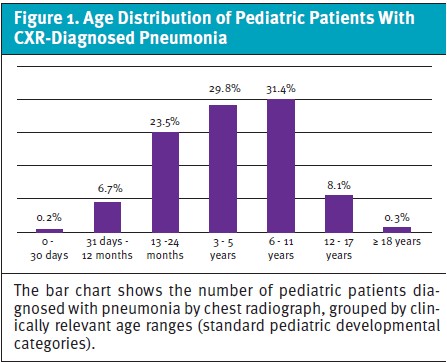
A total of 649 patients with a positive CXR for pneumonia were included in the study. Of these, 52% (n=335) were male and 48% (n=314) were female. The mean age of the cohort was 5.3 years (standard deviation 3.85 years), with a median age of 4 years. Patient ages ranged from 0 to 20 years. Age distribution is included in Figure 1.
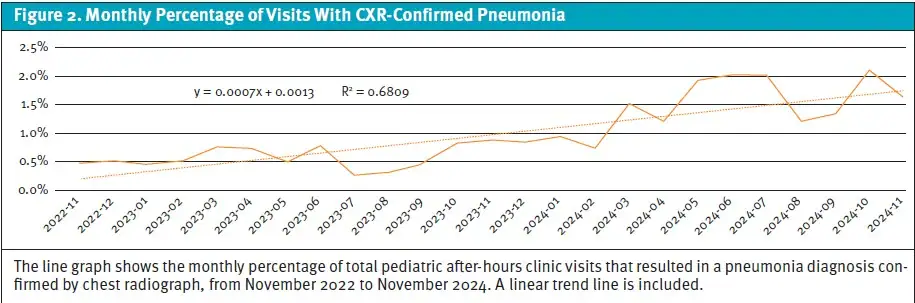
There was a significant upward trend in the percentage of patient visits with a pneumonia diagnosis based on CXR findings during the study period. The percentage of visits with a pneumonia diagnosis identified on CXR increased from 0.4% to 1.6% (Figure 2), demonstrating a substantial rise in the prevalence of radiographically confirmed pneumonia within our AHC clinics. This trend was statistically significant (R²=0.68, p<0.001).
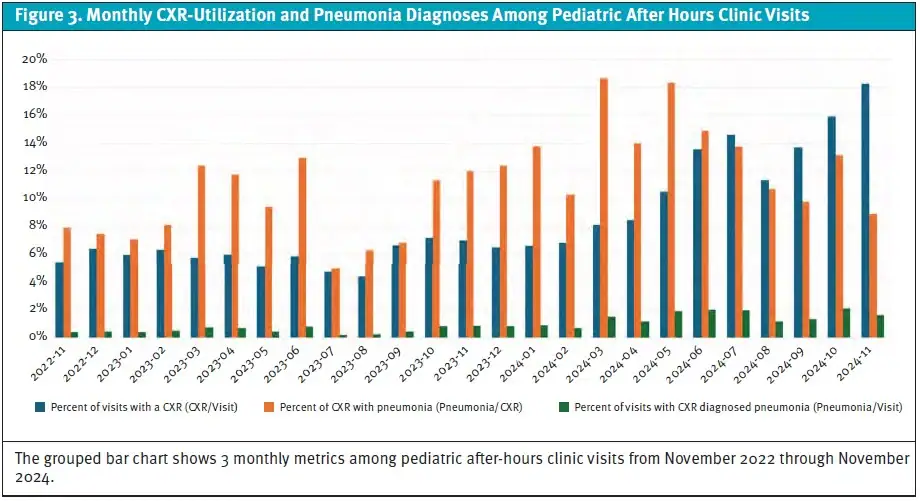
Further examination of the data revealed a dynamic pattern in the prevalence of positive CXR findings. The percentage of positive CXRs exhibited a peak during the period of March to May 2024, suggesting a potential seasonal or episodic increase in pneumonia cases. However, despite a subsequent decline in the percentage of positive CXRs, the overall percentage of visits with a pneumonia diagnosis remained elevated throughout the study period, indicating a sustained increase in pneumonia prevalence within our patient population.
Discussion
This retrospective study demonstrated a significant increase in the proportion of patient visits with radiographically confirmed pneumonia within our pediatric AHC clinics over a 2-year period. This finding aligns with national and international reports highlighting a surge in Mycoplasma pneumoniae infections during this time period. The observed peak in positive chest radiographs during the spring of 2024 suggests a potential seasonal variation in the prevalence of respiratory infections, a phenomenon commonly observed with many infectious diseases.
The sustained elevation in pneumonia diagnoses, despite a decline in the proportion of positive CXRs after the spring peak, likely reflects a lowering of the threshold for ordering CXRs. In threshold models of diagnostic testing, clinicians are more likely to order a test when the estimated pretest probability rises.16 When pneumonia is perceived as more prevalent, less severe symptoms may prompt more CXRs to be ordered, thereby lowering CXR yield. This kind of threshold shift can be driven by cognitive shortcuts such as the availability heuristic (judging the likelihood of a diagnosis by how easily similar cases come to mind) and recency bias (the tendency for recent clinical experiences to disproportionately influence subsequent judgments).17,18 For example, in a large emergency department study, physicians were about 15% more likely to test for pulmonary embolism in the 10 days after diagnosing a pulmonary embolism.17
Limitations
This study has several limitations. As a retrospective analysis, it is subject to inherent limitations of data availability. Our definition of pneumonia relied on CXR reports, which likely underestimated the true burden of disease for several reasons. First, many cases of pneumonia in otherwise well-appearing children can be diagnosed clinically without obtaining a CXR, consistent with current pediatric guidelines that discourage routine imaging in mild, uncomplicated cases.15 Second, CXR may have limitations in detecting certain types of pneumonia.6 Atypical bacterial pneumonia is less likely than typical bacterial pneumonia to demonstrate focal consolidation on CXR and is more likely to have a reticular pattern with peribronchial cuffing.14,19 As a result, our approach almost certainly excluded some clinically diagnosed or radiographically occult pneumonia. However, focusing on CXR-confirmed pneumonia provided a standardized, reproducible outcome measure across encounters in our pediatric AHC clinics. Furthermore, the study did not investigate the specific etiologies of pneumonia (viral, typical bacterial, or atypical bacterial), limiting our ability to draw definitive conclusions about the drivers of the observed increase. Additionally, as a single center study, this may limit the generalizability of the findings.
Despite these limitations, this study highlights a trend of increased pneumonia prevalence within our pediatric AHC clinics. These findings underscore the importance of continued surveillance of respiratory infections in the pediatric population, particularly during periods of increased community transmission. Further research is warranted to investigate the specific etiologies of pneumonia, identify risk factors for severe disease, and evaluate the effectiveness of current prevention and treatment strategies.
Conclusion
This study found a significant increase in pneumonia diagnoses confirmed by CXR among children visiting our AHC clinics over 2 years, mirroring a national and international rise in Mycoplasma pneumoniae infections. Continued surveillance to determine if this trend persists is crucial, along with further investigation into the factors driving this increase.
Manuscript submitted June 30, 2025; accepted January 13, 2026.
References
- Kronman MP, Hersh AL, Feng R, Huang YS, Lee GE, Shah SS. Ambulatory visit rates and antibiotic prescribing for children with pneumonia, 1994-2007. Pediatrics. 2011;127(3):411-418. doi:10.1542/peds.2010-2008
- Gupta GR. Tackling pneumonia and diarrhoea: the deadliest diseases for the world’s poorest children. Lancet Lond Engl. 2012;379(9832):2123-2124. doi:10.1016/S0140-6736(12)60907-6
- de Benedictis FM, Kerem E, Chang AB, Colin AA, Zar HJ, Bush A. Complicated pneumonia in children. Lancet Lond Engl. 2020;396(10253):786-798. doi:10.1016/S0140-6736(20)31550-6
- Global, regional, and national incidence and mortality burden of non-COVID-19 lower respiratory infections and aetiologies, 1990–2021: a systematic analysis from the Global Burden of Disease Study 2021. Lancet Infect Dis. 2024;24(9):974-1002. doi:10.1016/S1473-3099(24)00176-2
- Verhoeven D. Influence of Immunological Maturity on Respiratory Syncytial Virus-Induced Morbidity in Young Children. Viral Immunol. 2019;32(2):76-83. doi:10.1089/vim.2018.0121
- Yun KW, Wallihan R, Desai A, et al. Clinical Characteristics and Etiology of Community-acquired Pneumonia in US Children, 2015-2018. Pediatr Infect Dis J. 2022;41(5):381-387. doi:10.1097/INF.0000000000003475
- Berg AS, Inchley CS, Aase A, et al. Etiology of Pneumonia in a Pediatric Population with High Pneumococcal Vaccine Coverage: A Prospective Study. Pediatr Infect Dis J. 2016;35(3):e69-75. doi:10.1097/INF.0000000000001009
- Atkinson TP, Waites KB. Mycoplasma pneumoniae Infections in Childhood. Pediatr Infect Dis J. 2014;33(1):92-94. doi:10.1097/INF.0000000000000171
- Stansbury D, Koenig C. Media Advisory. Warren County Health District; 2023. Accessed December 7, 2024. https://warrencohealthoh.gov/wp-content/uploads/2023/11/WCHD-media-release-pneumonia-112923-004-1.pdf
- Indiana Health Alert Network Notification. Indiana Department of Health; 2024. Accessed December 7, 2024. https://www.in.gov/health/emergency-preparedness/files/IDOH-IHAN-10.2.24.pdf
- Health Advisory: Increase in Mycoplasma Pneumoniae Activity in the United States. California Health Alert Network San Diego; 2024. Accessed December 7, 2024. https://www.sandiegocounty.gov/content/dam/sdc/hhsa/programs/phs/cahan/communications_documents/11-15-2024.pdf
- CDC. Mycoplasma Pneumoniae Infections Have Been Increasing. National Center for Immunization and Respiratory Diseases. October 18, 2024. Accessed December 7, 2024. https://www.cdc.gov/ncird/whats-new/mycoplasma-pneumoniae-infections-have-been-increasing.html
- Dungu KHS, Holm M, Hartling U, et al. Mycoplasma pneumoniae incidence, phenotype, and severity in children and adolescents in Denmark before, during, and after the COVID-19 pandemic: a nationwide multicentre population-based cohort study. Lancet Reg Health Eur. 2024;47:101103. doi:10.1016/j.lanepe.2024.101103
- Bradley JS, Byington CL, Shah SS, et al. The management of community-acquired pneumonia in infants and children older than 3 months of age: clinical practice guidelines by the Pediatric Infectious Diseases Society and the Infectious Diseases Society of America. Clin Infect Dis Off Publ Infect Dis Soc Am. 2011;53(7):e25-76. doi:10.1093/cid/cir531
- Lipsett SC, Monuteaux MC, Bachur RG, Finn N, Neuman MI. Negative Chest Radiography and Risk of Pneumonia. Pediatrics. 2018;142(3):e20180236. doi:10.1542/peds.2018-0236
- Pauker SG, Kassirer JP. The Threshold Approach to Clinical Decision Making. N Engl J Med. 1980;302(20):1109-1117. doi:10.1056/NEJM198005153022003
- Ly DP. The Influence of the Availability Heuristic on Physicians in the Emergency Department. Ann Emerg Med. 2021;78(5):650-657. doi:10.1016/j.annemergmed.2021.06.012
- Webster CS, Taylor S, Weller JM. Cognitive biases in diagnosis and decision making during anaesthesia and intensive care. BJA Educ. 2021;21(11):420-425. doi:10.1016/j.bjae.2021.07.004
- Dueck NP, Epstein S, Franquet T, Moore CC, Bueno J. Atypical Pneumonia: Definition, Causes, and Imaging Features. RadioGraphics. 2021;41(3):720-741. doi:10.1148/rg.2021200131
Author Affiliations: Morgan McBee, MD, Medical University of South Carolina. Leslie Spence, MD, Medical University of South Carolina. Jeanne Hill, MD, Medical University of South Carolina. Leah S. McBee, MD, Pediatric After Hours Clinics at the Medical University of South Carolina. Leslie Spence has disclosed a financial relationship with SealCath, which is unrelated to the content of this educational activity. This relationship has been mitigated to prevent commercial bias. All other authors have no relevant financial relationships with any ineligible companies.