
Published on
Download the article PDF: Brugada Syndrome In The Urgent Care Center A Case Report
Urgent Message: Brugada syndrome may present with subtle electrocardiogram findings, and clinicians must recognize the pattern promptly to help prevent sudden cardiac death.
Katherine Quinn, MS IV; Eric Mast, DO; M. Drew Mattin, MS IV; Todd Fredricks, DO, MSS
Keywords: sudden cardiac death; Brugada syndrome; Brugada pattern; ventricular fibrillation
Abstract
Introduction: Syncope in young, otherwise healthy individuals is often attributed to benign causes but can occasionally signal life-threatening cardiac conditions. Brugada syndrome (BrS), a rare but serious arrhythmic disorder, can be missed due to absent family history, overlooked subtle electrocardiogram (ECG) changes, and low clinical suspicion. Delayed recognition may lead to ventricular fibrillation and sudden cardiac death.
Case Presentation: A 31-year-old male presented to a community urgent care clinic following a witnessed syncopal episode. Vital signs were normal, and the ECG was interpreted as normal sinus rhythm with subtle ST-segment elevation in V1–V2 that was not pursued further. The patient was discharged home.
Diagnosis: Although a key feature of BrS was initially present, due to the self-resolved syncopal episode in an otherwise healthy appearing male, the seriousness of the presentation was not recognized. The patient was later found unresponsive at home in ventricular fibrillation. Repeat ECGs demonstrated both type I and type II Brugada patterns. The combination of syncope, ventricular fibrillation, and diagnostic ECG findings established the diagnosis of Brugada syndrome.
Case Resolution: Despite advanced resuscitation and transfer for electrophysiologic evaluation, the patient ultimately decompensated and could not be resuscitated.
Conclusion: This case illustrates the critical importance of recognizing early signs of Brugada syndrome. Recognition of both ECG findings and clinical symptoms is essential, as patients with BrS remain at high risk of sudden cardiac death. Careful ECG interpretation, family history, and timely referral for electrophysiologic assessment are vital for preventing fatal outcomes in these patients.
Introduction
Brugada syndrome (BrS) is a cardiac condition characterized by abnormal ST-segment elevation in the right precordial leads (V1–V3) that can be observed on a resting electrocardiogram (ECG). The diagnosis of BrS involves both clinical evaluation and characteristic electrocardiographic findings. BrS may manifest with ventricular fibrillation (VF), which in turn can lead to sudden cardiac death (SCD). BrS dysrhythmias are noted to be more frequently observed at night than during the day. Other clinical features of BrS include syncope, nocturnal agonal respirations, palpitations, and chest discomfort.1 Neurocardiogenic syncope is the most common cause of syncope in both the general population and individuals with BrS.2 BrS presenting with ventricular dysrhythmia demands emergent attention. This case highlights the importance of careful ECG interpretation and thorough family history review in young, healthy patients with minimal ischemic risk factors who present with a syncopal episode and ECG changes concerning for BrS.
Case Presentation
A 31-year-old male presented to a community urgent care center following a witnessed syncopal episode that occurred when he got out of bed in the morning. He described a brief sensation of lightheadedness before losing consciousness and striking the back of his head on a nearby dresser. He regained consciousness spontaneously within 1 minute and did not experience bowel or bladder incontinence or post-syncopal confusion. There was no tongue biting or seizure-like activity observed. He denied chest pain, palpitations, or shortness of breath.
Vital signs on arrival were within normal limits: blood pressure of 112/72 mmHg; heart rate of 84 beats per minute; and oxygen saturation of 98% on room air. Physical examination was notable only for mild tenderness over the right occipital region. An ECG was performed and interpreted by the urgent care provider as normal sinus rhythm. Although ST-segment elevation was present in leads V1–V2, no further evaluation or consultation was pursued. The patient was discharged home with instructions to follow up with his primary care physician and return if any worsening symptoms occurred.
Approximately 6 hours later, the patient was found unresponsive at home. Emergency medical services (EMS) were called, and paramedics arrived to find the patient in ventricular fibrillation (VF). Cardiopulmonary resuscitation was initiated and the patient was intubated.
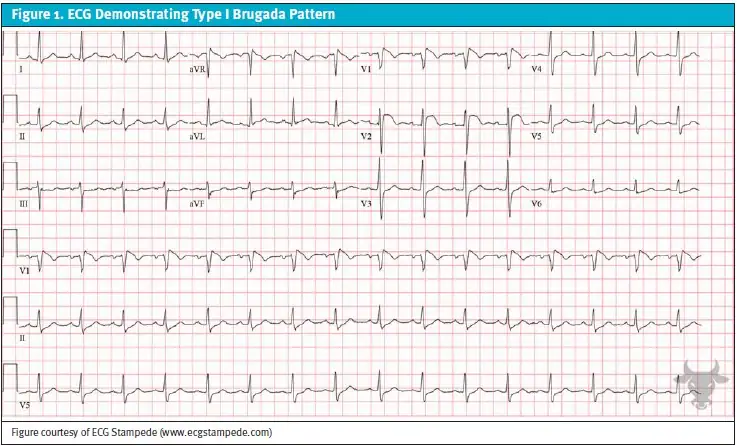
Upon arrival in the emergency department (ED), the patient had a pulse and an organized rhythm but was profoundly hypotensive, with an automated blood pressure reading of 50/27 mmHg. The patient’s Glasgow Coma Scale (GCS) score was 3. An ECG at this time demonstrated type I Brugada pattern (BrP)—a coved ST-segment elevation of 2 mm or more followed by a negative T wave in leads V1 and V2.
Further review of the ECG obtained during the urgent care visit demonstrated a type II BrP in V2, with a saddleback morphology with broad R’ and ST-segment elevation of ≥2 mm.
Medical Decision Making
In the urgent care center, the seriousness of the presentation was not recognized. ST-segment elevation with a saddleback morphology (type II BrP) in the setting of syncope should have prompted a heightened suspicion for underlying BrS and triggered additional evaluation following urgent care presentation. Following his VF or sudden cardiac arrest, emergent transfer to a tertiary care center for electrophysiologic evaluation and consideration of implantable cardioverter-defibrillator placement was appropriate.
Differential Diagnosis and Final Diagnosis
The differential diagnosis of syncope is broad and includes neurally mediated causes such as vasovagal and situational syncope, orthostatic hypotension from volume depletion or autonomic dysfunction, and cardiac etiologies including arrhythmias and structural heart disease.3 Distinguishing between serious and benign causes of syncope can be done through obtaining patient history, history of presenting incident, physical examination and ECG results.3 Cardiogenic syncope—particularly due to arrhythmias like ventricular tachycardia or channelopathies such as BrS—poses a significant risk of sudden cardiac death.1 A thorough evaluation requires careful attention to history, medication use, and high-risk features that may point toward a cardiac origin.1
Discussion
BrS, a genetic disorder once considered rare, is now recognized as accounting for approximately 4-12% of all SCD cases and up to 20% of SCD cases in individuals with structurally normal hearts.4 The estimated prevalence of BrS is between 1 in 2,000 and 1 in 5,000 individuals, with VF typically occurring at a mean age of 41 ±15 years.4

BrS results from an autosomal dominant mutation with variable expression affecting cardiac sodium channels, leading to abnormalities in depolarization and repolarization that predispose to ventricular arrhythmias and sudden cardiac death.5
Use of certain medications in those with BrS (eg, antiarrhythmics, psychotropic agents, anesthetics, and antihistamines), use of cocaine, and fever can provoke type 1 ECG changes and VF.6 These triggers can amplify the abnormal sodium current, increasing the risk of malignant arrhythmias and cardiac events.
There are 3 recognized ECG pattern types in BrS:4
- Type I BrP: Demonstrates a prominent J wave and a coved ST-segment elevation of ≥2 mm with a descending negative T wave in at least 1 right precordial lead (V1–V3).
- Type II BrP: Demonstrates a saddleback morphology with a broad R’ wave and an ST-segment elevation >2 mm.
- Type III BrP: Demonstrates a right precordial ST-segment elevation with either a saddleback or coved morphology but does not meet the clinical criteria to diagnose BrS.
A type I BrS ECG pattern remains the only definitive electrocardiographic finding required for the diagnosis of BrS (Figure 1), and it must be accompanied by clinical criteria to establish the diagnosis, including:6
- A family history of sudden cardiac death
- Coved-type ECG patterns in family members
- Inducibility of ventricular tachycardia on programmed electrical stimulation
- A history of syncope or nocturnal agonal respiration
In contrast, type II and type III BrP are considered nondiagnostic but can become clinically meaningful when they occur in patients who exhibit symptoms. Type II and III patterns serve as important risk markers and should raise significant concern for underlying Brugada syndrome. Because the type I pattern may be transient, it may appear spontaneously or be unmasked through a sodium-channel blocker challenge, which is often necessary when evaluating patients who present with suspicious symptoms but only demonstrate type II or III patterns on baseline ECG.6
These diagnostic criteria provide essential context to distinguish BrS from similar entities. BrS generally lacks structural heart disease; therefore, standard cardiac imaging and stress testing typically show normal results. If abnormalities are present, they often indicate an alternative diagnosis. Once BrS is confirmed, management emphasizes removing precipitating factors and preventing ventricular arrhythmias. The use of an implantable cardioverter-defibrillator remains the definitive treatment modality.5
Case Outcome
After initial stabilization of the patient’s ventricular fibrillation event, a repeat ECG revealed a diagnostic type I BrP confirming the diagnosis of BrS. Hospital laboratory studies showed marked elevations in liver enzymes, blood urea nitrogen/creatinine ratio, and creatine kinase, consistent with end-organ injury from prolonged hypoperfusion during ventricular arrhythmia. Despite transient return of circulation, the patient deteriorated and could not be resuscitated.
Conclusion
This case illustrates a critical missed opportunity to recognize BrS in a young patient with unexplained syncope and subtle ECG changes consistent with type II BrP. In the absence of ischemic risk factors or structural heart disease, such presentations should raise suspicion for primary arrhythmogenic disorders that can quickly progress to lethal arrhythmias. Patients with symptoms such as a history of ventricular tachycardia/VF or syncope of unknown origin and spontaneous coved-type ST-segment elevation are at increased risk for future arrhythmic events and SCD.6 Distinguishing true BrS from transient metabolic or pharmacologic effects involves identifying characteristic BrP ECG findings, supporting laboratory studies to rule out other causes, and clinical features indicating unstable ventricular arrhythmias. ECG changes alone are enough to indicate a BrP and should lead to further diagnostic studies to determine if BrS is present.5 Once other structural and physiologic causes are ruled out, patients showing a Brugada ECG pattern along with high-risk clinical features such as previous sudden cardiac arrest, sustained ventricular tachyarrhythmias, or unexplained syncope may need an implantable cardioverter-defibrillator.5 This case underscores the need for a broad differential diagnosis in patients with unexplained syncope and emphasizes the critical role of a thorough family history in uncovering occult cardiac etiologies.
Ethics Statement
The patient was unable to be contacted as he passed away. Therefore, demographics and some details of the case were altered to protect patient anonymity and confidentiality. Some elements of this case are hypothetical to make it more applicable to the urgent care setting.
Takeaway Points
- Maintain a broad differential when evaluating syncope to avoid missing life-threatening causes.
- BrS symptoms and ECG patterns can be subtle or intermittent, requiring a high clinical suspicion for identification.
- A detailed family history is essential for identifying inherited arrhythmia syndromes.
- Timely diagnosis and intervention are critical to prevent sudden cardiac death in BrS.
Manuscript submitted August 3, 2025, accepted February 11, 2026.
Author Affiliations: Katherine Quinn, MS IV, Ohio University Heritage College of Osteopathic Medicine.Eric Mast, DO, Firelands Regional Medical Center. M. Drew Mattin, MS IV, Ohio University Heritage College of Osteopathic Medicine. Todd Fredricks, DO, MSS, Ohio University Heritage College of Osteopathic Medicine. Authors have no relevant financial relationships with any ineligible companies.
References:
- Wilde AAM, Antzelevitch C, Borggrefe M, et al. HRS/EHRA/APHRS expert consensus statement on the diagnosis and management of patients with inherited primary arrhythmia syndromes. Heart Rhythm. 2013;10(12):1932-1963. doi:10.1016/j.hrthm.2013.05.014
- Belhassen B. Management of Brugada syndrome 2016: Should all high-risk patients receive an ICD? Circ Arrhythm Electrophysiol. 2016;9(12):e004185. doi:10.1161/CIRCEP.116.004185
- Brignole M, Moya A, de Lange FJ, Deharo JC, Elliott PM, Fanciulli A, Fedorowski A, Furlan R, Kenny RA, Martín A, Probst V, Reed MJ, Rice CP, Sutton R, Ungar A, van Dijk JG; ESC Scientific Document Group. 2018 ESC Guidelines for the diagnosis and management of syncope. Eur Heart J. 2018;39(21):1883–1948. doi:10.1093/eurheartj/ehy037
- Brugada J, Campuzano O, Arbelo E, Sarquella-Brugada G, Brugada R. Present Status of Brugada Syndrome. J Am Coll Cardiol. 2018;72(9):1046-1059. doi:https://doi.org/10.1016/j.jacc.2018.06.037
- Coppola G, Corrado E, Curnis A, et al. Update on Brugada syndrome 2019. Curr Probl Cardiol. 2021;46(3):100454. doi:10.1016/j.cpcardiol.2019.100454
- Mizusawa Y, Wilde AAM. Brugada Syndrome. Circulation: Arrhythmia and Electrophysiology. 2012;5(3):606-616. doi: https://doi.org/10.1161/circep.111.964577