
Published on
Download the article PDF: An Uncommon Cause Of Rectal Pain A Case Report Of Fishbone Foreign Body
Urgent Message: Careful history and examination are required when assessing patients presenting with rectal pain. Clinicians should maintain a high index of suspicion for accidental foreign-body ingestion when assessing unexplained rectal discomfort.
Ivan Koay, MBChB, MRCS, FCUCM, FRNZCUC, MD; Cameron Olphert, BSc (Hons), MSc
Key Words: rectal pain; foreign body; proctoscopy; fishbone ingestion; hemorrhoids; gastrointestinal issues
Abstract
Clinical Presentation: A 50-year-old male with a history of type 2 diabetes mellitus and hemorrhoids presented to urgent care with a painful lump in his rectal area that had been present for the last 3 days. He reported initial bleeding, which had resolved, but he continued to experience pain. His bowel movements had not changed.
Physical Exam: On rectal examination, a sharp foreign body (FB)-like material was palpable at the 6 o’clock position. There was no discharge, lumps, or abnormal growths.
Case Resolution: Following emergency department transfer, proctoscopy was performed, which identified the foreign body as palpable and spiky in nature. The FB was described as a “fishbone.” It was successfully removed using forceps. Following the procedure, the patient was discharged home with a prescription for metronidazole and laxatives to prevent trauma to the affected area during healing. He was advised to return if he experienced severe bleeding, abscess formation, fever, or significant pain.
Conclusion: This case highlights the importance of considering unintentional foreign bodies as a potential cause of rectal discomfort, particularly in patients with a history of hemorrhoids.
Case Presentation
A 50-year-old male with a history of type 2 diabetes mellitus (T2DM) and hemorrhoids presented to urgent care (UC) with a painful lump in his rectal area that had been present for the last 3 days. He reported initial bleeding, which had resolved, but he continued to experience pain. His bowel movements had not changed. He did not notice any weight loss, and there was no previous history of any colorectal or gastrointestinal (GI) issues. He was on a beta-blocker and aspirin as his regular medications.
Besides T2DM and hemorrhoids, his past medical history included ischemic heart disease, for which he had a coronary stenting 6 months prior. A hemorrhoidectomy procedure was done several years previously as well. There was no family history of GI or colorectal malignancies.
Physical examination revealed a temperature of 36.4°C, heart rate of 76 beats per minute, with a blood pressure of 148/89 mm Hg, respiratory rate of 16 breaths per minute, and oxygen saturation of 99% on air.
He had a normal cardiovascular physical examination, and abdominal examination did not reveal any tenderness to palpation. There were no palpable hernias. Digital rectal examination (DRE) revealed a palpable foreign body (FB) located at the 6 o’clock position, which felt sharp and pointy. The FB felt embedded in the anal canal within the anal mucosa. There was no discharge, and no other abnormal lumps or growths were detected.
Urinalysis testing results were within normal limits.
Differential Diagnosis and Final Diagnosis
Differential diagnoses considered at the time of the UC consultation were:
- Suture retention from the previous hemorrhoid procedure
- FB in the rectal area
- Perianal infection, abscess, or granuloma
- Perianal malignancy
Disposition
The clinical findings of the DRE favored either suture retention from the previous hemorrhoid procedure or FB in the rectal area. The patient was referred to the emergency department for surgical consultation and further evaluation and management.
Patient care was taken over by the surgical team. Proctoscopy revealed no visible foreign body, although mucus and a palpable mass at the 6 o’clock position were noted, similar to that noted during the UC visit. The patient was scheduled for examination under anesthesia with the surgical team the following day for exploration and removal of the presumed FB.
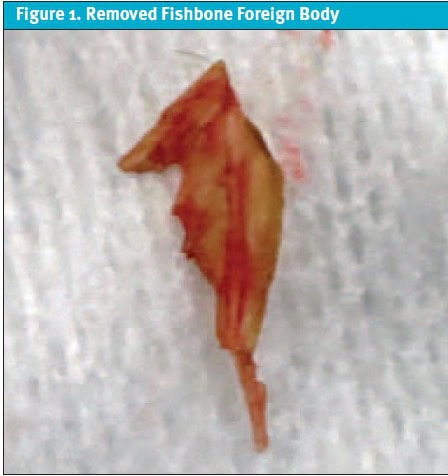
The following day, the patient was experiencing pain at rest and with defecation. On examination, the FB was again palpated, characterized as spiky, and removed with forceps under local anesthesia. The extracted foreign body was consistent in appearance with a fishbone (Image 1). This confirmed the final diagnosis of a retained fishbone causing local rectal trauma. Post-examination, the patient was told that mild rectal bleeding may occur with bowel movements due to mucosal damage caused by the fishbone. The patient was prescribed metronidazole and laxatives to prevent trauma in the affected area.
Discussion
Accidental FB ingestion is a common clinical issue, and typically, most ingested FB will pass into the stomach and traverse the GI tract within 1 week without any significant sequelae.[1] One case series reviewed hospital admissions over an 8-year period and noted 60 admissions for ingested or placement of FB. The FB was located in the esophagus in 68.3% of patients, in the stomach in 11.6%, and in the colon or rectum in 13.3%.[2] In a separate series reviewing cases of ingested foreign bodies, a total of 38 patients were reported over a 4-year period. Within this group, 1 patient was noted to have ingested a fishbone. The authors observed that edentulous individuals were at a higher risk of foreign body ingestion, including accidental swallowing of dentures. Clinical presentations varied widely; while some patients remained asymptomatic, others developed symptoms such as lower abdominal or rectal pain. Previous case reports have also described gastrointestinal perforations caused by ingested fishbones, most frequently involving the small bowel and colon.[3],[4],[5]
Fishbones are high-risk objects for GI perforation due to their hard and sharp-pointed ends. The site of potential perforation may be varied, and therefore clinical presentations can mimic many other surgical conditions such as diverticulitis, appendicitis, and perforated gastric ulcers. This makes potential diagnosis of an unidentified ingested fishbone difficult.[6] Moreover, not all fishbones are radiopaque.[7] The most common fishbones that are visible on x-rays include cod, haddock, lemon sole, cole fish, grey mullet, plaice, red snapper, monk fish, gurnard, and salmon. X-ray is unhelpful to detect bones from herring, pike, mackerel, and trout. Therefore, use of radiography may be indicated if the type of fish ingested is known.7 As a result, imaging of choice in most scenarios would be computed tomography (CT) imaging.6 In the reported case, the presence of a distinct abnormality detected during DRE made it possible to proceed without imaging.
Management of retained FB in the GI tract depends predominantly on the site of the FB, particularly if penetration into the GI mucosa occurs (as in the case presented). Treatment of ingested FB generally involves either endoscopic or surgical approaches with previous case reports suggesting that between 10-20% of patients require endoscopic intervention for foreign body removal, while surgical intervention is required in less than 1% of cases.[8],[9] The management of ingested fishbones generally depends on the patient’s presenting signs and symptoms and the nature and location of the fishbone.[10] Successful endoscopic retrieval and removal of fishbones are often associated with specific protective factors. Notably, the physiological response that mitigates edema formation following perforation may aid in facilitating closure of the perforation site.[11] Furthermore, the typically small diameter of fishbones tends to limit the leakage of gastrointestinal contents into the peritoneal cavity, thereby decreasing the risk of severe peritonitis and abscess development. This was noted in the case described.
Patient Perspective
The patient tolerated the procedure well and expressed relief following FB removal.
Ethics Statement
This case report did not require ethics approval from the Kings College Hospital ethics committee. The patient was unable to be contacted, and therefore demographics and some details of the case were changed or redacted to protect patient anonymity and confidentiality.
Takeaway Points
- Accidental ingestion of foreign bodies may cause GI and rectal symptoms.
- Performing a DRE with consent is crucial in the workup of rectal pain.
- FB in the GI tract may require referral to the emergency department for further imaging and consultation for removal (eg, endoscopy or surgery).
Manuscript submitted August 23, 2025; accepted December 20, 2025.
References
- [1]. McCanse D, Kurchin A, Hinshaw J. Gastrointestinal foreign bodies. Am J Surg. 142(3):335-337.
- [2]. Bloom R, Nakano P, Gray S, et al. Foreign bodies of the gastrointestinal tract. Am Surg. 1986;52(11):618-621.
- [3]. Ayantunde AA, Oke T. A review of gastrointestinal foreign bodies. Int J Clin Pract. 2006;60(6):735-739. doi:10.1111/j.1368-5031.2006.00709.x
- [4]. Yamashita K, Komohara Y, Uchihara T, et al. A rare case of perforation of a colorectal tumor by a fish bone. Clin J Gastroenterol. 2022;15:598-602. doi:10.1007/s12328-022-01622-8
- [5]. Wu CW, Chiu YW. Unintentional fish bone ingestion causing perforation of small intestine. Intern Emerg Med. 2021;16:1371-1372. doi:10.7007/s11739-020-02519-5
- [6]. Cho M, Lee M, Han H, et al. Fish bone migration to the urinary bladder after rectosigmoid colon perforation. World J Gastroenterol. 2014;20(22):7075-7078. doi:10.3748/wjg.v20.i22.7075
- [7]. Ell SR, Sprigg A. The radio-opacity of fishbones—species variation. Clin Radiol 1991;44(2):104-107. doi:10.1016/S0009-9260(05)80506-9
- [8]. Kuwahara K, Mokuno Y, Matsubara H, et al. Development of an abdominal wall abscess caused by fish bone ingestion: a case report. J Med Case Rep. 2019;13:369.
- [9]. Di Guglielmo M, Savage J, Gould S, et al. Female adolescent presenting with abdominal pain: accidental wire bristle ingestion leading to colonic perforation. Pediatr Emerg Care. 2017;33:356-358.
- [10]. Ueda T, Sato H, Ogimi T, et al. Use of endoscopy to remove fish bone that caused sigmoid colon perforation. Intern Med. 2024;63(19):2626-2630. doi:10.2169/internalmedicine.3063-23
- [11]. Goh B, Tan Y, Lin S, et al. CT in the preoperative diagnosis of fish bone perforation of the gastrointestinal tract. AJR Am J Roentgenol. 2006;187(3):710-714. doi:10.2214/AJR.05.0178
Author Affiliations: Ivan Koay, MBChB, MRCS, FCUCM, FRNZCUC, MD, King’s College Hospital Urgent Treatment Centre, London, England; Watford General Hospital Urgent Treatment Centre, Watford, United Kingdom; Royal New Zealand College of Urgent Care; Royal College of Surgeons, Edinburgh, Scotland. Cameron Olphert, BSc (Hons), MSc, King’s College Hospital Urgent Treatment Centre, London, England. Authors have no relevant financial relationships with any ineligible companies.
