
Published on
Download the article PDF: Addressing Congenital Syphilis With Point Of Care Testing In Urgent Care
Urgent Message: Urgent care centers can help prevent congenital syphilis by screening pregnant patients lacking prenatal records, confirming reactive point-of-care results, and administering penicillin when follow-up is uncertain.
Amir Reza Tehrani, BS; Glenn E. Harnett, MD; Jeffrey D. Klausner, MD, MPH
Keywords: syphilis screening; congenital syphilis; point-of-care testing; sexually transmitted infections; pregnant patients; urgent care; rapid diagnostics
Abstract
Purpose: The purpose of this review is to use clinical, operational, and economic evidence to support integrating rapid point-of-care syphilis testing in U.S. urgent care centers. Urgent care centers, despite becoming a de facto frontline for sexually transmitted infection (STI) care in key populations, have limited adoption of point-of-care syphilis testing.
Recent Findings: Epidemiological data reveals that, although primary and secondary syphilis rates are falling, congenital syphilis rates are climbing. Clinical data from emergency department settings show that opt-out point-of-care testing models increase screening rates as much as 28-fold (from 2% to 56%), enabling single-visit testing and treatment. Adoption of the models, however, may be hindered due to perceived increased costs and staff time and lack of adequate models demonstrating workflow and clinical outcomes.
Summary: To navigate limitations of current tests, we propose a “test-and-treat” algorithm. A longer-term solution requires a multifaceted approach: changes to point-of-care testing reimbursement; creating or strengthening partnerships between urgent care centers and public health departments for reporting and follow-up; and accelerated Food and Drug Administration approval of additional point-of-care tests targeting multiple STIs.
Introduction
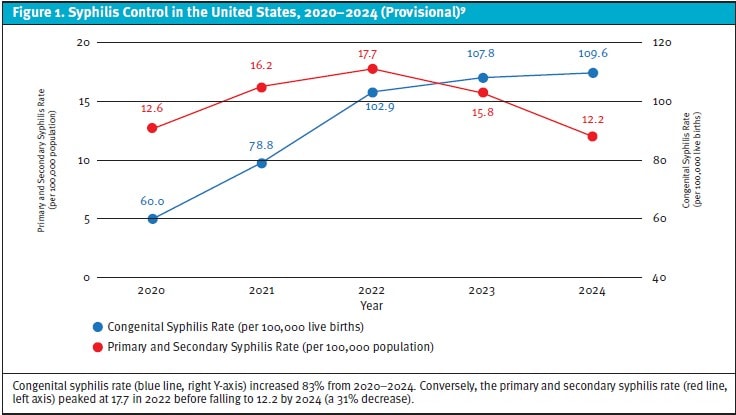
Congenital syphilis—a preventable outcome of maternal Treponema pallidum infection—is surging in the United States primarily due to 3 factors: missed or delayed prenatal care; missed or delayed screening; and missed or delayed stage-appropriate treatment.1 Congenital syphilis is often preventable when maternal infection is diagnosed and treated with stage-appropriate penicillin. Despite effective treatment, congenital syphilis cases continue to rise. Patients increasingly rely on urgent and on-demand care settings for care, where the lack of rapid point-of-care testing may represent a missed opportunity for same-day syphilis screening, staging, and treatment.2,3 Paradoxically, even as rates of primary and secondary syphilis in the general population have begun to decline, congenital cases have continued to rise (Figure 1). As publicly funded sexually transmitted infection (STI) clinics reduce services—such as STI screening and treatment, partner notification, and follow-up care—the care burden shifts onto the most accessible on-demand providers.4 Consequently, the confluence of reduced public services and primary care access as well as patient preference for convenience has positioned urgent care centers as a point of access for rapid STI diagnosis and treatment.4,5
A 2017 analysis quantified the trend of urgent care centers being transformed into the main point of access for STI care, showing that urgent care centers saw a ~2-fold increase in the number of visits (for chlamydia and gonorrhea testing) and a >3-fold increase in visits by persons with diagnosed STIs.6 More recent data demonstrates that the top 1% of urgent care centers in the United States by STI volume attribute 6% of their total visits to STI testing.4 Leading this increasing patient volume in urgent care is patient avoidance of the traditional primary care system; the 2025 Health of U.S. Primary Care Scorecard found that more than 30% of U.S. adults lacked a usual source of care in 2022, the highest level in a decade.7 Additionally, an urban urgent care study of men aged 20–55 years found that 92% of visits (10,144/10,983 total visits across 6,946 unique patients) had no documented syphilis testing in the previous year, regardless of HIV status; 44% of the study population was uninsured.8
Adapting the ‘Test-and-Treat’ Model
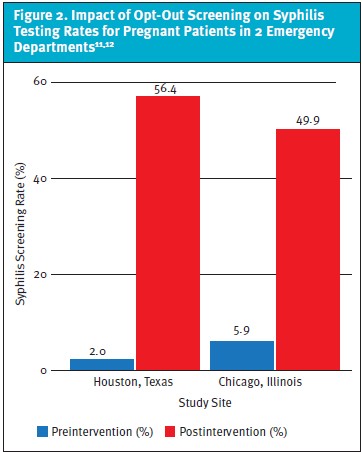
The “test-and-treat” model, where diagnosis and treatment occur in a single visit, can directly address some of the issues associated with untreated maternal syphilis. Some states have specific policies aimed at improving identification and treatment of maternal syphilis. For example, Colorado codified statewide requirements mandating healthcare settings—including urgent care clinics—to offer syphilis screening to pregnant patients.10 Emergency department studies support the clinical principle that point-of-care testing and immediate treatment improve screening and treatment completion rates (Figure 2). An opt-out rapid point-of-care syphilis testing program in a Houston, Texas, emergency department resulted in a 28-fold increase in syphilis testing. The program raised the syphilis screening rate for pregnant individuals from 2% during the preimplementation phase (where laboratory-based testing was only performed when clinically indicated) to 56% in the postimplementation phase (which included opt-out rapid point-of-care and laboratory-based testing for pregnant patients without documented syphilis testing results).11 The intervention in Houston detected a 3.5% prevalence of active syphilis (4 positive cases out of 114 tested) and all 4 (100%) patients who tested positive were treated in the emergency department before discharge. The study reported that approximately 80% of pregnant patients found syphilis testing acceptable, with 100% of them demonstrating a willingness to accept the rapid Syphilis Health Check (Diagnostics Direct, LLC, Stone Harbor, New Jersey) test at the point of care.11A similar program in Chicago, Illinois, yielded an approximately 8.5-fold increase in screening among pregnant women, from 5.9% of encounters (272 of 4,579) preintervention to 49.9% (2,061 of 4,129) postintervention.12
The Economic and Operational Case for Adoption
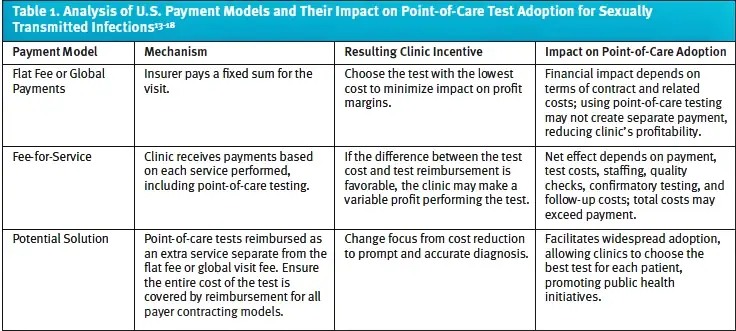
There are several hurdles to the adoption of point-of-care testing for sexually transmitted infections, such as unfavorable or nonexistent reimbursement for rapid testing and the operational costs required to conduct testing. Some urgent care centers with payer contracts using Healthcare Common Procedure Coding System (HCPCS) Level II code S9083 may be financially discouraged from pursuing point-of-care testing because of the contractual flat fees or global payments, whereby the insurer pays a bundled rate for the entire visit regardless of the clinic’s treatment expenses.13 Reimbursement for a rapid test with separate payment, depending on the payment model, may not account for test acquisition, staff time, quality control, and follow-up. Similarly, some urgent care centers may be discouraged by capitation models, in which the clinic receives a fixed monthly payment per patient per month.4,14-16 Under those payment models, urgent care centers may be financially disincentivized from performing screening tests, as they must purchase, conduct, and document the tests—and provide treatment when necessary—without receiving any additional reimbursement. Even urgent care centers that have fee-for-service payer contracts may find it difficult to economically justify rapid syphilis testing. Overall, reimbursement differs based on the insurer, area of service, and provider-insurer contractual agreement.
By way of example, a rapid syphilis test waived under the Clinical Laboratory Improvement Amendments (CLIA), reported with Current Procedural Terminology (CPT) code 86780, might cost approximately $10.50. The 2026 Medicare Clinical Laboratory Fee Schedule—basing payment amounts on the weighted median of reported private-payer rates—averages only $13.24.17,18 This $2.74 difference may fall short of covering the total cost of providing point-of-care syphilis testing after staff time, quality control, documentation, and other costs are considered (Table 1).
Despite clear benefits to early detection and treatment, current payment models continue to hinder implementation of these evidence‑based public health interventions. Molecular point‑of‑care diagnostic tests for STI screening may soon be widely available, but the potential for their adoption across urgent care centers is uncertain.
Improving Outcomes
For clinicians, implementing point-of-care syphilis testing could lead to improvements in treating cases of syphilis, treating cases of maternal syphilis, and decreasing adverse outcomes. Newborns with congenital syphilis have hospital stays 3.53 times longer (95% confidence interval [CI], 3.38–3.68) and hospital expenses 4.93 times higher (95% CI, 4.57–5.32) than newborns without congenital syphilis.2 In a separate 2019 nationwide analysis, mean hospitalization charges for infants with congenital syphilis were $58,502 vs. $12,592 for unaffected infants.19,20
Existing CLIA-waived point-of-care testing represents a reasonably accurate and actionable initial screening test in persons without prior history of syphilis.3,11 Since reactive treponemal assays cannot distinguish treated infection from active infection, the National Syphilis and Congenital Syphilis Syndemic Federal Task Force recommends combining point-of-care screening with confirmatory nontreponemal laboratory testing and clinical staging. For patients with a reactive point-of-care test who lack documented treatment history, including pregnant patients for whom follow-up is uncertain, same-visit treatment may be appropriate based on clinical judgment (such as an initial dose of benzathine penicillin G) while confirmatory testing is pending, with subsequent treatment based on clinical staging.1,3,11 Stocking benzathine penicillin G may pose a financial challenge, however, due to several factors including cost and low-volume use.
Recommendations
To reduce incidence of congenital syphilis, stakeholders may consider the following strategies:
- Clinicians
- Consider adopting a rapid “test-and-treat” workflow as described above, prioritizing pregnant patients—especially those presenting without documented prenatal screening—as well as those presenting with signs, symptoms, or high-risk exposures for sexually transmitted infections
- Urgent Care Administrators
- Consider establishing standing-order protocols defining patient eligibility, same-visit confirmatory lab collection, access to benzathine penicillin G, responsibilities for reviewing pending results and contacting patients, prenatal and referral pathways, and reporting
- Policymakers
- Consider separate reimbursement for point-of-care syphilis screening (CPT code 86780) when testing is not included in a payment; set reimbursement to reflect operational costs and test acquisition costs
- Review payment bundling of tests recommended by the Centers for Disease Control and Prevention, the U.S. Preventive Services Task Force, and the American College of Obstetricians and Gynecologists for all STIs that may financially discourage suggested tests
- Test Developers, Food and Drug Administration
- Expedite the regulatory CLIA-waiver process for diagnostic tests capable of differentiating active from previously treated infection
Conclusion
A test‑and‑treat model for syphilis—and potentially other STIs—may improve access to same-visit screening and treatment if leaders from urgent care, policymakers, public health authorities, and payers are encouraged to collaborate on solutions.
Funding
This work was funded in part by the National Institutes of Health/National Institute of Allergy and Infectious Diseases grant no. R01AI139265.
Manuscript submitted January 20, 2026; accepted July 19, 2026.
References
- McDonald R, O’Callaghan K, Torrone E, et al. Vital signs: missed opportunities for preventing congenital syphilis—United States, 2022. MMWR Morb Mortal Wkly Rep. 2023;72(46):1269-1274. doi:10.15585/mmwr.mm7246e1
- Chen HY, Klausner JD, Stafford IA. Congenital syphilis in live births: adverse outcomes, hospital length of stay, and costs. Obstet Gynecol. 2024;144(2):207-214. doi:10.1097/AOG.0000000000005642
- National Syphilis and Congenital Syphilis Syndemic Federal Task Force. Considerations for the Implementation of Point of Care (POC) Tests for Syphilis. US Department of Health and Human Services; June 2024. Accessed August 17, 2026. https://www.hhs.gov/sites/default/files/nscss-considerations-for-the-implementation-of-syphilis-poc-tests.pdf
- Ayers AA. The urgent need for STI testing in urgent care centers. J Urgent Care Med. 2024;18(10):39-42.
- Harnett G. The rising importance of urgent care in the fight against the STI epidemic. J Urgent Care Med. 2022;16(3):15-20.
- Pearson WS, Tao G, Kroeger K, Peterman TA. Increase in urgent care center visits for sexually transmitted infections, United States, 2010-2014. Emerg Infect Dis. 2017;23(2):367-369. doi:10.3201/eid2302.161707
- Jabbarpour Y, Jetty A, Byun H, Siddiqi A, Park J. The Health of US Primary Care: 2025 Scorecard Report—The Cost of Neglect. Milbank Memorial Fund and The Physicians Foundation; February 18, 2025. doi:10.1599/mmf.2025.0218
- Schechter SB, Romo DL, Cohall AT, Neu NM. Approach to human immunodeficiency virus/sexually transmitted infection testing for men at an urban urgent care center. Sex Transm Dis. 2017;44(4):255-259. doi:10.1097/OLQ.0000000000000571
- Centers for Disease Control and Prevention. Sexually Transmitted Infections Surveillance, 2024 (Provisional). US Department of Health and Human Services; 2025. Published September 24, 2025. Accessed August 17, 2026. https://www.cdc.gov/sti-statistics/annual/
- Colorado Department of Public Health and Environment. Epidemic and Communicable Disease Control: Regulation 12 (Congenital Syphilis), 6 CCR 1009-1. Code of Colorado Regulations, Colorado Secretary of State. Effective January 14, 2025. Accessed August 14, 2026. https://www.sos.state.co.us/CCR/DisplayRule.do?action=ruleinfo&ruleId=2415
- Stafford IA, Bakunas C, Haydamous J, et al. Implementation of an opt-out and rapid point-of-care syphilis testing program for pregnant patients presenting to the emergency department. Sex Transm Dis. 2025;52(6):352-355. doi:10.1097/OLQ.0000000000002131
- Stanford KA, Hazra A, Friedman E, Augustine E, Schneider J. An opt-out emergency department screening intervention leads to major increases in diagnosis of syphilis. Open Forum Infect Dis. 2024;11(9):ofae490. doi:10.1093/ofid/ofae490
- Stern D. Understanding case-rate reimbursement. J Urgent Care Med. 2017;12(3):35-36.
- National Academies of Sciences, Engineering, and Medicine. Sexually Transmitted Infections: Adopting a Sexual Health Paradigm. National Academies Press; 2021. doi:10.17226/25955
- Toma E, Malyuta Y, Salhaney P, et al. Implementation of point-of-care sexually transmitted infection testing in a community clinic setting. Sex Transm Dis. 2024;51(4):251-253. doi:10.1097/OLQ.0000000000001943
- Belenky N, Watson CJ, Huber B, Gibbons B. Reimbursement Mechanisms and Challenges in Team-Based Behavioral Health Care. Office of the Assistant Secretary for Planning and Evaluation, US Department of Health and Human Services; 2023. Accessed August 17, 2026. https://aspe.hhs.gov/reports/reimbursement-mechanisms-team-based-bh-care
- CLIAwaived, Inc. Syphilis Health Check. Accessed August 14, 2026. https://www.cliawaived.com/syphilis-health-check-1.html
- Centers for Medicare & Medicaid Services. CY 2026 Q3 Clinical Laboratory Fee Schedule (26CLABQ3). Updated July 2026. Accessed August 17, 2026. https://www.cms.gov/medicare/payment/fee-schedules/clinical-laboratory-fee-schedule-clfs/files/26clabq3
- Umapathi KK, Thavamani A, Chotikanatis K. Incidence trends, risk factors, mortality, and healthcare utilization in congenital syphilis-related hospitalizations in the United States: a nationwide population analysis. Pediatr Infect Dis J. 2019;38(11):1126-1130. doi:10.1097/INF.0000000000002445
- LeBlanc M, Moore E. Issue Brief: Congenital Syphilis. National Governors Association; January 9, 2024. Accessed August 17, 2026. https://www.nga.org/publications/issue-brief-congenital-syphilis/
Author Affiliations: Amir Reza Tehrani, BS, University of Southern California, Keck School of Medicine, Los Angeles, California. Glenn E. Harnett, MD, No Resistance Consulting Group, Birmingham, Alabama. Jeffrey D. Klausner, MD, MPH, Department of Population and Public Health Sciences, Keck School of Medicine, University of Southern California, Los Angeles. Disclosure: Jeffrey D. Klausner reports serving as an advisor to Chembio, Inc. and Diagnostics Direct, LLC. All other authors have no relevant financial relationships with any ineligible companies.