Published on

Differential Diagnosis

  • Lateral STEMI
  • Wolff-Parkinson-White (WPW)
  • Sinus tachycardia
  • Brugada syndrome
  • First-degree AV block


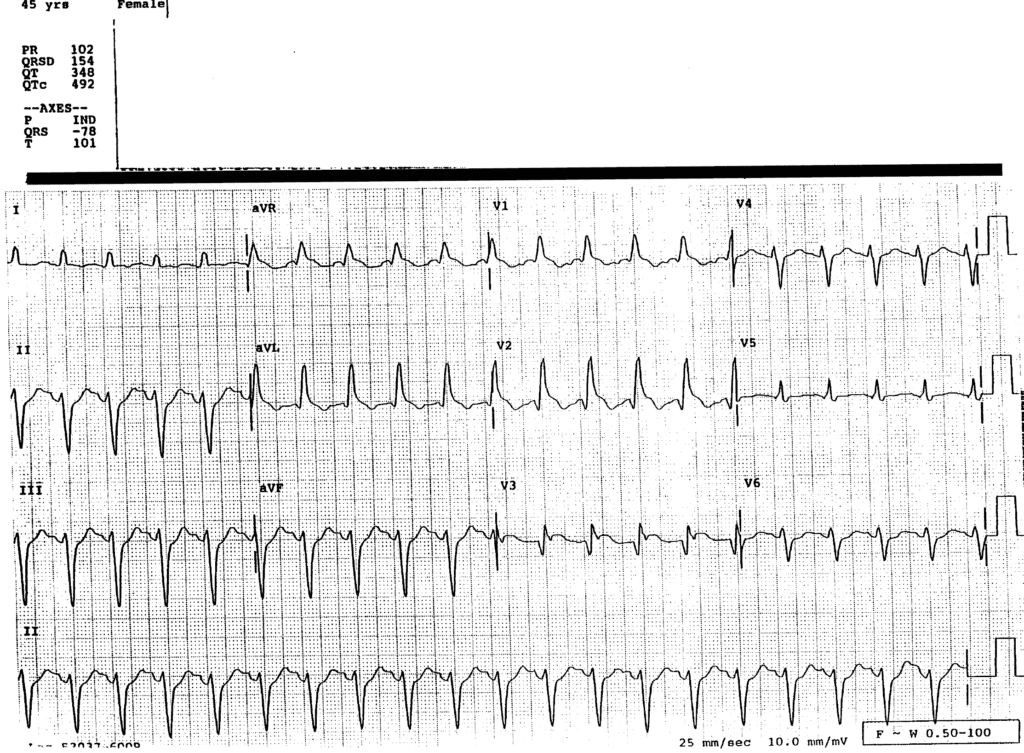
Figure 2.
Diagnosis
The ECG reveals a sinus tachycardia with a rate of 120.
The QRS is widened, and although a wide complex tachycardia should be evaluated for ventricular tachycardia, there are P waves before each QRS complex, so this is not V tach.
WPW can also cause a wide complex tachycardia with a short PR interval, but would show presence of the โ€œupslopingโ€ delta wave.
Brugada is an incomplete RBBB with ST elevation seen in leads V1 and 2, not present on this ECG. Normal PR interval is 0.12-0.20 and is not prolonged.
Other aspects of the ECG include bifascicular block as well as q waves anteriorly, likely indicating an old anterior MI.
There is ST elevation in leads V2 and V3; comparison to a previous ECG will help to determine if this acute from a STEMI or chronic.
Learnings/What to Look for

  • Normal heart rate is 60-100 beats per minute
  • Unexplained tachycardia, even in well-appearing patients, may indicate a more serious underlying process such as ischemia, myocarditis, aortic dissection, pneumothorax, pericardial tamponade, bleeding, or sepsis
  • If the q waves and BBB are present on a previous ECG, this will help with the disposition decision by decreasing our concern; however, the tachycardia remains troubling for serious underlying pathology
  • A smoker on oral contraceptive therapy over the age of 35 is at high risk for a thrombotic event such as pulmonary embolism (PE) or acute coronary syndrome (ACS)

Pearls for Initial Management and Considerations for Transfer

  • A chief complaint of chest pain should prompt consideration of ACS, PE, and aortic dissection. Stratify risk based on the history of present illness and risk factors
  • The presence of q waves in the above ECG is concerning for a previous MI. Though not 100% diagnostic, in the context of this presentation this should prompt consideration for emergent transfer
  • Ongoing chest pain with an HPI concerning for ACS or PE should prompt emergent transfer, regardless of the ECG findings


A 45-Year-Old Woman with Acute Chest Pain
Log In