
Published on
Download the article PDF: Portable X Ray In Urgent Care Why Cheaper Isnt Better
Urgent Message: Urgent care startups should avoid “cheaper” portable x-ray units, as they face regulatory restrictions, create workflow bottlenecks, and produce inferior images, making a fixed DR suite a better long-term investment.
Keywords: portable x-ray; diagnostic radiology; radiation exposure; fractures
Urgent care centers thrive by delivering fast, comprehensive, 1-stop service to ambulatory patients, and imaging capability is central to that promise.
New operators commonly face a dilemma: their pro forma is tight, build-out costs are high, and a portable x-ray unit appears to offer the promise of “x-ray on-site” for a fraction of the price of a full room. Sales literature often reinforces this perception by emphasizing mobility, compact footprints, and lower capital costs for portable units. But it may not be the best choice.
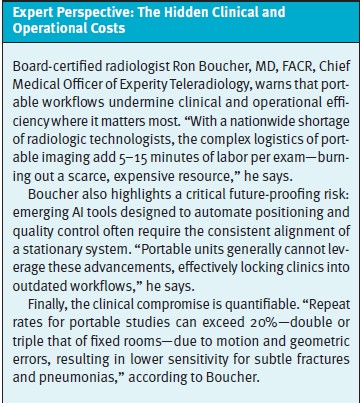
For urgent care, the value proposition for x-ray is different from that of home health or long-term care. The real decision is not “x-ray or no x-ray,” but whether to invest once in a compliant fixed diagnostic radiology (DR) suite or gamble on a portable option that operations may outgrow.
Regulatory Reality
Most radiation control programs make a clear distinction between stationary installations and portable or mobile x-ray units. The latter are intended for situations in which it is truly not feasible to move the patient—such as long-term care facilities and hospital trauma units.
Several jurisdictions explicitly codify this principle:
- Nevada’s technical bulletin on portable and mobile x-ray machines states that these units are intended for bedside use when transporting the patient is impractical and warns against using them as substitutes for proper x-ray rooms in outpatient settings.1
- New York City’s health code similarly restricts portable units in clinics, specifying that they “must only be used for examinations where it is impractical to transfer the patient to a stationary x-ray installation.”2 An ambulatory urgent care population rarely meets that threshold.
- New York State regulations go further: If a mobile unit is used routinely in 1 location, it is reclassified as a fixed installation and must meet all requirements for shielding, room design, and control booth protection.3
A portable unit may be present in urgent care, but using it as a primary, routine imaging solution for walk-in patients runs counter to both the intent and letter of many state rules. Once the unit is reclassified as a “fixed” unit, any perceived savings from avoiding x-ray room requirements disappear. The clinic must retrofit shielding and a compliant control area—often at higher cost and greater disruption than if the room had been designed intentionally for x-ray at the outset.
Workflow and Infection Control
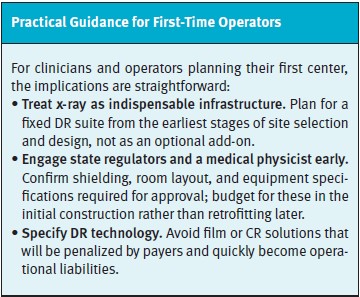
Urgent care economics are driven by patient throughput—how many patients can be safely and efficiently seen per hour. A fixed x-ray suite supports that model, while a portable unit undermines it when used as the main resource.
With a fixed installation, the equipment is always set up and ready. Technologists can smoothly escort patients into the room, obtain images, and return them to the exam room or discharge area for better throughput.
With a portable-as-primary approach, every x-ray order adds multiple steps:
- Retrieve the unit from storage.
- Maneuver it through hallways into an exam room.
- Position the tube and detector to optimize geometry.
- Perform the study
- Disinfect and move the device.
Each cycle adds minutes of non–value-added time and increases the risk of equipment damage from repeated movement. When roughly 10% of urgent care visits include radiology services, even small delays per patient quickly reduce capacity over a day’s schedule.4
In a high-throughput urgent care environment, the “flexibility” of a portable unit translates into bottlenecks, clutter, and staff workarounds—the opposite of the lean workflows that support profitable operations.
Image Quality and the Standard of Care
The technical limitations of portable units bring into question their clinical appropriateness. Typical fixed x-ray generators for outpatient rooms operate in the 30–80 kW range. Many portable units intended for bedside or field use offer only 1.5–5 kW of power.1 As a result, there may be difficulty penetrating thicker anatomy (eg, adult chest, abdomen, pelvis) and longer exposure times, increasing the risk of motion blur and higher radiation dose.
The American College of Radiology (ACR) practice parameter for chest radiography clearly distinguishes between standard room-based exams and portable studies.5 For ambulatory patients, the recommended standard is a posterior anterior and lateral chest radiograph in an upright position, which:
- Minimizes cardiac magnification
- Optimizes visualization of lung bases and costophrenic angles
- Provides 2 orthogonal views for improved diagnostic sensitivity
The portable chest radiography parameter instead describes an anteroposterior exam, usually performed for critically ill, non-transportable patients, and explicitly acknowledges its lower image quality and higher artifact rate.5
When an urgent care clinic chooses a portable unit as its primary imaging device, it is effectively committing to use an inferior technique. That strategy increases the risk of:
- Missed or delayed diagnoses (eg, subtle fractures, small pneumonias obscured behind the heart)
- Repeat exams, with additional radiation exposure and time
- Defensive referrals to emergency departments or imaging centers when x-ray results are equivocal
From both a clinical and medicolegal standpoint, it is far easier to defend care when imaging has been performed at the recognized standard of care, which presumes access to a properly equipped x-ray room.
Reimbursement and Compliance
Some operators assume that a portable unit will unlock special billing opportunities. In reality, there is no reimbursement premium for performing an x-ray with a portable device inside an urgent care clinic. Payers reimburse not based on whether the equipment rolls or is bolted down, but based on:
- The CPT code for the study performed
- Whether the imaging is digital
- Site of service
Medicare’s additional allowances for “portable x-ray” services apply to independent suppliers who travel to the patient (eg, in a nursing home), not to fixed-site clinics using a mobile unit. A walk-in urgent care cannot legitimately bill a transportation or setup fee simply because it owns a portable machine.
From a compliance perspective, the Urgent Care Association (UCA) recognizes both portable and stationary units as acceptable means of meeting its imaging criterion—but only if they are installed and used in accordance with state law and radiation safety regulations.6 UCA expects:
- Proof of state x-ray registration or licensure
- Evidence that imaging is available during all posted operating hours
- Adherence to applicable professional standards (including ACR guidelines).5,6
A portable setup that cannot legally be used as the main imaging modality, or that is unavailable when key staff are absent, may technically “check a box” on equipment inventory but fail in practice to satisfy accreditation, payer expectations, or malpractice scrutiny.
Cost and ROI
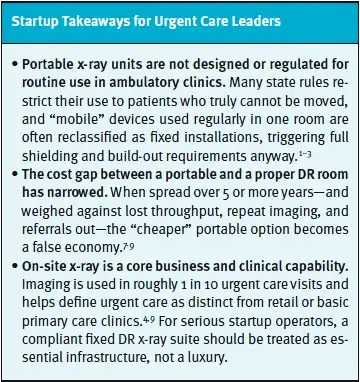
The primary appeal of a portable unit is often price—especially for first-time operators watching every line of the start-up budget. However, the real cost gap has narrowed and becomes small when amortized over time.
Recent market surveys suggest:
- Entry-level fixed DR x-ray room packages suitable for urgent care volumes commonly fall in the $45,000–$60,000 range, including installation.7
- Modern portable DR systems (a portable generator plus a flat-panel detector) often range from the high-$20,000s into the $40,000s, and hospital-grade portables can cost considerably more.8
In other words, a truly capable portable system is not dramatically cheaper than an entry-level DR room. A lower cost is usually the result of compromising on power output, image quality, digital capability, and regulatory readiness (eg, no shielding, no dedicated control booth).
Even if a start-up could save, for example, $40,000 upfront by choosing a cheaper configuration, spreading that difference over 5 years equates to about $8,000 per year—a figure often eclipsed by the revenue from just a few additional properly imaged patients each month.
More importantly, portable-first strategies carry hidden costs:
- Later construction to add shielding when the unit is reclassified as “fixed”
- Lost visits or referrals out when the portable x-ray unit cannot produce adequate images
- Repeat studies due to poor image quality or positioning

As digital radiography prices have fallen, industry experts increasingly view a compliant DR x-ray room as a foundational investment for any serious urgent care center rather than a discretionary upgrade.7,9
Business Case: X-Ray as a Core Value Proposition
On-site x-ray is not merely a clinical convenience; it is a key driver of volume and revenue in urgent care. Analyses of urgent care visit data show that imaging—primarily x-ray—is performed in approximately 10% of encounters.4 These visits tend to involve higher acuity presentations (eg, fractures, pneumonia, work injuries) and generate higher reimbursement per visit as well as additional billable services such as splinting, casting, and follow-up care.
Centers that cannot provide imaging on site must refer these patients elsewhere, forfeiting both the immediate revenue and the opportunity to be viewed as a full-service urgent care facility.
Industry voices have repeatedly emphasized that x-ray capability is a defining feature of urgent care, distinguishing it from lower-acuity retail clinics and simple walk-in primary care practices.9 Payers and networks often structure credentialing and contracting accordingly. Facilities without x-ray may be classified differently and reimbursed at lower levels or excluded from certain urgent care networks.
Conversely, a clinic that advertises “x-ray on site” but relies on a portable unit that cannot reliably produce diagnostic images, or that can be used only under limited circumstances, risks damaging its reputation. Patients who are told they still need to go to a hospital or imaging center after receiving an in-house x-ray at an urgent care may not return—and may share that negative experience widely.
For start-ups in competitive markets, investing in a fixed DR suite is effectively investing in higher visit capacity, broader scope of services, and a more compelling value proposition to both patients and payers.
Conclusion
For urgent care operators, relying on a portable x-ray to save money creates significant regulatory, operational, and financial problems. Regulators restrict portable x-ray applications, and units used routinely may be reclassified as “fixed,” requiring expensive retrofits. Portables are also less powerful, produce inferior images, and create workflow bottlenecks, all with no reimbursement upside.
A properly planned fixed DR x-ray suite supports the urgent care model of fast, comprehensive care. New centers should build the fixed room right the first time for long-term clinical and financial success.
References
- Nevada Office of State Epidemiology. Use limitations for portable and mobile x-ray machines (technical bulletin). Published September 14, 2023. Accessed February 17, 2026. https://nvose.org/use-limitations-for-portable-and-mobile-x-ray-machines/
- New York City Department of Health and Mental Hygiene. New York City Health Code, Article 175 – Radiation Control. Amended July 2021. Accessed February 17, 2026. https://www.nyc.gov/assets/doh/downloads/pdf/about/healthcode/health-code-article175.pdf
- N.Y. Comp. Codes R. & Regs. tit. 10, § 16.57(b). Portable, bedside or mobile x-ray equipment—reclassification as fixed if used routinely. Accessed February 17, 2026.
- Experity Health Research. An analysis of the impact of urgent care radiology. Published 2019. Accessed February 17, 2026. https://www.experityhealth.com/resource/research/radiology-impact-on-urgent-care-industry/
- American College of Radiology; Society for Pediatric Radiology; Society of Thoracic Radiology. ACR–SPR–STR practice parameter for the performance of chest radiography. Revised 2022. Accessed February 17, 2026. https://gravitas.acr.org/PPTS/GetDocumentView?docId=129
- Urgent Care Association. UCA certification criteria—imaging requirements and state license proof for x-ray services. Accessed February 17, 2026. https://urgentcareassociation.org/quality/certification/certification-criteria/
- Block Imaging. 2025 x-ray room price guide—typical costs for stationary x-ray installations. Published 2025. Accessed February 17, 2026. https://www.blockimaging.com/x-ray-machine-cost-price-guide
- Dicom Solutions. MinXray Impact portable x-ray machine—product information. Published 2025. Accessed February 17, 2026. https://dicomsolutions.com/product/minxray-impact-portable-x-ray-machine/
- Ayers A. Why x-ray is vanishing from urgent care centers. AuntMinnie.com. Published June 13, 2021. Accessed February 17, 2026. https://www.auntminnie.com/industry-news/article/15628581/why-x-ray-is-vanishing-from-urgent-care-centers
