
Published on
Download the article PDF: Clinical Image Challenges March 2026
Differential Diagnosis
- Second degree atrioventricular block, Mobitz Type I
- Second degree atrioventricular block, Mobitz Type II
- Third degree (complete) heart block
- Sinus bradycardia
- First degree atrioventricular block
Diagnosis
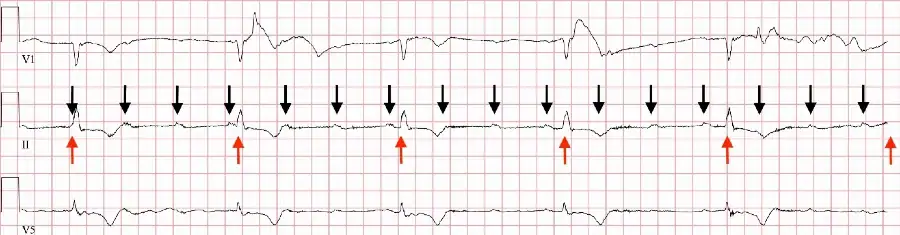
The diagnosis in this case is complete heart block. The ECG shows regular sinus P waves at a rate of approximately 75 and a slower QRS escape rhythm at a rate of about 35, without consistent PR intervals. There are T-wave inversions in the inferior leads and precordial leads V3-V5. The atrial and ventricular rhythms are independent of each other (ie, atrioventricular dissociation), resulting in a slow ventricular escape rhythm.1,2
Discussion
Atrioventricular (AV) dissociation can be identified by “marching out” the atrial P waves and ventricular QRS complexes separately (Figure 2).
Sinus bradycardia and first-degree AV block (PR > 200ms) have identifiable and fixed PR intervals. Second-degree AV block with Mobitz type I conduction describes a pattern in which the PR interval progressively prolongs until a beat is dropped (ie, a non-conducted P wave). Second-degree AV block with Mobitz II conduction occurs when dropped beats are present with a fixed PR interval.2
This patient was transferred to an electrophysiology-capable facility where a temporary transvenous pacer was placed, followed by a permanent one.
Clinically, complete heart block presents with signs of low cardiac output, such as syncope, dizziness, or hemodynamic instability. This reduction in cardiac output can occur independent of reduced ejection fraction and ischemia.3 Chest pain and heart failure symptoms can suggest a block due to myocardial infarction. Reversible causes must be considered, including medication toxicity (beta-blockers, calcium-channel blockers, digoxin), acute ischemia, hyperkalemia/hypermagnesemia, and rare infectious causes.1
What To Look For
- Complete heart block shows atrioventricular dissociation with independent atrial and ventricular rhythms. “March out” the p waves to assess.
- Clinically, complete heart block presents with signs of low cardiac output, such as syncope or hemodynamic instability.
Pearls For Initial Management And Considerations For Transfer
- Immediate stabilization and supportive measures: apply continuous monitoring; provide supplemental oxygen; ensure IV access; and obtain a prompt 12-lead ECG. If available, place transcutaneous pacing pads.
- Consider reversible causes like medications or hyperkalemia.
- Atropine may help in narrow QRS escape but is often ineffective in wide QRS escape.1
- Activate emergency medical services or 911 for transport to a facility capable of definitive management with permanent pacemaker placement.2
References
- Tannenbaum L, Long B. Electrocardiogram essentials: Bradycardia. American Journal of Emergency Medicine. W.B. Saunders. 2025;97:58-64. doi:10.1016/j.ajem.2025.07.030
- Kusumoto FM, Schoenfeld MH, Barrett C, et al. 2018 ACC/AHA/HRS Guideline on the Evaluation and Management of Patients With Bradycardia and Cardiac Conduction Delay: A Report of the American College of Cardiology/American Heart Association Task Force on Clinical Practice Guidelines and the Heart Rhythm Society. Circulation. 2019;140(8):e382-e482. doi:10.1161/CIR.0000000000000628
- Sande K, Diaz O, Loyola G. Out of Sync: A Report of Complete Heart Block. Cureus. Published online March 19, 2025. doi:10.7759/cureus.80851